
Category: postmodernism


Definition of Philosophy

April 20th, 2010 — 9:14am

front

The definition of philosophy — judging, at least, from very nearly every philosophy dictionary on the planet — has confounded philosophers for many centuries, the concept being too large, it is sometimes said, to properly convey in a concise fashion. Yet, at the same time, in all branches of philosophy, minutia is cataloged to complete weariness.

This spurious problem is nothing more than skepticism and its little bitch postmodernism running amok again. The Cambridge Dictionary of Philosophy, for instance, a thoroughly postmodern compilation, says this:

“Some readers might be surprised to find that there is no entry simply on philosophy itself. This is partly because no short definition will do.”

That statement — and all others like it — is flatly false.

The definition of philosophy is as follows:

Philosophy: the science of rudiments and foundations; the study of fundamentals.

A philosophy is an organized system of ideas and arguments.

Etymologically, the word, as you know, comes from the Greek term philia (meaning love) or philos (meaning friend or lover); and sophia (meaning wisdom).

A fellow by the name of Diogenes Laertius claims that the term philosopher was coined by Pythagoras, in place of the word sophist, which meant “wise man.” But Diogenes Laertius was squirrelly, and his Pythagorean claim is therefore dubious.

Oxford — evidently not as equivocal as Cambridge — defines philosophy thus:

“The investigation of the most general and abstract features of the world and the categories with which we think, in order to lay bare their foundations and presuppositions.”

Not bad; better still, however, is Penguin’s philosophy dictionary, which says that philosophy studies “the most fundamental and general concepts and principles involved in thought, action, and reality.”

And yet the best of them all comes not from a philosophy dictionary, exactly, but a man named Désiré-Félicien-François-Joseph Mercier — a.k.a. Cardinal Mercier — the late nineteenth-century thinker, who spoke well when he spoke thus:

“[Philosophy] does not profess to be a particularized science [but] ranks above them, dealing in an ultimate fashion with their respective objects, inquiring into their connexions and relations of these connexions.”

Philosophy, he continues, “deserves above all to be called the most general science” (A Manual of Modern Scholastic Philosophy).

Lexically, here’s all you really need to know:

Philosophy comes first, and last.

Philosophy is the alpha and the omega; it is the most fundamental science because it studies the foundations of all subsequent knowledge, and that is why all the other sciences depend upon it: because knowledge forms a hierarchy.

For humans, to live is to think; our life is in large part our consciousness: we are defined by the entirety of our actions, but our actions are shaped by our thoughts.

Thinking, as stated once before, is the human quiddity.

Philosophy provides the gauge for, and also defines the limits (or lack) of, all human knowledge, as well as systematizing the proper methods by which we are able to know.

That is the definition of philosophy.


2 comments » | Philosophy, Skepticism, Uncategorized, metaphysics, postmodernism

Global Warming

January 10th, 2010 — 9:00am

Politically, global warming and climate change have little if anything to do with climate science, and the fact that this subject has become such an overwhelming political issue is a fine testament to how poorly the world understands the legitimate functions of government, and why those functions are legitimate.

Indeed, it turns out that the whole anthropogenic global warming (AGW) position can be easily defused without any reference to science at all, because the error, at root, is epistemological.

The truth about global warming which many don’t want to hear is that it’s become so polarized only because it’s turned political. The essentials of the subject have thereby been swallowed up in a murky ocean of misinformation, equivocation, and propaganda.

Let us then start by defining terms:

Statism is concentrated state authority; it refers to a government that believes it has legitimate power to any extent over individual rights and freedom of trade.

Opposition to laissez-faire capitalism derives in part from ethics, but even more fundamentally from the science of epistemology.

Ethically the fundamental political question is this: are humans free by nature?

The answer to that depends upon the answer to an even deeper question: why (if at all) are humans free by nature?

And the answer to that is epistemologic.

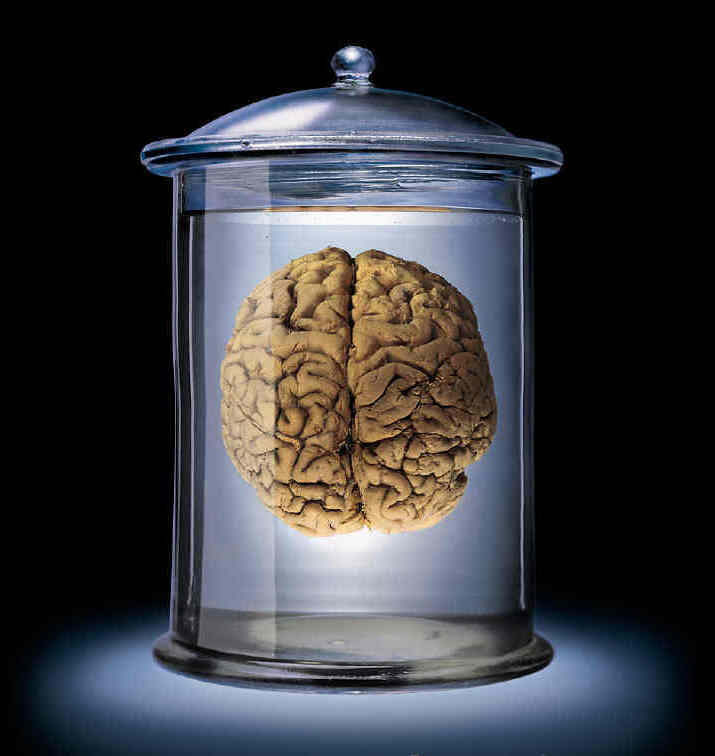
The human brain – to address the latter query first – is individuated and rational by nature; because of this, man by nature possesses the faculty of choice.

Rationality is choice.

And choice presupposes the freedom to choose. This is the locus of the inseparable, indivisible link between reason and rights. Ultimately it is only the individual who can exercise the power of volition, or not. Government bureaus cannot. The state cannot. The collective cannot. Only the individuals who make up these entities.

If humans did not possess the faculty of choice, humans would be neither moral nor immoral but amoral, just as animals for this very reason are amoral.

But human action is chosen.

This, then, is what finally gives rise to the fact of human freedom as an epistemological necessity.

It’s also what it means to say that humans are free by nature: we are born with a cognitive faculty that gives us the power of choice; since this faculty is the primary method by which we thrive and keep ourselves alive, we must (therefore) be left free to exercise that faculty — and leave others likewise free.

This is a form of contractarianism.

Please note that this is not just some esoteric theory on how human freedom could conceivably be defended: the rights of each individual are demonstrably rooted in man’s cognitive quiddity – and for this precise reason, human freedom without an accurate and thorough understanding of man’s epistemologic nature can never be fully understood.
Or defended.

In the words of Samuel Adams:

“Rights are evident branches of, rather than deductions from, the duty of self-preservation, commonly called the first law of nature.”

And Claude Fredrich Bastiat:

“For what are our faculties but the extension of our individuality? And what is property but an extension of our faculties? … Man can live and satisfy his wants only by ceaseless labor, and by the ceaseless application of his faculties to natural resources.”

It is precisely the lack of epistemological grounding that has made rights and therefore human freedom vulnerable throughout all of history.

The evolution of the human brain created rights; it happened at the exact moment when this same evolution created a rational animal called a human being – which is to say, when nature created the capacity of free will.

Philosophy, then, being the most general science, unifies facts from all disciplines into an indivisible whole.

Thus, without proper philosophical underpinnings, scientific facts, no matter how airtight they are, remain unincorporated.

It is this point that provides us with the real and final connection between global warming and individual rights; for the provenance of rights, including private property rights and the freedom to trade that property, is found ultimately in man’s freedom of will, and it is only statist politics – also known as coercive government – that can with impunity negate the individual’s natural rights.

It does so through force, either directly (as in physical expropriation or imprisonment), or indirectly (as in compulsory taxation or fines).

The statist politics that the AGW position explicitly calls for are in this way antithetical to the methods by which the human brain and the human species properly functions and flourishes.

That is the fundamental argument against statism, in any of its multifarious guises. It is a foolproof argument, and it is the first and strongest line of defense: because each and every individual is free by nature, we are free to, in Adam Smith’s words, “truck, barter, and exchange.”

But there’s much more to it than this.

It must first of all never be forgotten that the philosophy of science is only a species of philosophy proper.

This has crucial ramifications.

Science is the systematic gathering of data through observation and reason.

Science is built upon knowledge, and knowledge is built upon reason.

Reason derives from the nature of the human mind, for man is the rational animal.

Epistemology – one of the two main branches of philosophy – is the science of knowledge.
Epistemology, therefore, studies the nature of reason.

In this way, all science is hierarchically dependent upon epistemology.

In the realm of human conviction, there exists at any given time only three primary alternatives: possible, probable, and certain.

Possible is when some evidence exists, but not much.

Probable is when a lot of evidence exists, but not all.

Certain is when the evidence is so overwhelming that no other conclusion is possible.

Obviously, then, what constitutes possible, probable, or certain is the amount of evidence and the context of knowledge within which that evidence is found.

To conclude certain, or even “over 99 percent certain,” to quote James Hansen of NASA, requires a sufficient knowledge of all relevant data and all potentially relevant data.

This is as true in a scientific laboratory as it is in a court of law.

It means that nothing – the complexity of clouds, for instance, or aerosols, deep ocean currents, cosmic rays, sun spots, et cetera – nothing is poorly understood, or insufficiently understood.

It means that the science has culminated to such a degree that our knowledge of it is complete or near-complete – so much so, at any rate, that there is essentially very little left to learn.

It means that because the evidence is so great, the conclusion admits no doubt.

It means, moreover, that the data-gathering process is not biased or influenced in any way by anything extracurricular, like activism.

Such is the nature of certainty.

From an epistemological standpoint, certainty means absolute.

And yet it’s many of these same AGW scientists who, today, under the insidious influence of postmodernism, assure us that there are no absolutes in science – “science doesn’t deal in truth, but only likelihood,” to quote another NASA scientist, Gavin Schmidt.

Truth is only relative, you see.

Quantum physics and thermodynamics have “proven” that the only certainty is that nothing is certain; definitions are purely a question of semantics; a unified philosophy is “circular reasoning” (or, at best, “system-building”); all moral law and all social law is subjective and unprovable.

The mind, in short, cannot know anything for certain. Yet AGW is virtually certain.
These are all epistemological assertions.

Syllogistically, the entire anthropogenic global warming position can be recapitulated in this way:

Global warming is man-made. Man is ruled by governments. Therefore, government bureaus, centralized planning committees, and more laws are the only solution.

In philosophy, this is called a non-sequitur.

It does not follow.

It’s far too hasty.

Please read Chapter 15 of my book to find out why.


13 comments » | Global Warming, Philosophy, Political philosophy, Skepticism, environmentalism, epistemology, postmodernism

Epistemology: The Science Of Thought

December 23rd, 2009 — 7:23am

Epistemology is the science of knowledge. The word derives from the Greek episteme, which means knowledge.

Epistemology proper didn’t actually begin until Rene Descartes (1596-1650); but the stuff of epistemology — logic, reason, deduction, induction, et cetera — has been with us since the Ancient Greeks.

Epistemology is an extraordinarily complicated discipline that starts with three simple words:

Consciousness is awareness.

That is an epistemological axiom which cannot be refuted or denied: for any theory of knowledge that purports to refute that consciousness is awareness must rely on the awareness of his consciousness to refute it.

First there exists the external world — also known as reality or existence — and then there exists the awareness of it.

These two things are separate, but not equal: by definition, the external comes first, before there can be an awareness of it.

In the words of the philosopher Douglas B. Rasmussen:

“Consciousness is ultimately of or about something other than itself — it is ultimately relational.”

The tired argument that one cannot prove anything beyond one’s own consciousness was, contrary to what you may have heard all your life, refuted long ago, and thoroughly so, by Thomas Aquinas, when he wrote the following:

“No one perceives that he understands except from this, that he understands something: because he must first know something before he knows that he knows.”

This intelligent insight was explicated upon by the neo-Thomist priest Celestine Bittle, in his 1945 textbook The Whole Man:

“Consciousness,” says Father Bittle, “is irreducible [because] consciousness can’t be reduced to other facts or broken into component parts.”

Father Bittle goes on to describe consciousness as “an ultimate datum of experience … at the very root of all mental activity.”

This is called by neo-Thomists “the reflexive nature of consciousness,” which means that consciousness, by its very definition – by nature of what it is – cannot be conscious of only itself, because consciousness is awareness, which by definition means (as Thomas Aquinas said it in the quote above) that it must first be aware of some thing.

I’m only aware of my faculty of awareness.

This is a meaningless statement.

Why?

Quoting another erudite neo-Thomist epistemologist, Jacques Maritain:

“The first thing thought about is being independent of the mind…. We do not eat what has been eaten; we eat bread. To separate object from thing is to violate the nature of intellect” (Jacques Maritain, The Degrees of Knowledge, 1938).

The ramifications of all this may be summed up thus:

The existence of the external world (i.e. reality) and the awareness of it (which is to say, consciousness) form the very underpinnings of all knowledge.

Whether scientists know it or not and whether scientists like it or not, every field of every scientific endeavor, and every part of every field of every scientific endeavor, no matter how postmodernistic the curriculum, and no matter how relativistic the agenda, assumes the following:

There exists an external universe, which human consciousness does not in any way create but rather apprehends and measures.

That is the proper starting point of any philosophy of science, as well as the rest of learning.

Comment » | epistemology, postmodernism

Esthetics: The Theory Of Art

November 29th, 2009 — 8:50pm

What-is-Art
“The artist is the creator of beautiful things.”

Said Oscar Wilde.

Esthetics — or aesthetics, if you prefer — is the philosophy of art.

It is a sub-branch of epistemology. Epistemology, the philosophy of knowledge, spawns esthetics like Superman spawns sequels.

Esthetics is classified as a sub-branch of epistemology because art is a by-product of the reasoning brain — which is why animals (for example) don’t create art or enjoy it — or, at any rate, not without some intensive human coaxing and coaching.

Art is the process of capturing through an artistic medium abstract ideas and the emotions that go along with them.

That is the definition of art.

Art is not a luxury item but a human necessity.

Quoting Oscar Wilde once again, who is at his best in the esthetic arena:

“The function of art is to recreate, from the rough material of actual existence, a new world that will be more marvelous, more enduring, and more true than the world that common eyes look upon.”

Art starts with an abstraction such as jealousy, and in an artistic creation like Othello, shows us how in human life jealousy manifests.

The degree to which an artistic creation persuades or seems plausible is the degree to which it is good or bad. Contrary to popular belief, art can and should be held to standards. Of a poor film, therefore, it is perfectly proper to say “This movie sucks!”

Painting and drawing perform the same function as our Othello example, but in a purely visual manner.

Sculpture does so by visual-tactile means.

Music, which is unique among the arts, captures so-called emotional abstractions, via sound, so that when we hear music, we feel ourselves perhaps excited, or melancholic, or thoughtful, or sexy, whathaveyou.

It should also be noted here (not quite parenthetically) that music’s modus operandi is not well understood — not in terms of how the brain organizes sound into euphony, and why, exactly, melody and harmony strike human ears in the precise way that they do.

To qualify as a legitimate art form, the medium must have the power to convey ideas in a perceptual form — which is to say immediately.

That’s why culinary art is not, in the true sense, an actual art but a skill: the best foie gras in the world cannot convey even the simplest human abstraction, let alone something as complex as the ceiling of the Sistine Chapel.

The same thing is true of sewing, gem-cutting, carpentry, and a million other skills and trades as well. They are not actually arts because they don’t have the power to capture or convey a wide range of abstract meaning. They cannot objectify reality through their medium.

That’s what art does. That is why art is a necessity.

To truly qualify as art, the medium must be able to reproduce nature, via sensory data, and then infuse that data with conceptual content.

Plays and screenplays, for instance, are art.

Movies are art.

Novels and poems are art.

Dancing is art but not a primary: it depends upon music.

This same is true of acting: it depends upon a script, which is one of the reasons that scripts sometimes feel flat when they’re read rather than watched, and why an actor without a script is like a clam without a shell.

Cinematography, like photography, occupies the middleground. Both contain an artistic component, and yet both are stylistically confined — they record more than they create — and are therefore more skill than art.
(Journalism is analogous to this: it too has an artistic component — specifically, in the freedom of writing style afforded it — but journalism also primarily records.)

Art came into existence within the human species because the human brain operates by means of abstractions, which is to say words, which is to say ideas formed by means of words.

Abstractions are thoughts — or, to put that more precisely, abstractions are the human way of grasping the natural world.

We do this by means of thought.

And we think by means of words.

Art assists.

And that is why esthetics is a sub-branch of epistemology.

The senses — sight, sound, touch, taste, and hearing — are what feed our brains with the raw sensory data Oscar Wilde speaks of in the previous quotation.

The brain then processes this raw sensory data conceptually — that is, through a process of abstraction, or, in other words, through thinking — which is essentially the process of learning words and grasping what in reality those words denote.

By means of sensory data, art recasts reality and shows us our abstractions made solid.

Art thereby enhances reality.

And because, as its name implies, art is artificial, it also perfects reality.

Artists themselves are among the most inarticulate when it comes to explaining the nature and function of art. To get beyond their artsy mumbo-jumbo, so that we can see clearly at last what gives rise to art, we need not listen to artists and art critics, but instead merely observe how the artistic drive develops in children. “Through Children,” said Dostoevsky, “the soul is healed.”

Observe what the child with that big stick of sidewalk-chalk draws upon the concrete.

A large yellow crescent with blue stars around it.

A white house in a field.

A blazing sun coming up over black mountains.

Animals.

Stick figures.

Death.

War.

Now ask yourself this: what drives a child to make those drawings?

What is she thinking about that makes her want to set it down in concrete form?

What dictates her subject-matter?

Why did she choose this and not that?

What is the child doing?

And, as important, what is that process doing for her?

Ask yourself:

Why did prehistoric humans paint animals and hunting scenes upon cave walls? What drove that urge? Why did these people choose the subjects they chose? And what did painting those things fulfill within them?

Why have humans always invented stories?

Why have humans always enjoyed listening to those stories, or seeing them played out?

Why the human invention of musical instruments?

Why did David “dance with all his might before the Lord”?

What need is being fulfilled in this?

The answer to these questions is the same:

Each one of those things, through whichever medium, captures the abstract and makes it real and immediate.

Humans — the rational animal — need this because our rational mind operates in an opposite manner: it is thoughtful, inductive, long-range. Art brings the entirety of the elegant universe into our immediate ken.

Art makes the conceptual perceptual.

There is no mood or passion that art cannot give us…. Art is mind expressing itself under the conditions of matter, and thus, even in the lowliest of her manifestations, she speaks to both sense and soul alike…. It is through art, and only through art, that we can realize our perfection; through art, and through art only, that we can shield ourselves from the sordid perils of actual existence…. Like Aristotle, like Goethe after he had read Kant, we desire the concrete, and nothing but the concrete can satisfy us.

– Oscar Wilde

5 comments » | Esthetics, postmodernism

Postmodernism: The Destruction Of Thought

November 23rd, 2009 — 8:49am

pomo

Postmodernism, in all its vicious variations, is a term devoid of any real content, and for this reason dictionaries and philosophy dictionaries offer very little help in defining it.

And yet postmodernism has today become almost universally embraced as the dominant philosophy of science — which is the primary reason that science crumbles before our eyes under its corrupt epistemology.

Postmodernism, like everything else, is a philosophical issue. Accordingly, postmodernism’s tentacles have extended into every major branch of philosophy — from metaphysics, to epistemology, to esthetics, to ethics, to politics, to economics.

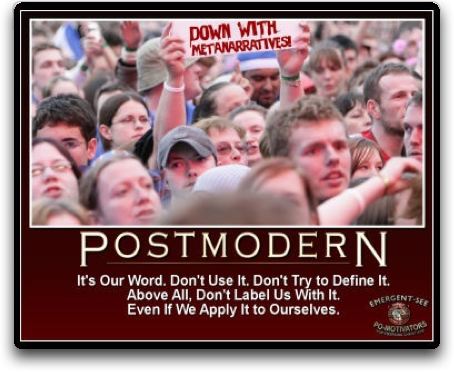
In order to get any kind of grasp on postmodernism, one must grasp first that postmodernism doesn’t want to be defined. Its distinguishing characteristic is in the dispensing of all definitions — because definitions presuppose a firm and comprehensible universe.

You must understand next that postmodernism is a revolt against the philosophical movement that immediately preceded it: Modernism.

We’re told by postmodernists today, that modernism and everything that modernism stands for is dead.

Thus, whereas modernism preached the existence of independent reality, postmodernism preaches anti-realism, solipsism, and “reality” as a term that always requires quotation marks.

Whereas modernism preached reason and science, postmodernism preaches social subjectivism and knowledge by consensus.

Whereas modernism preached free-will and self-governance, postmodernism preaches determinism and the rule of the collective.

Whereas modernism preached the freedom of each and every individual, postmodernism preaches multiculturalism, feminism, environmentalism, egalitarianism by coercion.

Whereas modernism preached free-markets and free-exchange, postmodernism preaches Marxism and its little bitch: statism.

Whereas modernism preached objective meaning and knowledge, postmodernism preaches deconstruction and no-knowledge — or, if there is any meaning at all (and there’s not), it’s subjective and ultimately unverifiable.

In the words of postmodernism’s high priest Michel Foucault: “It is meaningless to speak in the name of — or against — Reason, Truth, or Knowledge.”

Why?

Because according to Mr. Foucault again: “Reason is the ultimate language of madness.”

We can thus define postmodernism as follows:

It is the philosophy of absolute agnosticism — meaning: a philosophy that preaches the impossibility of human knowledge.

What this translates to in day-to-day life is pure subjectivism, the ramifications of which are, in the area of literature, for example, no meaning, completely open interpretation, unintelligibility.

Othello, therefore, is as much about racism and affirmative action as it is about jealousy.

Since there is no objective meaning in art, all interpretations are equally valid.

Postmodernism is anti-reason, anti-logic, anti-intelligibility.

Politically, it is anti-freedom. It explicitly advocates leftist, collectivist neo-Marxism and the deconstruction of industry, as well as the dispensing of inalienable rights to property and person.

There is, however, a deeply fatal flaw built into the very premise of postmodernism, which flaw makes postmodernism impossible to take seriously and very easy to reject:

If reason and logic are invalid and no objective knowledge is possible, then the whole pseudo-philosophy of postmodernism is also invalidated.

One can’t use reason to prove that reason is false.


10 comments » | America, postmodernism

New Entries

Newest comments

  • Ray: Coming from someone who uses “Ugh” and “douche baggy” in the same breath, one can feel...
  • Ray: You’re preaching to the converted about nuclear energy: http://rayharvey.org/index....
  • Elijah: Ugh. I feel sorry for the guy who asked the question. That may be the most douche baggy answer I’ve...
  • Phil: I think your definition of a “clean” environment is suspect. I agree that Fossil Fuel has brought...
  • Ray: Actually, we can’t use all the coal in the US — there’s too much of it to use. Fossil fuel has...

Categories

Monthly Archives

Search


rayharvey.org Bio  |  Books  |  Contact  |  Blog

Back to top