Jones Beach Airshow
These photos, which someone just sent me, gleam with clarity and seem to me to represent America at her one-time best. Happy Fourth of July.
The 30th of May, 1868, is designated for the purpose of strewing with flowers, or otherwise decorating the graves of comrades who died in defense of their country during the late rebellion, and whose bodies now lie in almost every city, village, and hamlet churchyard in the land. In this observance no form of ceremony is prescribed, but posts and comrades will in their own way arrange such fitting services and testimonials of respect as circumstances may permit.
These words were spoken on May 5th, 1868, by General John A. Logan. It was the first official recognition of Decoration Day — or, as it was later named, Memorial Day — a day designed specifically to commemorate the fallen Civil War soldiers.
On that May day in 1868, during the first celebration, General James Garfield (later the twentieth U.S. President, and, incidentally, one of the last great Presidents this country has had) gave a moving speech at Arlington National Cemetery. After his speech was concluded, 5,000 participants decorated the graves of the more than 20,000 Union and Confederate soldiers buried in Arlington Cemetery.
Francis Bellamy was born in Rome, New York, May 18, 1855. He died August 28, 1931. His original Pledge of Allegiance was first published in a magazine called Youth’s Companion, a nationally circulated publication written for youngsters.
In 1888, Youth’s Companion began its campaign to sell American flags to public schools. For Francis Bellamy, this was more than a mere money-maker: it was an opportunity for him to spread his statist propaganda, and in the end Youth’s Companion became a supporter of the Schoolhouse Flag Project, which, under Bellamy’s watchful eye, aimed to place a flag above every public school in America.
His Pledge of Allegiance was first published in the September 8th (1892) issue of Youth’s Companion.
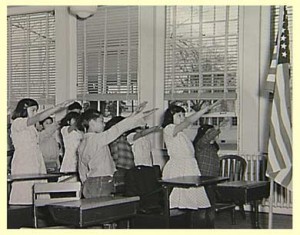
Along with the Pledge, the children were asked to perform the so-called Bellamy Salute (photo below).
Not four decades later, when the Nazi’s rose to power and began saluting in a similar manner, Franklin Roosevelt changed the salute to the hand-over-heart method we see today.
Francis Bellamy’s original Pledge of Allegiance, the recitation of which he intended to take no more than 15 seconds, went like so:
I pledge allegiance to my Flag and to the Republic for which it stands, one nation indivisible, with liberty and justice for all.
Here, in Bellamy’s own words, is why he chose the specific language that he chose for his Pledge:
It began as an intensive communing with salient points of our national history, from the Declaration of Independence onwards; with the makings of the Constitution … with the meaning of the Civil War; with the aspiration of the people…
The true reason for allegiance to the Flag is the ‘republic for which it stands’. …And what does that vast thing, the Republic mean? It is the concise political word for the Nation – the One Nation which the Civil War was fought to prove. To make that One Nation idea clear, we must specify that it is indivisible, as Webster and Lincoln used to repeat in their great speeches. And its future?
Just here arose the temptation of the historic slogan of the French Revolution which meant so much to Jefferson and his friends, ‘Liberty, equality, fraternity’. No, that would be too fanciful, too many thousands of years off in realization. But we as a nation do stand square on the doctrine of liberty and justice for all…
The phrase under God was incorporated into the Pledge on June 14, 1954. The man to introduce it was a fellow named Louis A. Bowman (1872-1959).
Here are the transmutations that the Pledge has undergone since its inception in 1892:
1892
“I pledge allegiance to my flag and the republic for which it stands: one nation indivisible with liberty and justice for all.”1892 to 1923
“I pledge allegiance to my flag and to the republic for which it stands: one nation indivisible with liberty and justice for all.”1923 to 1924
“I pledge allegiance to the flag of the United States and to the republic for which it stands: one nation indivisible with liberty and justice for all.”1924 to 1954
“I pledge allegiance to the flag of the United States of America, and to the republic for which it stands; one nation indivisible with liberty and justice for all.”1954 to Present
“I pledge allegiance to the flag of the United States of America and to the republic for which it stands: one nation under God, indivisible, with liberty and justice for all.”
The problem, of course, with all this indivisibility talk is that the states were not necessarily intended to be indivisible. As Thomas Jefferson said:
If any state in the Union will declare that it prefers separation … to a continuance in union, I have no hesitation in saying, “let us separate” (Thomas Jefferson, 1816).
And John Quincy Adams — a devoted unionist — noted in a 1839 speech about secession:
[In] dissolving that which can no longer bind, we would have to leave the separated parts to be reunited by the law of political gravitation to the center.
If, then, you’ve ever wondered why it is when you hear the Pledge of Allegiance you feel as if you’re hearing the intonations of brainwashed drones, this is why:
The Pledge was a propaganda prayer written by a socialist who’s goal was to inculcate young minds with dogma.
And that’s the end of it.
Author’s Note: This article first appeared January 1st, 2010, on this website.
The following article, quoted only in part, was written by Michelle Malkin, with whom I do not, for the record, always agree. (I believe in open borders, with thorough and proper background checks.) But she does raise an exceptionally important point here:
In the aftermath of the botched Times Square terror attack over the weekend, Pakistani-born bombing suspect Faisal Shahzad’s U.S. citizenship status caused a bit of shock and awe. The Atlantic magazine writer Jeffrey Goldberg’s response was typical: “I am struck by the fact that he is a naturalized American citizen, not a recent or temporary visitor.” Well, wake up and smell the deadly deception.
Shahzad’s path to American citizenship — he reportedly married an American woman, Huma Mian, in 2008 after spending a decade in the country on foreign student and employment visas — is a tried-and-true terror formula. Jihadists have been gaming the sham marriage racket with impunity for years. And immigration benefit fraud has provided invaluable cover and aid for U.S.-based Islamic plotters, including many other operatives planning attacks on New York City. As I’ve reported previously:
– El Sayyid A. Nosair wed Karen Ann Mills Sweeney to avoid deportation for overstaying his visa. He acquired U.S. citizenship, allowing him to remain in the country, and was later convicted for conspiracy in the 1993 World Trade Center bombing that claimed six lives.
– Ali Mohamed became an American citizen after marrying a woman he met on a plane trip from Egypt to New York. Recently divorced, Linda Lee Sanchez wed Mohamed in Reno, Nev., after a six-week “courtship.” Mohamed became a top aide to Osama bin Laden and was later convicted for his role in the 1998 United States embassy bombings in Africa that killed 12 Americans and more than 200 others.
– Embassy bombing plotter Khalid Abu al Dahab obtained citizenship after marrying three different American women.
– Embassy bombing plotter Wadih el Hage, Osama bin Laden’s personal secretary, married April Ray in 1985 and became a naturalized citizen in 1989. Ray knew of her husband’s employment with bin Laden, but like many of these women in bogus marriages, she pleaded ignorance about the nature of her husband’s work. El Hage, she says, was a sweet man, and bin Laden “was a great boss.”
– Lebanon-born Chawki Youssef Hammoud, convicted in a Hezbollah cigarette-smuggling operation based out of Charlotte, N.C., married American citizen Jessica Fortune for a green card to remain in the country.
– Hammoud’s brother, Mohammed Hammoud, married three different American women. After arriving in the United States on a counterfeit visa, being ordered deported and filing an appeal, he wed Sabina Edwards to gain a green card. Federal immigration officials refused to award him legal status after this first marriage was deemed bogus in 1994. Undaunted, he married Jessica Wedel in May 1997 and, while still wed to her, paid Angela Tsioumas (already married to someone else, too) to marry him in Detroit. The Tsioumas union netted Mohammed Hammoud temporary legal residence to operate the terror cash scam. He was later convicted on 16 counts that included providing material support to Hezbollah.
– A total of eight Middle Eastern men who plotted to bomb New York landmarks in 1993 — Fadil Abdelgani, Amir Abdelgani, Siddig Ibrahim Siddig Ali, Tarig Elhassan, Abdo Mohammed Haggag, Fares Khallafalla, Mohammed Saleh, and Matarawy Mohammed Said Saleh — all obtained legal permanent residence by marrying American citizens.
A year after the 9/11 terrorist attacks, homeland security officials cracked a massive illegal alien Middle Eastern marriage fraud ring in a sting dubbed “Operation Broken Vows.” Authorities were stunned by the scope of the operations, which stretched from Boston to South Carolina to California. But marriage fraud remains a treacherous path of least resistance. The waiting period for U.S. citizenship is cut by more than half for marriage visa beneficiaries. Sham marriage monitoring by backlogged homeland security investigators is practically nonexistent.
As former federal immigration official Michael Cutler warned years ago: “Immigration benefit fraud is certainly one of the major ‘dots’ that was not connected prior to the attacks of September 11, 2001, and remains a ‘dot’ that is not really being addressed the way it needs to be in order to secure our nation against criminals and terrorists who understand how important it is for them to ‘game’ the system as a part of the embedding process” (link).
And from a recent article written by indefatigable attorney Leo Donofrio, Esquire:
It looks like Natural-Born-Citizen-Gate is hitting top volume….
The report was closely followed by a historical discovery of Sharon Rondeau at the Post & Email which highlighted the legal opinion of lifelong Democrat Breckenridge Long – an attorney and graduate of Washington University Law School who later served as Secretary of State as well as U.S. ambassador to Italy under FDR – who, in an article written for the Chicago Legal News, argued that a “native born citizen” of the US who is also born to a British father is NOT a “natural born citizen” by stating – in 1916 – about Presidential candidate Charles Evans Hughes:
“It is not disputed that Mr. Hughes is not a citizen of the United States, but if he had the right to elect, he must have had something to choose between. He was native born because he was born in this country, and he is now a native born citizen because he is now a citizen of this country; but, had he been a “natural born” citizen, he would not have had the right to choose between this country and England; he would have had nothing to choose between; he would have owed his sole allegiance to the government of the United States, and there would have been no possible question, whether he found himself in the United States or in any other country in the world, that he would be called upon to show allegiance to any Government but that of the United States.”
There you have a lifelong Democrat politician – who served at a high level of Government service – making the argument that President Obama would not be eligible to the office of President despite his place of birth. Is the former Democrat Secretary of State now to be retroactively attacked as a wingnut birther?
The historical dam is breaking as more and more evidence surfaces proving Obama is not eligible. A reader of this blog who has asked to remain anonymous recently provided further historical proof that Obama is not eligible to be president. The New Englander And Yale Law Review, Volume 3 (1845) states:
“The expression ‘citizen of the United States occurs in the clauses prescribing qualifications for Representatives, for Senators, and for President. In the latter, the term ‘natural born citizen’ is used and excludes all persons owing allegiance by birth to foreign states.”
That is serious on-point historical research. At the time of his birth, Obama owed allegiance to Great Britain. That is not disputed, it is admitted by the President himself. And this admission is the true problem Obama faces should this issue ever make its way to the Supreme Court. Obama owed allegiance to great Britain when he was born.
In a previous article, I highlighted the opinion of Alexander Porter Morse, taken from the Albany Law Review article entitled, “NATURAL-BORN CITIZEN OF THE UNITED STATES: ELIGIBILITY FOR THE OFFICE OF PRESIDENT”:
“If it was intended that anybody who was a citizen by birth should be eligible, it would only have been necessary to say, “no person, except a native-born citizen”; but the framers thought it wise, in view of the probable influx of European immigration, to provide that the president should at least be the child of citizens owing allegiance to the United States at the time of his birth. It may be observed in passing that the current phrase “native-born citizen” is well understood; but it is pleonasm and should be discarded; and the correct designation, “native citizen” should be substituted in all constitutional and statutory enactments, in judicial decisions and in legal discussions where accuracy and precise language are essential to intelligent discussion.”
It’s a rather clear testimony to the fact that simply being “native born” does not mean that one is “natural born” but “accuracy and intelligent discussion” are not the goals of propaganda. A fraudulent blogger who shall remain nameless attempted to justify Obama’s eligibility with the following lie:
“Some people have confused Alexander Morse’s paper on child born (abroad) to two US citizens being natural born citizens as a necessary requirement. Of course, anyone familiar with Alexander Morse realizes that he never held such a position…”
It appears the liar has selectively failed to read the quote above as well as Mr. Morse’s letter to the Albany Law Journal of December 18th, 1884, which states:
“It seems to the undersigned, aside from judicial sanction, that the children of aliens born in the United States are, to use the language of Judge Cooley in another connection, ” subject to the jurisdiction of the United States only in a much qualified sense; ” until they take some steps submitting themselves to the jurisdiction….”
This letter was written in 1884 – before Wong Kim Ark was decided. His article quoted above, was written in 1904 – after Wong Kim Ark. The historical evidence proves that Morse held the same point of view before and after Wong Kim Ark. The article and the letter both indicate clearly that Morse would not have agreed Obama was eligible.
(Link)
Chief Seattle was an extraordinarily intelligent and charismatic man, a 19th century leader of Puget Sound Indian tribes. In 1884 he purportedly said, among other things, the following:
The earth is our mother. What befalls the earth befalls all the sons and daughters of the earth…. I have seen a thousand rotting buffaloes on the prairies left by the white man who shot them from a passing train… What will happen when the buffalo are all slaughtered? The wild horses tamed? What will happen when the secret corners of the forest are heavy with the scent of many men and the view of the ripe hills is blotted by talking wires?
The above words have been cited by Supreme Court Justice William Douglas, in his mind-numbing autobiography; they have been broadcast over the airwaves of at least six foreign countries; and, according to a 1993 Reader’s Digest report, “Chief Seattle’s words” are read as “a matter of curriculum” in elementary public schools all across our great country.
Al Gore, of course, routinely trots out Chief Seattle’s words in his own speeches and articles, most famously in his other propaganda publication Earth in the Balance, which predates his more mendacious Inconvenient Truth by over a decade.
The problem, of course, as you’ve no doubt already guessed, is that Chief Seattle never made any such speech. He was too smart and too articulate for such hackneyed lines, and doubtless the good chief would be appalled to hear that these words are being put in his mouth like so much bad pemmican.
The “thousand rotting buffaloes on the prairie,” for example (shot by white men from trains), should tip off all would-be quoters of Chief Seattle that this speech is ersatz: buffalo did not “roam” anywhere near where Chief Seattle lived, nor did trains run through there until years after his speech was supposedly delivered.
Also, the “ripe hills being blotted out by talking wires” doesn’t fit the timeline either.
But since when have actual facts really mattered to the religion of environmentalism?
It turns out that this speech was actually written by a university professor named Ted Perry.
Ted Perry.
He was hired to write a documentary about pollution.
The lie was deliberate, though not on Ted Perry’s part.
You may read all about this story in “What Chief Seattle Said,” by Paul S. Wilson, in “Environmental Law” (vol. 22, p. 1451-1468).
Or, alternatively, on the front page of The New York Times, April 1992.
The hard rock miner died last night, a beefy man, a strong man, with the soft-sad eyes of a thoughtful child.
His name was Neil. He’d been a miner most of his life. He chewed Copenhagen and played guitar (he loved hard rock). In Vietnam he’d been awarded the Silver Star for an act of great courage.
After the war, at twenty-five, he went to work in a uranium mine outside Moab called The Gentleman Sloan. Two years later, he moved into the coal-mining country of east-central Wyoming. Then, at age thirty-one, he drove into the spiky mountains of southwestern Colorado and began working in a gold mine called The Equity, which is where he remained for the rest of his life.
His end began suddenly, less than ten months ago, when he was only fifty-eight-years-old. He found, one unforgettable evening, a terrifying eruption of crystal-like growths all along his ribcage. His doctors punched cylindrical core samples out his skin. They drilled him full of holes and loaded him with tubes like tiny sticks of dynamite, blasting caps of pinkish-blue. Cancer is what they found. Cancer blooming like clusters of quartz everywhere beneath his skin.
The strangeness of this was not lost on him: that something so small could take down a man his size—a man so living and vital, a man, in short, like him. He hadn’t expected to die this way. He thought his end would come in the cold dark caves among the echo-drip of black water, or from blacklung.
Or perhaps on his way home from work one star-sprent frozen night, a wall of white would come pounding down out of the galactic blackness above, building in a moment a skyscraper of snow atop him and his jeep. But it had not been so.
Enraged, he cursed at first. And overnight his skin went totally slack, the flesh about the bones—a padding—melting like candlewax. His temples grew indrawn, clustered with silver veins. For reasons the doctors could not explain, the cave of his mouth began to morph so that his palate became a ceiling of ribbed rock, tasting of sulfur and sprouting miniature stalactites of limey tissue, or bone. The gold-and-copper of his hair, which had lasted him his whole life, now faded to galena threads, threads of winking lead.
Over the years, the mines had exacted heavy tolls upon his health, as mines so often will. A chronic cough plagued him the last decade of his life. He had poor blood circulation, his veins dying like underground streams inside his skin, and his skin, from head-to-toe, transparent, mica-thin.
Twenty years previous, on a cold autumn morning, while he was exploring an abandoned shaft, he was brought up short by an iron fist clenching inside his chest; it sent him running back in the direction he had come. He’d barely made it. Lack of oxygen, they said, had caused a small heart attack. Thereafter his “ticker” (as he termed it) was never again the same.
And who could forget the time, early on in his mining career, when a stone slab the size of a boxcar busted loose from the low rock ceiling above and mashed him face-first into the soggy ground. He lay like that for two days and two nights, unable to move at all, while his headlamp subsided into ultimate black, and he, half-delirious, heard the whole time the purling of underground streams rocking gently by. This, he thought, is it; this is how I die.
His rescuers told him later that the softness of the earth and the freezing cold had, in part, saved him, but mainly, they whispered among themselves, it was the sheer strength of his will, and the strength of his muscle and bone.
Still, for all this, he loved his work. He loved the whole lifestyle, loved it with his body and soul. He loved the sound of sluicing water, the smell of wet mineral and adamantine stone. He loved the vitreous air where he worked (and worked), the air itself exuding sparseness, the reek of ozone and pine. He loved the sandy tailing ponds, their poisonous waters, the sound of the ravens grokking at him from the firs all around the mine, and the firs themselves stunted and dark and weird, crepitating with human-like moans. He loved all the magpie and the chipmunks and the fat brown marmots – “whistle pigs,” he called them – sunning themselves in the sharp western sunlight the short summers long; he loved the arsenic-burned rocks they scorched their bellies on.
He loved the massive gray shadows that tilted the ground, and the white dusty earth that the ubiquitous mountains cast their shadows upon.
He loved Sugarloaf peak in spring, with its necktie of mist and wig of snow, and the ragged mountains beyond poking the sky – and that sky forever, in his memory, tarnished like zinc, or a verdigris stone.
The rarified air he could never get enough of: the glassy gales in autumn and the mean winter wind pouring down from the milky sky above, rushing through the conifers in sporadic bursts and blowing the black cliffs bare of vapor and snow, showing naked chines of rock – rock everywhere, the smell of rock, rock rearing up into the high-altitude air, angular walls all along the roads that led up to the mines.
To him this was worth ten years of life.
And his life was not yours, or mine.
Our final meeting came on my last day of work, before I moved out of the San Juans for good. He was just coming on shift, swing. He stood at the entrance of the shaft, half turned away. A long shadow from the mouth of the cave fell diagonally across him, and in his hardhat and yellow slicker, the hard rock miner looked like one about ready to fight fires, or cyclones. His headlamp was not turned on yet. His boots were covered in year-old muck; his gloves poked partially out his bib. For some reason, then, I do not know why, he turned to me and waved goodbye. Then he swiveled back around and lumbered alone into the black dripping shaft, where no light shone at all, and then he disappeared forever from my site,
underground.
The United States is not a democracy and was never intended to be. Democracy means majority rule. The rights of each individual, however, regardless of race, sex, sexual orientation, color, class, or creed, are inalienable in the literal sense (i.e. cannot be transferred, revoked, or be made alien) and are thus never subject to vote or the “whims of the majority.”
Which is why the word “democracy” does not appear one time in either the Constitution or the Declaration of Independence.
The United States is, as Benjamin Franklin said, a Constitutional Republic.
Calvin Coolidge had a pet pygmy hippo, which he kept in the White House.
Whereas Teddy Roosevelt kept a pet hyena.
Ronald Reagan was once given an honorary doctorate in professional football.
The largest scientific study ever conducted on acid rain (National Acid Precipitation Assessment Program, Integrated Assessment, External Review Draft) didn’t find any real evidence that acid rain destroys forests.
As a teaching method, the National Wildlife Federation routinely had students dump highly acidic water on plants to, quote, “simulate acid rain.” Thus, when the plants died, the kids naturally assumed that acid rain kills forests in this same manner.
In 1992, a man in Carson City, Nevada, ran in the Democratic primarily as, quote, “God Almighty!” And did not win.
Dichloro-diphenyl-trichloroethane (DDT) was invented to protect American troops in WWII from insect-borne disease.
Despite numerous studies, DDT has never once been shown to be harmful. On the contrary, it has saved more lives than any other chemical invention in the history of the world, with the possible exception of antibiotics.
One spraying of DDT lasts longer than all other pesticides combined. Which is one of the many reasons mosquitoes are less resistant to it.
Since DDT was banned, more pesticides are now required, because none are as effective as DDT.
Which is one of the biggest reasons malaria has come back with such a vengeance.
During the final rush to get the first shipment of DDT out the door to American Troops, a valve at the bottom of a large vessel of DDT accidentally came open. Chemist Joseph Jacobs, who was standing under the vessel when it opened, was covered with hot DDT. “When it dried,” he says, in his autobiography, The Anatomy of an Entrepreneur, “I had DDT an inch thick all over me. In my hair, in my ears, and in my mouth and nose. I took off my clothes, showered, and scrubbed, but probably ingested more DDT during that one incident than is today considered safe to absorb over many years.”
Rachel Carson, author of Silent Spring, which singlehandedly succeeded in getting DDT banned, believed that one touch of DDT could kill you.
Chemist Joseph Jacobs lived another sixty years with no adverse health effects whatsoever.
Joseph Jacobs routinely lectured on the utter safety of DDT. In fact, he began each lecture by eating a spoonful of raw DDT at the podium.
He was awarded the Nobel Prize for his DDT work and was eighty-eight when he died, in 2004.
“In all the previous wars of history,” wrote chemical engineer O.T. Zimmerman, in 1946, “the louse [singular for lice] has killed more men than ever died from bullets, swords, or other weapons.”
The Audubon Society, though sympathetic to Rachel Carson’s claims, has stated publicly that no extinction or significant loss to bird populations came about through the use of DDT: “of the 40 birds Carson said might by now be extinct or nearly so, 19 have stable populations, 14 have increasing populations, and 7 are declining” (Easterbrook, 1995, p. 82). It should be noted furthermore that the 7 listed as “declining” declined only slightly, and not through any demonstrable link with DDT.
After President Bush senior banned broccoli from the White House in 1990, California broccoli growers delivered nine tons of it to Washington DC.
Science is in large part government-funded. Thus, scientists improve their access to research money if they can show politicians that they are “saving the planet.”
Statistically speaking, scientists who don’t propagate the fear-factor receive far less money than those who do, regardless of the actual truth.
Melvin Shapiro, for instance, head of research at the National Oceanic and Atmospheric Administration, told Insight Magazine: “If there were no dollars attached to the game, you’d see it played on intellect and integrity. When you say the ozone threat is a scam, you’re not only attacking people’s scientific integrity, you’re going after their pocketbook as well.”
After that interview, Shapiro stopped taking phone calls. Word circulated that his supervisors censored him for fear of hurting their own funding.
Bureaucrats realize this as well: “When the Superfund Law was passed in 1980 … the EPA’s budget went up almost instantly by hundreds of millions of dollars, and ultimately billions…. The EPA administrator actively campaigned for the Superfund Law…. And, in fact, the law that emerged was largely written by members of the agency” (Facts Not Fear, p. 8).
The Superfund Law has achieved next to nothing — apart, that is, from spending billions in taxpayer dollars.
George Washington carried a sundial instead of a watch to tell time.
More timber grows each year than is cut.
“In the time it takes you to read this letter, nine hundred acres of rainforest will have been destroyed forever,” said Russell E. Train, of the World Wildlife Fund & The Conservation Foundation, back in 1992, a complete fiction, we now know.
The famous statement made by biologist Norman Myers, which sent environmentalists everywhere scurrying to their soapboxes, that “2 percent of all tropical forest was being destroyed per year,” and that by “2000 we will have lost a third of the world’s tropical forest” (Myers cited in Goudie 1993:46.), has proved inanely inaccurate.
The Food and Agriculture Organization (FAO) puts tropical deforestation in the 1980s at 0.8 percent. In 2001, satellite imagery, which is precise, shows that tropical deforestation had declined to 0.46 percent.
Lack of property rights — i.e. private property — makes tropical deforestation worse.
The snows of Kilimanjaro, one of Al Gore’s pet props, have been receding for a very long time, a well-known fact among scientists, who, additionally, are also quick to note that the temperature on Kilimanjaro has not been going up. Why, then, the recession of Kilimanjaro’s snows? Ice requires cold and moisture. And it’s precisely the latter that’s lacking.
As climate scientist Robert Balling says: “Gore does not acknowledge the two major articles on the subject published in 2004 in the International Journal of Climatology and the Journal of Geophysical Research showing that modern glacier retreat on Kilimanjaro was initiated by a reduction in precipitation at the end of the nineteenth century and not by local or global warming.”
I.e. the local climate shift on Kilimanjaro began a century ago.
About a decade ago, Doctor R.J. Braithwaite wrote an article that appeared in Progress in Physical Geography.
In that article, which was peer-reviewed, Doctor Braithwaite tells us how he analyzed 246 glaciers, sampled from both hemispheres and latitudes, between the years 1946 and 1995. This “mass balance analysis” he conducted found that “some glaciers were melting, while a nearly equal number were growing in size, and still others remained stable.” Doctor Braithwaite’s unequivocal conclusion:
“There is no obvious common or global trend of increasing glacier melt in recent years.”
“By some estimates, 160,000 glaciers exist on Earth. Only 63,000 have been inventoried, and only a few hundred have been studied in the detail described by Braithwaite” (“It Would Be Nice to Know More about Ice,” Jay Lehr).
On the basis of that logical fallacy known as the fallacy of insufficient evidence, all glacier fears are stopped cold right there.
But in fact that’s only the tip of the iceberg.
Keith Echelmeyer, a glaciologist at the University of Alaska’s Geophysical Institute, says this:
“To make a case that glaciers are retreating, and that the problem is global warming, is very hard to do… The physics are very complex. There is much more involved than just the climate response.”
Mr. Echelmeyer goes on to tell us that in Alaska there are large glaciers advancing in the very same areas where others are retreating.
Quoting Doctor Martin Beniston of the Institute of Geography at the University of Fribourg, Switzerland:
Numerous climatological details of mountains are overlooked by the climate models, which thus makes it difficult to estimate the exact response of glaciers to global warming, because glacier dynamics are influenced by numerous factors other than climate, even though temperature and cloudiness may be the dominant controlling factors. According to the size, exposure and altitude of glaciers, different response times can be expected for the same climatic forcing.
According to the excellent glacier program at Rice University, those response times run something like this:
Ice sheet: 100,000 to 10,000 years
Large valley glacier: 10,000 to 1,000 years
Small valley glacier: 1,000 to 100 years
“Glaciers are influenced by a variety of local and regional natural phenomena that scientists do not fully comprehend. Besides temperature changes, glaciers also respond to changes in the amount and type of precipitation, changes in sea level and changes in ocean circulation patterns. As a result, glaciers do not necessarily advance during colder weather and retreat during warmer weather” (John Carlisle, National Center for Public Policy).
Grist magazine: There’s a lot of debate right now over the best way to communicate about global warming and get people motivated. Do you scare people or give them hope? What’s the right mix?
Al Gore: I think the answer to that depends on where your audience’s head is. In the United States of America, unfortunately we still live in a bubble of unreality. And the Category 5 denial is an enormous obstacle to any discussion of solutions. Nobody is interested in solutions if they don’t think there’s a problem. Given that starting point, I believe it is appropriate to have an over-representation of factual presentations on how dangerous it is, as a predicate for opening up the audience to listen to what the solutions are, and how hopeful it is that we are going to solve this crisis. Over time that mix will change. As the country comes to more accept the reality of the crisis, there’s going to be much more receptivity to a full-blown discussion of the solutions. (Source of this astonishing exchange: Grist Magazine[boldface mine].)
John Quincy Adams (1767-1848) was a foreign diplomat at age 14.
Teddy Roosevelt once delivered a one-hour speech, despite the fact that he had just been shot by a would-be assassin.
Quondam senator Barry Goldwater recommended peanut butter for shaving cream.
The tenth President of the United States, John Tyler (1790-1862), was unable to get a job after leaving office and so worked at a village pound tending cows and horses.
All the trash produced by the United States for the next one thousand years could fit into a landfill forty-four miles square by 120 feet deep—one tenth of 1 percent of all this country’s entire land area. (“A Consumer’s Guide to Environmental Myths and Realities,” Policy Report #99, National Center for Policy Analysis, Dallas, TX, September 1991, 3, quoting Clark Wiseman of Gonzaga University.)
“It is entirely possible that we may be the last generation of humans to know this wondrous earth as it was meant to be,” said the Sierra Club Legal Defense Fund, many years ago.
“Nearly every habitat is at risk,” said Time Magazine, almost two decades ago. “Swarms of people are running out of food and space …” Which is another statement that time and the facts have exposed as completely false. Thus:
Article 1, Section 8, of the Constitution says Congress has only these powers. To borrow money (not the same thing as taxation); regulate commerce with foreign nations; establish rules for naturalization; coin money and fix standards of weights and measures; punish counterfeiting; establish a post office; promote science with patents; establish the lower courts; punish pirates; declare war; raise and support armies, but only for a term of two years; provide a navy; regulate naval and land forces; call forth the militia; and administer capital.
“It would be impossible to construct a logical argument that these powers permit the massive welfare state and regulatory state that exists today in America,” said Doctor Thomas Dilorenzo, in 2006.
“The United States is not a Christian Nation,” said President John Adams, in the Treaty of Tripoli.
“Private property is the guardian of every other right” said James Madison, the father of the Constitution.
“I precisely advocate the abolition of private property,” said Karl Marx.
“Capitalism is a social system based on the recognition of individual rights, including property rights, in which all property is privately owned,” said Ludwig von Mises.
“The only alternative to private property is government ownership — that is, socialism,” says Doctor Dilorenzo.
Peter Cooper, inventor of a gelatinous dessert called Jell-O, once ran for the Presidency of the United States.
And lost.
10 comments » | America, Capitalism, Political Trivia, Political philosophy, environmentalism
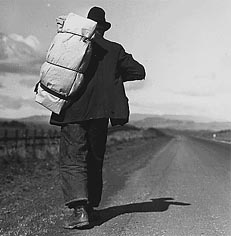
He was one of the mellow, the soft-spoken, the tawny-haired — one who preferred to be alone.
His name was Mark, a dishwasher at age 45.
He was a drifter, a loner. He valued his freedom above all; dishwashing jobs he could always find.
Our paths crossed and re-crossed at the Café Claire, where I was tending bar. The Café Claire stood on the outskirts of an industrial town, near the railroad tracks, beside his temporary home. Sometimes he’d sit at the end of the bar, before his shift or after, and drink black coffee. Sometimes he’d speak to me, and sometimes he would not.
He was a tidy man, and orderly; he organized things in an oddly geometrical way. He did not drink, he did not smoke, he did not use drugs. He was clean-living and in good shape, neither depressed nor its opposite.
He was single, without children.
And he was free.
He read a lot – novels and non-fiction – to endure, perhaps, the knives of lust that so frequently strike. He had the quietude of one who has gone a long time without sex.
His home was an efficiency apartment – a “hutch,” he called it – with good plumbing. (This mattered to him.) He dealt only in cash and he was good with his money. He saved, he moved on. Sometimes he worked on farms, sometimes he loaded and unloaded freight, sometimes he carried hod. But when I first met him and asked him what he did, he said “I’m a sudsbuster.”
So in the way of things, he would come behind my bar at times, when I was busy, and, without asking me, he’d wash my dishes. I loved him for that. He was fast on his feet and knew how to work around people, so that nobody was in anybody’s way. Buried in bloody marys and martinis, I’d glance over and see him plunged to his elbows in suds, his gold-rim spectacles, which somehow endeared him to me, filled with the burning bar light, his neat goatee damp with perspiration and pied with skeins of gray.
Two or three times, I saw him outside work while I was in my car. Each time, he was walking alone along the railroad tracks, at dusk like some solitary figure carved from the coming dark. This was a grizzled landscape, a prairie desert of Euclidian perfection, full of rings and radii, vast yet traversed by a single road: an isolate highway humming day or night with Mack truck tires. The wind ferried tumbleweeds across the lion’s pelt land. Deadwood everywhere stood silvery-gray, like the moon above, and invariably whenever I saw him, a feeling of melancholy came over me, a melancholy for him, I am not sure why.
This, though, is not about pity or pathos, and Mark was not a person to pitied, not at all.
This is about one man out of many millions making his way
in the land of the free,
the USA.
This year rather than celebrating Earth Day by advocating still more government bureaus, which will then determine for the rest of us what we can do with our property, let us instead celebrate the only real way to clean up and beautify the planet: private property rights and private stewardship.
From Chapter 2 of Leave Us Alone:
The right to property is, as James Madison said, “the guardian” of every other right. Freedom and private property are inseparable. Property is freedom: you cannot be free if you are not free to produce, use, and dispose of those things necessary to your life.
“Control the property, control the person,” said Lenin, correctly.
Property, like every other right, is first and foremost the right to act: specifically, it is the right to produce, exchange, and use.
“Property is not only money and other tangible things of value, but also includes any intangible right considered as a source or element of income or wealth…. It is the right to enjoy and to dispose of certain things in the most absolute manner” (Electric Law Library).
Money is property.
The only alternative to private property is government or communal ownership of property, both of which amount to the same thing in the end: a bureau of centralized planners controlling the property.
If you desire to know precisely what someone’s political viewpoint is, all you need do is find out his or her stance on property; for it is through the stance on property that the entire political philosophy is disclosed. You needn’t listen to anything anyone says about “freedom” or “liberty” or any of these other easy platitudes: no one in her or his right mind will go against those things. Instead, simply check the stance on property. If someone doesn’t believe in full private property rights, that person is, to the exact extent he or she denies private property rights, a statist.
Property is the sine-qua-non of human freedom.
To defend freedom, therefore, you must start by defending the unalienable right to property.
The diversity in the faculties of men, from which the rights of property originate, is not less an insuperable obstacle to a uniformity of interests. The protection of these faculties is the first object of government (James Madison, Federal Papers 10).
Government is instituted no less for protection of the PROPERTY, than of the persons (James Madison, Federalist Paper #54, emphasis in the original).
The true foundation of republican government is the equal right of every citizen in his person and property and in their management (Thomas Jefferson to Samuel Kercheval).
A right to property is founded in our natural wants, in the means with which we are endowed to satisfy these wants, and the right to what we acquire by those means without violating the similar rights of other sensible beings (Thomas Jefferson to Pierre Samuel Dupont de Nemours).
The political institutions of America, its various soils and climates, opened a certain resource to the unfortunate and to the enterprising of every country and insured to them the acquisition and free possession of property (Thomas Jefferson: Declaration on Taking Up Arms).
The moment the idea is admitted into society, that property is not as sacred as the laws of God and that there is not a force of law and public justice to protect it, anarchy and tyranny commence (John Adams).
Comment » | America, Capitalism, Property Rights, environmentalism
This giant billboard was posted along I-70 in Lafayette County, Missouri. If you can’t quite make it out, it displays this message: “A Citizens Guide to Revolution of a corrupt government.”
It then displays the following list of actions:
1. Starve the Beast.
2. Vote out incumbents.
3. If steps, 1 & 2 fail?
Prepare for War –Live Free or Die
This billboard replaced a previous one:
According to Think Progress: “It’s unclear who the owner of the billboard is, but the first one was the work of a ‘Missouri businessman.’”
Radical?
Maybe, maybe.
And yet in any society (and perhaps America most especially) you can restrict freedom only so much before people will naturally revolt, as people should.
Freedom is not “granted” by bureaucrats.
Freedom is a birthright — to every single human being. Laissez-nous faire.
Full many a flower is born to blush unseen and waste its sweetness on the desert air (Thomas Gray “Elegy Written in a Country Churchyard”).
She works in a diner called the Desert Rose on the northwestern edge of Colorado, near the Utah border. The diner is small and undistinguished, clean and lit up in an American wasteland. Triangles of cherry sit bleeding in the pie case and honey-yellow flypaper spirals back and forth above the cash register. She grew up in a mountain town, drinking beer and smoking cigarettes with all the other small-town girls and boys. She began working when she was in the 11th grade, and she’s not stopped working since. Waiting tables is what she’s done for most of her life. She graduated high school but never matriculated. After school, she drifted; where she lives now is not where she grew up.
By age thirty, she’d already buried two husbands, both miners, one killed in a car crash. No longer young, she is not yet old, and she is pretty still. She’s single. She has two teenage children who love her. She smokes mentholated cigarettes and rents an apartment too small for three, but it’s what she can afford.
There have been other jobs – night auditor, bankteller, housecleaner – but waitressing is the one she always comes back to. There are no special skills in her repertoire, no trade. She’s reasonably well-read, her mind is of a naturally speculative cast. At twilight she invariably feels a sense of sadness creep over her.
Fifty feet behind the Desert Rose, a cluster of cottonwoods grows along the banks of a sloppy canal. They are ancient and massive trees. Wind moves sluggishly through their dusty boughs. Moonlike globes of cotton orbit the bodies of the trees and fall soundlessly into the molecular green water. Sparse grass grows along the desert floor, and the desert stretches off into an intricate horizon. At the end of her shift, she likes to stand at the back porch of the café and listen to the wind sifting softly through the grass. Pretty blue flowers grow among the stalks, and she feels them wasting their sweetness on the desert air. The bone-colored moon rises in the east and fills a small quadrant of the sky, suffusing the clouds with its yellow and sulfurous light.
The trucker who lives next door is seldom home.
He’s a long-haul trucker, he’s over-the-road. He earns good money and does not spend. Something of the ascetical about him. He’s forty. His hair is long. He wears jeans and combat boots. Sallow and haggard, his face is handsome nevertheless. His willowy wife does not ride with him but stays at home. They have no children. The wife is solitary, long-legged and tan. She has a ponytail of sandy-brown. She smokes Marlboro’s. They do not rent but own. The wife spends hours in her garden, or she reads in her backyard. Her eyes are pensive. She waves to us but rarely speaks.
The trucker who lives next door arrives at unexpected hours, on unexpected days. Emerging from his rig, he has the leanness of a desert prophet about him. I imagine him eating very little while he’s out on the road. He transports the goods from north-to-south. He hauls the freight from coast-to-coast. He kisses his wife in the driveway. They hold hands and enter their tidy cottage together. They shut the door behind.
Sometimes, on holidays, his rig will sit for three or four consecutive nights along our residential side street. It sits gleaming in the dark. The trucker loves his rig; it is his home away from home. Once, in the middle of the night, I heard a gentle noise outside and crept up to the window. The trucker who lives next door was polishing his semi with a white cloth in the moonlight. The semi is midnight-blue and chrome.
Here on the ragged edge of this desert town where the ancient railroad tracks lie rusting in the grass, the frontiers begin. This is the frontier the trucker crosses and re-crosses year around. Our town is like many western towns, with its looping river and cauliflower clouds, its one Masonic lodge and the hard clean skies above, and in the distance, fields of clay where woolly mammoth once knelt down in the soft earth to die, and a billion bison bones fossilize in the ground. Beyond the backyards, the interstate curves off into the lonesome horizon, and the distant cars make very little sound.
When portable radios first appeared in American stores, the average American worker had to labor 13 hours to buy one; today he or she toils for about 1 hour.
In the 1920s it took 79 hours of work to buy a nice men’s suit; today it takes less than half that.
At the beginning of the twentieth century the average American family spent three-quarters of its income on food, clothing, and shelter; today it spends about one-third on those items, and spends and even greater proportion on taxes (source).
That principle is the exact principle whereby capitalism enriches any and every society that implements it.
The insidious myth that capitalism “exploits the workers” while a few capitalist pigs get rich at the workers’ expense is a canard that’s been bunked a billion times.
But there’s even more:
Electric light was first deployed along Pearl Street in downtown Manhattan in 1882, powered by America’s first commercial electric grid. Electric lighting initially cost much more than gas lighting (the dominant form of lighting at the time) and was available only to multi-millionaire JP Morgan and a handful of businesses in New York’s financial district. By 1932, however, the price of electricity had fallen to one-third its former level, and 70 percent of Americans had electricity. Within fifty years of Edison introducing the electric grid, gas light was all but forgotten, and electricity emerged as the power source for the masses. Electricity not only provided clean, odorless, and safe lighting compared to its predecessor; it also powered refrigerators, fans, heaters, irons, and ovens, and it quickly became the dominant source of motive power in factories (source).
Capitalism lowers the cost of every new technology. It does so by taking products — cars, cotton, electricity, phones, computers, it doesn’t matter — and through constant innovation and the ingenuity that free markets foster, mass producing these items, which lowers and lowers the costs. That is why in this country even those below the poverty level own televisions, phones, microwaves, toasters, and so on. That is why no one starves to death in the United States.
The locus of wealth is production and free exchange. The locus of production and free exchange is private property. And that is why private property is the most important ingredient to capitalism.
Consider that government cannot redistribute or spend a single penny without first either taxing, borrowing, or printing, all three of which deplete real wealth. In this way, government intervention, in any of its multifarious forms, is by definition self-defeating: It can only end in wealth destruction. It’s also why labor unions cannot, over the long run, increase real wages and living standards, and only advances in technology can.
“Historically, real wages (wages adjusted for the effects of inflation) rose at about 2 percent per year before the advent of unions, and at a similar rate afterward” (Morgan Reynolds, Power and Privilege: Labor Unions in America, 1984).
Says Dr. Dilorezo:
If labor unions were responsible for the historical rise in wages, then the solution to world poverty would be self-evident: unionize all the poorest nations on earth. [And yet] private-sector unions reached their peak in terms of membership in the 1950s, when they accounted for about a third of the workforce. Today, they represent barely 10 percent of the private-sector workforce. All during this time of declining union memberships, influence, and power, wages and living standards have risen substantially. All of the ‘declining industries’ in America from the 1970s on tended to be the highly unionized ones, whereas the growing industries, especially in the high-technology fields, are almost exclusively nonunion. At best, unions can improve the standards of living of some of their members, but only at the expense of other, nonunion workers, consumers, and others. When unions use their power to go on strike, or threaten to strike, and succeed in increasing their members’ wages above what they could earn on the free market, they inevitably cause some union members to lose their jobs.
The reason? When wages rise, it makes labor more costly; therefore, to keep turning a profit, employers simply cannot employ as many workers.
There’s never been a famine in the United States, and one thing alone is responsible for this: private property rights.
Capitalistic societies are the wealthiest societies in the history of the world, and it is the absence of fully protected property that creates poverty. As the Peruvian economist Hernando de Soto puts it in his instructive book The Mystery of Capital:
Many of the poorest countries in the world possess enormous amounts of capital, but their ownership is insecure because of faulty or nonexistent property law or property rights protection. The value of private savings in the ‘poor’ countries of the world is forty times the amount of foreign aid they have received since 1945. [The citizens of poorer countries] hold these resources in defective forms: houses built on land whose ownership rights are not adequately recorded, unincorporated businesses with undefined liability, industries located where financiers and investors cannot see them. Because the rights to these possessions are not adequately documented, these assets cannot readily be turned into capital, cannot be traded outside of narrow local circles, cannot be used as collateral…
Compare that to property laws in the west “where every parcel of land, every building, every piece of equipment, or store of inventories is represented in a property document that is the visible sign of a vast hidden process that connects all these assets to the rest of the economy.”
Private property is the crux of wealth. And property is nothing more, or less, than an extension of person.
What is capitalism? Capitalism is a social system based upon private ownership of the means of production and the preeminence of the individual over the group.
The hour of capitalism’s greatest triumph is its hour of crisis. The fall of the Berlin Wall ended more than a century of political competition between capitalism and communism. Capitalism stands alone as the only feasible way to rationally organize a modern economy. At this moment in history, no responsible nation has a choice (ibid).
In the beginning, and for several decades afterward, slavery was not primarily a governmental institution, neither in Europe, nor the United States.
Initially, the enslavement of Africans was almost all done privately. There were, to be sure, a handful of governmental charters, but in the early days, the preponderating number of slaves were traded by private entrepreneurs who exchanged rum, spices, and other items to tribal chiefs for Africans whom these same tribal chiefs had already enslaved. In essence, they were merely relocated.
Make no mistake, however: the European traders were indeed responsible for perpetuating that barbaric institution; but they were not the people responsible for “enslaving the tribe that had lost a war or the man who had fallen into debt or the child sold by the family” (Roger McGrath). That blame goes directly to the tribal African chiefs.
In fact, slavery was not for a very long time recognized as a legal institution in the colonies of this country. Thus, the first Africans were not, strictly speaking, slaves but rather indentured servants.
The fact of it becoming a legalized institution in the United States was actually brought about by a black man named Anthony Johnson, himself an erstwhile slave back in Africa, and then an indentured servant in the American colonies. After his indentured servitude had expired, Mr. Johnson was granted land in Virginia, where he subsequently acquired several indentured servants of his own – among them, one John Castor, an African who had been sold to him while already in the American colonies.
It was these same men, John Castor and Anthony Johnson, both black, who were initially responsible for the institution of slavery becoming recognized legally in this country.
When John Castor’s years of indentured servitude were finished, he was not immediately granted his freedom. And so he sued for it, as well he should have, as you and I would have too.
But Anthony Johnson, his owner, fought back, alleging in court that John Castor had never entered into what they called a “contract of indenture” but had been bought in toto as a slave in Africa. In a landmark decision, in 1654, the high court of the colony of Virginia found in Anthony Johnson’s favor, pronouncing that “John Castor was a servant for life.”
Chilling words, which no human should ever have to hear.
This was a monumental and precedent-setting case, later cited to weariness by the Southern colonies, so that slavery was soon officially institutionalized.
The fact that two black men are in large part the authors of American slavery is a piece of American history well worth teaching, no matter how postmodern the curriculum.
It is also a fact that black Americans held slaves all throughout the Civil War.
“In 1860, some 3,000 blacks owned nearly 20,000 black slaves. In South Carolina alone, more than 10,000 blacks were owned by black slaveholders. Born a slave in 1790, William Ellison owned 63 slaves by 1860, making him one of Charleston’s leading slaveholders. In the 1850 census for Charleston City, the port of Charleston, there were 68 black men and 123 black women who owned slaves. In Louisiana’s St. Landry Parish, according to the 1860 census, black planter Auguste Donatto owned 70 slaves and farmed 500 acres of cotton fields” (“Slavery’s Inconvenient Facts,” Chronicles, November 2001).
In terms of total population, white or black, the majority of people of either color did not own slaves in the south. In fact, “75 percent of Southerners neither owned slaves themselves nor were members of families who did” (Ibid).