Category: economics


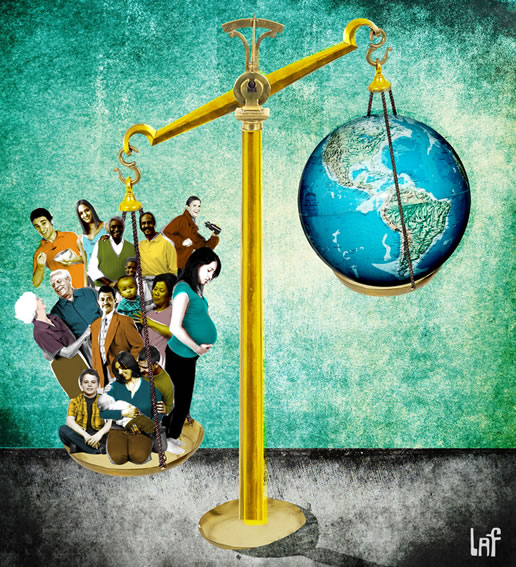
The Great Overpopulation Myth

February 10th, 2010 — 6:51am

The population of the entire world could fit shoulder-to-shoulder in a space about the size of Jacksonville, Florida.

Ninety-seven percent of the earth’s land surface is empty.

If you allotted to each person 1,250 square feet (which is quite a bit), all the people in the world would fit into the state of Texas.

According to the Food and Agriculture Organization, world food supplies exceed requirements in all world areas, amounting to a surplus approaching 50% in 1990 in the developed countries, and 17% in the developing regions.

Problems commonly blamed on ‘overpopulation’ are the result of bad economic policy. For example, Western journalists blamed the Ethiopian famine on ‘overpopulation,’ but that was simply not true. The Ethiopian government caused it by confiscating the food stocks of traders and farmers and exporting them to buy arms. That country’s leftist regime, not its population, caused the tragedy. In fact, Africa, beset with problems often blamed on ‘overpopulation,’ has only one-fifth the population density of Europe, and has an unexploited food-raising potential that could feed twice the present population of the world, according to estimates by Roger Revelle of Harvard and the University of San Diego. Economists writing for the International Monetary Fund in 1994 said that African economic problems result from excessive government spending, high taxes on farmers, inflation, restrictions on trade, too much government ownership, and over-regulation of private economic activity. There was no mention of overpopulation.

The government of the Philippines relies on foreign aid to control population growth, but protects monopolies which buy farmers’ outputs at artificially low prices, and sell them inputs at artificially high prices, causing widespread poverty. Advocates of population control blame “overpopulation” for poverty in Bangladesh. But the government dominates the buying and processing of jute, the major cash crop, so that farmers receive less for their efforts than they would in a free market. Impoverished farmers flee to the city, but the government owns 40% of industry and regulates the rest with price controls, high taxes and unpublished rules administered by a huge, corrupt, foreign-aid dependent bureaucracy (Dr. Jacqueline R. Kasun).

The world’s population is expected to max out at around 8 billion by 2050. Then it starts to decline.

That’s when the real trouble begins.


20 comments » | Capitalism, economics, Political philosophy

Depression Before the Great Depression

February 3rd, 2010 — 8:12am

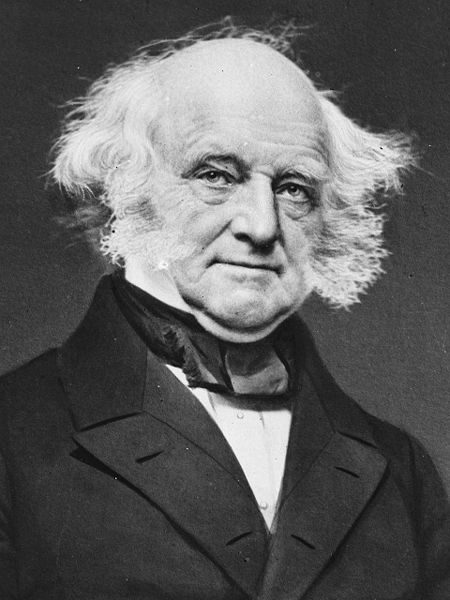
Martin van Buren

The following is Chapter 21 of Leave Us Alone:

Before the Great Depression of the 1930’s and 1940’s, there were a number of depressions and recessions in this country, two of the most notable being the Panic of 1819 and the depression of 1837. In every instance prior to the Great Depression, the government policy was essentially a policy of hands-off.

Which was exactly as it should have been, since depressions are not caused by the private sector but by government interference in the marketplace, and only that.

What were the results of these hands-off policies prior to the Great Depression?

Answer: a drastic reduction in the amount of time the depression lasted.

Let us reiterate and emphasize that the only way to create wealth and jobs is through production.

That is why capitalism, true laissez-faire capitalism, is the only possible way to end an economic depression or recession.

Government spending will always compound problems. Why? Because government can only obtain money by taxing or borrowing or printing.

Always remember: government by definition is not an agency of production: it is a mechanism of force. That is its defining characteristic.

Thus the money that government takes away from the private sector depletes money that would otherwise have by choice (as opposed to by coercion) been saved or spent upon other things.

Private money, in other words, is diverted from the capital sector into the hands of bureaucrats. Which is exactly the thing that exacerbates and prolongs the preexisting economic problem.

It is so very easy to spend money that is not yours, money that you’re not fully accountable for, money that you obtain through force or the threat of force. Whereas, on the other hand, cutting governmental borrowing and spending and taxation and printing, it frees private money and private resources, which in the end is the one and only thing that can produce genuine wealth.

Printing more and more money to cover the cost of government spending will only ever bring inflation. It can happen in no other way.

Economic law cannot be abolished, just as mathematical law cannot be abolished, and for the exact same reasons. It doesn’t even matter how many politicians wish to abolish these economic laws, or how charismatic the masses find these bureaucrats: economic laws will not be subverted. One might just as well try turning back the tide with one’s own two hands.

Here, then, is how to end a recession or depression as swiftly as possible:

Slash government spending.

Slash taxes.

Stop the inflationary process that fiat money (i.e. money printing) inevitably brings.

Deregulate private enterprises so that the private sector can function – which is to say, free the market so that businesspeople can start up businesses, produce products, and create more and more jobs.

That’s all there is to it. And yet it’s a pill that bureaucrats simply cannot swallow.

The depression of 1837 was the biggest depression this country had seen prior to the Great Depression. The good President Martin Van Buren and his administration did exactly the right thing: they stepped back and let the market correct itself, which indeed it did, so that the depression lasted less than a year.

Martin Van Buren stated in his inaugural address that he advocated a policy of laissez faire.

Two months later, the United States experienced a banking crisis. President Van Buren stuck to his guns.

“All but six of the nation’s eight hundred or so banks had ceased redeeming their bank notes in gold or silver, but in his first message to Congress the President proclaimed that his policy would be one of governmental retrenchment” (Dr. Thomas Dilorenzo, How Capitalism Saved America, p. 158).

In President Van Buren’s own words:

“All communities are apt to look to government for too much, especially at periods of sudden embarrassment and distress…. All former attempts on the part of Government to assume management of domestic or foreign exchange have proved injurious.”

President Van Buren added that the solution is “a system founded on private interest, enterprise and competition, without the aid of legislative grants or regulations by law” (James D. Richardson, A Compilation of the Messages and Papers of the Presidents, New York: Bureau of National Literature, 1922).

It should be noted that Van Buren had to fight every step of the way against governmental intervention by such notable statists as Daniel Webster, Henry Clay, and the young Abraham Lincoln, all of whom remained statists until the day they died.

President Van Buren waged a tireless war for deregulation of finance, and he thereby created the Independent Treasury System in which all bank notes were redeemable in gold and silver.
In so doing, he brought this country the strongest and most stable monetary system it’s perhaps ever had.

President Van Buren also, in the words of historian Jeffrey Hummel, “thwarted all attempts to use economic depression as an excuse for expanding governments role.”

Conversely, interventionists like Henry Clay and his young protégé Abe Lincoln saw this economic downturn as a political opportunity to create pork-barrels for so-called internal improvements. Sound familiar?

These same statists also attempted to get the federal government to bail out the states, but President Van Buren fought them tooth-and-nail and eventually won; so that government spending actually fell during his term, and the debt remained steady, the free-market price system allowed to operate without intervention.

That is why the depression of 1837 lasted only one year.

That is why it never spun out of control, as today’s crisis has.

By refusing to pile up debt, President Van Buren thereby refused to drag out the economic downturn, which by necessity steals money from the private sector.

Compare that to, in the next chapter, the brief but by-no-means exhaustive list of extraordinarily destructive policies followed first by Herbert Hoover, who was an admirer of Soviet Russia and “believed that human manipulation could triumph over any alleged ‘laws’ of economics,” and then the even more brutal Franklin Delano Roosevelt, a discussion of whom will come in the chapter after the next.

2 comments » | Capitalism, economics

Natural Resource and Goods Theory

February 1st, 2010 — 7:23am

Carl Menger, Founder of the Austrian School of Economics

The two essential claims of the environmentalists, which I take for granted are already well known to everyone, are (1) that continued economic progress is impossible, because of the impending exhaustion of natural resources (it is from this notion that the slogan “reduce, reuse, recycle” comes), and (2) that continued economic progress, indeed, much of the economic progress that we have had up to now, is destructive of the environment and is therefore dangerous.

The essential policy prescription of the environmentalists is the prohibition of self-interested individual action insofar as the byproduct of such action when performed on a mass basis is alleged damage to the environment. The leading concrete example of this policy prescription is the attempt now underway to force individuals to give up such things as their automobiles and air conditioners on the grounds that the byproduct of hundreds of millions or billions of people operating such devices is to cause global warming. And this same example, of course, is presently the leading example of the alleged dangers of economic progress (source).

In his groundbreaking Principles of Economics, Carl Menger (1840-1921), the founder of the Austrian School of Economics, developed what he came to call the Theory of Goods.

This theory has direct and immediate relevance regarding, for example, global warming, ozone depletion, resource scarcity, and so on. Indeed, its relevance cannot be overstated.

Menger’s Goods Theory begins by pointing out that there is a crucial distinction between objects in and of themselves and “goods” proper.

The object alone — for example, any resource before it actually becomes a resource — does not possess value intrinsically. Rather, it is in relation to human use that the thing becomes valuable. It is precisely this, then, that makes it a good.

Or put another way: a thing becomes a good when it is able to satisfy some human need or want.

Menger lists the following four criteria that need to be simultaneously met to reach what he calls the “goods-character.”

* A human need.

* Such properties as render the thing capable of being brought into a causal connection with the satisfaction of this need.

* Human knowledge of this causal connection.

* Command of the thing sufficient to direct it to the satisfaction of the need (Principles of Economics, page 52).

It is important to note that these last two things are man-made.

It is equally important to realize that the last one is for the most part achieved by means of labor and the capital that that labor produces.

This implies – to quote Dr. Reisman – that the resources provided by nature, such as iron, aluminum, coal, petroleum and so on, are by no means automatically goods. Their goods-character must be created by man, by discovering knowledge of their respective properties that enable them to satisfy human needs and then by establishing command over them sufficient to direct them to the satisfaction of human needs.

For example, iron, which has been present in the earth since the formation of the planet and throughout the entire presence of man on earth, did not become a good until well after the Stone Age had ended. Petroleum, which has been present in the ground for millions of years, did not become a good until the middle of the nineteenth century, when uses for it were discovered. Aluminum, radium, and uranium also became goods only within the last century or century and a half.

The upshot of all this is that nature — or, if you prefer, the environment — is not some relatively limited pool of resources that man merely plucks, exploits, depletes, and then moves on from. On the contrary, as Menger makes incontrovertibly clear, mother nature gives us only the barest material — “the physical properties of the deposits in mines and wells” — but she does not provide the goods-character. We provide that.

“Indeed, there was a time when none of them were goods” (Ibid).

Nature, contrary to what the environmental philosophy would have you believe, does not possess intrinsic value.

That — and nothing else — is the fundamental argument against all of environmentalism.

The earth is a plenum: it’s a solid sphere packed full of chemicals. Those chemical elements are indestructible. They can change properties and forms, but they cannot cease to exist.

That mass of teeming chemicals are all potential resources.

As humans evolve — as we make new discoveries and develop newer and ever newer technologies — we find new resources; we find things we cannot conceive of even months before. We find new uses for things that were once useless, like oil, which is barely 100 years old as a resource (a “goods character”); and we find new ways of using old. We move on from whale oil and wood, to kerosene, to coal, to hydro, to nuclear….

Most of what people think they know about energy is so very wrong that their convictions, heartfelt though they may be, lie beyond logical contradiction or refutation….What most of us think about energy supply is wrong. Energy supplies are unlimited; it is energetic order that’s scarce, and the order in energy that’s expensive….Supplies do not ultimately depend on the addition of reserves, the development of new fuels, or the husbanding of known resources. Energy begets more energy; tomorrow’s supply is determined by today’s consumption. The more energy we seize and use, the more adept we become at finding and seizing still more. What most of us think about energy demand is even more wrong. Our main use of energy isn’t lighting, locomotion, or cooling; what we use energy for, mainly, is to extract, refine, process, and purify energy itself. And the more efficient we become at refining energy in this way, the more we want to use the final product. Thus, more efficient engines, motors, lights, and cars lead to more energy consumption, not less (Peter Huber and Mark Mills, The Bottomless Well).

The earth, far from being “raped and nearly depleted,” has barely been touched.

This mass hysteria regarding CO2 and chlorofluorocarbons and so on is a waste of time and energy.

Human freedom breeds human progress. And progress by definition is not static. The economist Joseph Schumpeter called it creative destruction.

Today’s consumption determines tomorrow’s technology. The more we use, the more we innovate — provided, that is, we are left free to innovate.

Politically and economically free.

The profit motive, as its very name implies, motivates and incentives; for humans have a limitless desire to better their lives.

Wealth not only builds progress; wealth is progress.

If there is a demand for something to replace, for instance, freon, the untrammeled freedom to innovate will meet that demand by far the fastest.

Thus, if it is the environment you’re concerned about, then it is pure, unadulterated laissez-faire capitalism you should be fighting for tooth and nail. It is this, and not centralized power, or the establishment of worldwide central-planning committees to regulate CFCs and CO2 — this is what brings cleaner environments.

To think anything less is to commit a grave logical fallacy.

Real, positive knowledge of the profit motive and the price system, of saving and capital accumulation, of money, economic competition, and economic inequality, and of the harmony of interests among men that results from the joint operation of these leading features of capitalism — all this knowledge is almost entirely lacking on the part of the great majority of today’s intellectuals. To obtain such knowledge, it would be necessary for them to read and study von Mises, who is far and away the most important source of such knowledge. But they have not done this.

Ignorance of the ideas of von Mises — the willful evasion of his ideas — has enabled the last three generations of intellectuals to go on with the delusion that capitalism is an “anarchy of production,” a system of rampant evil, utter madness, and continuous strife and conflict, while socialism is a system of rational planning and order, of morality and justice, and the ultimate universal harmony of all mankind. For perhaps a century and a half, the intellectuals have seen socialism as the system of reason and science and as the ultimate goal of all social progress. On the basis of all that they believe, and think that they know, the great majority of intellectuals even now cannot help but believe that socialism should succeed and capitalism fail (George Reisman, “Environmentalism Refuted”).


11 comments » | Capitalism, economics, environmentalism

Peak Oil?

January 28th, 2010 — 7:03am

From the moment oil first made it into the mainstream, peak oil and the imminent depletion of fossil fuels have been vehemently predicted.

A by-no-means exhaustive list of those predictions might run something like this:

“I take this opportunity to express my opinion in the strongest terms, that the amazing exhibition of oil which has characterized the last twenty, and will probably characterize the next ten or twenty years, is nevertheless, not only geologically but historically, a temporary and vanishing phenomenon – one which young men will live to see come to its natural end” (1886, J.P. Lesley, state geologist of Pennsylvania).

“There is little or no chance for more oil in California” (1886, U.S. Geological Survey).

“There is little or no chance for more oil in Kansas and Texas” (1891, U.S. Geological Survey).

“Total future production limit of 5.7 billion barrels of oil, perhaps a ten-year supply” (1914, U.S. Bureau of Mines).

“Reserves to last only thirteen years” (1939, Department of the Interior).

“Reserves to last thirteen years” (1951, Department of the Interior, Oil and Gas Division).

“We could use up all of the proven reserves of oil in the entire world by the end of the next decade” (President Jimmy Carter speaking in 1978 to the entire world).

“At the present rate of use, it is estimated that coal reserves will last 200 more years. Petroleum may run out in 20 to 30 years, and natural gas may last only another 70 years” (Ralph M. Feather, Merrill textbook Science Connections Annotated Teacher’s Version, 1990, p. 493).

“At the current rate of consumption, some scientists estimate that the world’s known supplies of oil … will be used up within your lifetime” (1993, The United States and its People).

“The supply of fossil fuels is being used up at an alarming rate. Governments must help save our fossil fuel supply by passing laws limiting their use” (Merrill/Glenco textbook, Biology, An Everyday Experience, 1992).

(Give particular heed to that last sentence.)

Quotes like these could fill hundreds of pages easily.

There comes a point, however — and we reached it long ago — when one needs to stop swallowing these scare-mongering scenarios.

There comes a point when one needs to look at the entire history of doomsday predictions and learn something from their long and undistinguished history of incontrovertible failure.

There comes a point, finally, when one needs to question what motivates these people.

To the millions of you who believe the latest round of dire forecasts, I ask you this in all seriousness:

What do you really think — that all the other apocalyptic predictions and predictors, over all the centuries and millennium, were wrong, but people like James Howard Kunstler and Richard Heinberg have at last got it right?

The fact is that anyone can say whatever he wants about anything. But that doesn’t necessarily make it true.

The 1970s book Limits to Growth, for instance, is chock full of reams of “hard data” proving mass famine and the end of the world as we know it — all to occur in a just couple of short decades from when it was written — but none of it came to pass. Not one word of it.

Thomas Malthus’s economic predictions of population-caused famines also failed stupendously, and Malthus himself — a guru of present-day environmentalists — eventually came to reject his early writings. No matter: This doesn’t stop neo-Malthusians like environmental high priest Lester Brown from forecasting a “2004 or 2005 worldwide famine.”

Or Dr. Paul Ehrlich of Stanford University laying “even odds that by the year 2000 Great Britain will no longer exist.”

Neither does it stop any of the endless predictions concerning global warming, species extinction, or forest depletion — for instance, the famous statement made by biologist Norman Myers, which sent environmentalists everywhere scurrying to their soapboxes, that “2 percent of all tropical forest was being destroyed per year,” and that by “2000 we will have lost a third of the world’s tropical forest” (Myers cited in Goudie 1993:46), which flew so far afield it would be laughable were it not so sickening.

(The Food and Agriculture Organization [FAO] puts tropical deforestation in the 1980s at 0.8 percent. In 2001, satellite imagery, which is precise, shows that tropical deforestation had declined to 0.46 percent.)

The history of humankind is replete with false prognostications. It’s time to ask why these predictions are not only always wrong but why they are always so spectacularly wrong.

Here is a crux:

In calculating the amount of natural resources, whether the resource is fossil fuel, crude oil, bauxite, bitumen, gold, or anything else, there is a vital principle at work; it is a principle that doomers of all persuasions have failed to discover and no longer, I think, have the capacity to grasp:

“No matter how closely it is defined, the physical quantity of a resource in the earth is not fully known at any time, because resources are sought and found only as they are needed. Even if the quantities of a particular resource were exactly known, such measurements would not be meaningful, because humans have a near-limitless capacity for developing additional ways to meet our needs: developing fiber optics, for instance, instead of copper wire …” (Julian Simon, The Ultimate Resource 2. Emphasis mine.)

The following is another secret about natural resources, which any legitimate graph or study will confirm:

The more a resource is used, the more that the supply of that resource increases.

It will sound counterintuitive, but only at first. Here’s why:

We begin to know about a resource only when we begin to use the resource. Knowing about that resource includes a cursory calculation of its quantity. The more we use of it, the more adept we become at finding it and calculating its quantity, extracting it and refining it. Thus, the more of it we use, the more of it we’re able to find.

The whole history of resource supply-and-demand has followed this exact principle.

Fossil fuel is no exception:

Observe any non-biased chart on the subject, and it will show that over the last century, oil supply has risen significantly, not diminished, as has virtually every other resource, so long as we’ve continued using it.

Quoting Peter Huber and Mark Mills:

Most of what people think they know about energy is so very wrong that their convictions, heartfelt though they may be, lie beyond logical contradiction or refutation….What most of us think about energy supply is wrong. Energy supplies are unlimited; it is energetic order that’s scarce, and the order in energy that’s expensive….Supplies do not ultimately depend on the addition of reserves, the development of new fuels, or the husbanding of known resources. Energy begets more energy; tomorrow’s supply is determined by today’s consumption. The more energy we seize and use, the more adept we become at finding and seizing still more.

What most of us think about energy demand is even more wrong. Our main use of energy isn’t lighting, locomotion, or cooling; what we use energy for, mainly, is to extract, refine, process, and purify energy itself. And the more efficient we become at refining energy in this way, the more we want to use the final product. Thus, more efficient engines, motors, lights, and cars lead to more energy consumption, not less (Peter Huber and Mark Mills, The Bottomless Well).

Some of the real data about fossil fuel is this:

Humanity consumes about 345 Quads of fossil fuel each year. A quad is a quadrillion British Thermal Units.

Of those 345 Quads, the United States consumes approximately 100.

The United States consumes by far the most, but — and here is a fact too often neglected in discussions of U.S. fossil fuel consumption — the United States also produces by far the most.

The inevitable exhaustion of fossil fuels, so strenuously predicted since the 1880’s, is a notion that’s invariably built upon a fraudulent premise: it’s built off the data of what today’s technology makes accessible.

This reasoning, as we’ve touched upon already, is demonstrably flawed.

No one seriously disputes that with better technology, and better power, we could retrieve far more [fossil fuel]. We already know where to find centuries’ worth of coal – global deposits hold 200,000 Quads. Oil shale deposits hold 10 Million Quads; heavy oils are already being extracted by brute force from the Canadian Athabasca deposits, and bioengineered bacteria could make the earth’s vast deposits of these oils economically accessible everywhere within a decade or less. Even more abundant is the energy locked up within uranium and other radioactive elements. The world’s oceans contain over 10 trillion Quads’ worth of deuterium, a fuel that we will in due course learn to unlock with nuclear fusion. And nothing very fundamentally new will be required to unlock it (Ibid).

Energy begets energy.

The more energy we use, the better we become at developing, extracting, and refining ever more.

Stopping or even slowing the use of fossil fuel would not, contrary to what you’ve been told, solve this (non-existent) fossil fuel problem: on the contrary, it would bring progress to a grinding halt; but even more than that, it would do so by shutting down the rational mind, which is the uniquely human method of survival.

It would blast us back to the stone age.

Which is precisely what many environmentalists, especially those of the better informed variety, want.

There exists no technology that can survey and measure the total quantity of oil and potential oil beneath all the land and sea, including tar sand and shale oil and the conversion of coal to oil.

So where exactly the doomers get their dire predictions is unclear.

What motivates these doomers is even more obscure.

And more frightening.

A quote from The Wall Street Journal, January 2005:

The cost of oil comes down to the cost of finding, and then lifting or extracting. First, you have to decide where to dig. Exploration costs currently run under $3 per barrel in much of the Mideast, and below $7 for oil hidden deep under the ocean. But these costs have been falling, not rising, because imaging technology that lets geologists peer through miles of water and rock improves faster than supplies recede. Many lower-grade deposits require no new looking at all.

To pick just one example among many, finding costs are essentially zero for the 3.5 trillion barrels of oil that soak the clay in the Orinoco basin in Venezuela, and the Athabasca tar sands in Alberta, Canada. Yes, that’s trillion – over a century’s worth of global supply, at the current 30-billion-barrel-a-year rate of consumption.

Please note particularly that last paragraph.

And, while you’re at it, do yourself another big favor:

Ignore all the dire predictions about peak oil and the end of fossil fuels that you’ve been hearing for the last one hundred years.

Ignore the catastrophic scare-mongering that books like The Party’s Over and The Long Emergency propound.

At every point in human history, the individual has been attacked by some government somewhere, on one side of the globe or another, always for the sake of some group.

In this century alone, to cite only a few of the more conspicuous examples, the individual was subordinated in Communist Russia to the proletariat; so too in Communist China, let us forget the millions upon millions of proletarians murdered or imprisoned under these romanticized regimes.

In Nazi Germany, the individual was subordinated to the “superior race.”

In Socialist Europe, in present day Germany and France, “labor” or the masses or The Environment all trump the individual.

In the United States as well claims concerning the environment threaten, as we speak, the individual’s right to her own life and property.

And the scare-mongering only increases: misinformation about fossil fuels has spawned, among a traditionally secular left, such a glut of doomsday predictions that they rival or eclipse any heard from the Religious Right — the only real difference being, instead of telling us to “repent, for the kingdom of heaven is at hand,” we’re told “learn to conserve and farm, for the end of the industrial society is at hand.”

But whether secular or non-secular, dogma is dogma, oppression is oppression, and the misguided doomsday predictions we hear from environmentalists are ultimately every bit as misbegotten as any doomsday predictions we hear from the Religious Right – and, one might well add, ultimately just as banal.

In one form or another, this propaganda is as old as mankind herself — the only real difference being the agenda.

Which agenda is this: let your big benevolent government regulate and control fossil fuels and all other energy besides, and let this same big benevolent government control your property as well, and thereby your life.

It’s called Environmentalism. But it’s really Neo-Marxism.

And Marxism by any other name is, and always will be, the same plain old discredited Marxism.



16 comments » | Capitalism, economics, environmentalism, Fossil Fuel

George W. Bush

January 25th, 2010 — 8:38am


Under President George W. Bush, who was the Herbert Hoover of his day, appropriated government programs grew from $298 billion to $613 billion.

Under President George W. Bush, Social Security spending went from $406 billion to $662 billion.

Under President George W. Bush, Medicare spending went from $216 billion to $425 billion.
Under under President George W. Bush, Medicaid spending went from $117.9 billion to $259 billion.

Under President George W. Bush, “miscellaneous spending” went from $290 billion to $673 billion.

Under President George W. Bush, net interest dropped from $222.9 billion to $139 billion.

Under President George W. Bush, disaster cost went from $0 billion to $4 billion.

In George W. Bush’s eight years, government spending increased more than 55 percent.

Even when adjusted for inflation in constant dollars, federal expenditures under Bush soared by 29 percent.

During his Presidency, real Gross Domestic Product (GDP) only increased by 17.3 percent, and over the Bush years, real government spending went up nearly twice as fast as the actual U.S. economy.

The left should therefore be in love with George W. Bush. He, like his father and like Ronald Reagan, was a complete statist.

There’s more:

Under George W. Bush, Washington ran deficits almost every year. Total federal debt doubled and rose from 58 percent to 66 percent of GDP, for a 14 percent increase in taxpayer debt burden (in terms of the Gross Domestic Product).

Here’s a quick rundown:

• Payment for Individuals: $1054.6 billion in the year 2000 to $1397.1 billion in the year 2007.

• Social Security and Railroad Retirement: $410.5 billion in the year 2000 to $487.7 billion in the year 2007.

• Federal Employees Retirement and Insurance: $100.3 billion in the year 2000 to $116.0 billion in the year 2007.

• Unemployment Insurance: 21.1 billion in the year 2000 to 27.1 billion in the year 2007.

• Medical Care: $362.7 billion in the year 2000 to $559.9 billion in the year 2007.

• Student Assistance: $10.9 billion in the year 2000 to $24.9 billion in the year 2007.

• Housing Assistance: $24.1 billion in the year 2000 to $27.0 billion in the year 2007.

• Food and Nutrition Assistance: $32.4 billion in the year 2000 to $46.3 billion in the year 2007.

• Public Assistance and Related Programs: $88.3 billion in 2000 to $103.4 billion in 2007.

• Other Transfers to Individuals: $4.3 billion in 2000 to $4.7 billion in 2007.

Of course, there was also the $700 billion Troubled Relief Assets Program (also known as the TARP bailout), and yet if you think these figures are difficult to fathom and the expenditures over-the-top, I assure you they do not even begin to compare to the massive spending apparatus that Barack Obama has unleashed.

Indeed, next to Barack Obama, George W. Bush’s reckless spending is downright frugal.


3 comments » | America, Capitalism, economics

Capitalism

January 23rd, 2010 — 8:33am


Capitalism is a social system based upon private ownership of the means of production and the preeminence of the individual over the group.

The word capitalism was popularized by Karl Marx, in the 1850′s. Marx used it to denounce private ownership of the means of production and the autonomous workings of the free market.

Capitalism is an entire political theory — not, as is sometimes supposed, merely economic. In this regard — and only in this regard — it is akin to communism.

The exclusively economic component of capitalism may be described as the right to life, liberty, and property applied to commerce and industry.

Pure laissez-faire capitalism, which does not exist now and has never existed fully, means that government removes itself from all commerce (and that includes healthcare), in the same way that government removes itself from your bedroom.

In addition to early America, there is at least one other society that has come close to laissez faire:

After the War Hong Kong had no minimum wage, low and simple taxes, zero tariffs, zero capital controls, and a stable legal environment. Postwar Hong Kong went as far with economic laissez faire as any other country in history. This resulted in economic development that benefited virtually all the people of Hong Kong. Living standards increased substantially even for the poorest people in Hong Kong (Stefan Karlsson, Inflation Leads to Protectionism, 2004).

Capitalism means that commerce and industry are entirely privatized.

Corporations that receive government subsidies are not capitalistic. They’re the opposite: they’re mercantilistic.

The same is true of small businesses and farms that receive subsidies.

Trade tariffs are not capitalistic but mercantilistic.

Mercantilism is an ancient and more primitive form of socialism. It is socialism before Karl Marx.

Political theory is the theory of government, and government, properly defined, is the body politic that possesses rule over a certain geographic region.

Economics is the science of production and exchange, but production does not just mean agriculture, although that is certainly included.

Productive work is any kind of work geared toward the task of survival — survival in the fully human sense of the word, including, therefore, arts, sports, industry, and so on.

Thus the essential questions of government are these:

Do humans exist by right or by permission? Are we free by nature? If so, why? Are we free to produce, exchange, and exist, or do politicians, elected or not, have authority and jurisdiction over the lives of us — to any degree?

Obviously, there’s only one sane answer to all these questions; for to say that humans do not exist by right is the same as saying humans only exist when someone permits us to. But if that were true, we must then ask: who permits? And why? And who gives these people permission?

Fundamentally, political freedom can be achieved only through recognizing each and every single individual’s right to life.

If, then, you believe that we are each individuated and sovereign, and if you believe that our lives are entirely our own and not the government’s and not another’s, if, in short, you believe “we each have a property in our person,” as John Locke said, then you believe in the inalienable right to life, liberty, and property.

You believe, therefore, in laissez-faire capitalism.


10 comments » | Capitalism, economics, Political philosophy

New Entries

Newest comments

  • Ray: Right?
  • Nick: Wow.
  • Ray: Thank you, Dale. It’s good to hear from you.
  • Dale: Okay, well, maybe the cave smelled like wine… maybe Dale just reacted to sensory evidence. Fun couple of...
  • Dale: The faces of stupid. Check out Corsi’s book on the usurper, who is most clearly not a natural born...
  • Maura: A bit like Zombie Apocalypse!
  • Ray: Green crap? Really? What exactly do you mean? Did you guys have tea?
  • Micky: Unfortunately this mans loose excrement will catch up too him only after soiling a nation. Buy stock in brown...

Categories

Monthly Archives

Search


rayharvey.org Bio  |  Books  |  Contact  |  Blog

Back to top