Category: Free Will


Gattaca

May 23rd, 2010 — 9:11pm

Gattaca is one of my all-time favorite flicks. It is not new — it came out almost thirteen years ago, in 1997 — and it remains, I think, one of the most underrated movies ever. It was written and directed by the New Zealand born auteur Andrew Niccol, who, before and after Gattaca, has been inexplicably silent. It stars Ethan Hawke, Uma Thurman and Jude Law. (The ultra-liberal Gore Vidal plays a most apposite supporting role.) In 1997, Gattaca was nominated for an Academy Award: Best Set Decoration.

Gattaca — the title of which is based on the initial letters of the four DNA nitrogenous bases (guanine, adenine, thymine, cytosine, guanine) — is set in the near future. It is a slightly cyberpunk, highly biopunk thriller that presents a vision of society driven by liberal eugenics.

Vincent Freeman, played by Ethan Hawke, is an imperfect man who desires to travel to the stars. But given his genetic make-up (he’s born with congenital heart condition), society, led by an elite bureau of planners called Gattaca Corp, has deemed Vincent “unsuitable.” He has therefore been relegated to the status of “underclass,” one of those human beings useful only for menial work. And yet not disclosed in his DNA is the fact Vincent’s will is unbreakable.

Thus he assumes a fraudulent identity: the identity of one Jerome Morrow. The real Jerome Morrow (played brilliantly by Jude Law) is a perfect genetic specimen who as a result of a botched suicide attempt is a paraplegic. The two of them, learning among other things how to deceive DNA sample testing, conspire to send Vincent on a space trip to one of Saturn’s moons. They succeed at passing one genetic test after another, using samples of the real Jerome’s hair, skin, blood and urine. Ultimately, a colleague of Vincent’s (A.K.A. Jerome Morrow) is killed, and so Vincent is at long last scheduled for his space mission. At which point, however, another colleague begins to suspect Vincent’s true origins, and the police investigate.

Vincent Freeman is one of the last “natural” babies. He is myopic and his DNA says that he is likely to die at age 30. He has an estranged younger brother named Anton (played well by Loren Dean), who is now a police detective pitted against Vincent. For me, the most moving moments in this very moving movie are the swimming contests — one told in flashback, when the two brothers are young, and one in the present — and when, afterward, Anton asks Vincent how as a genetically deficient human being, he nevertheless won the swimming contests, Vincent answers that he won because he didn’t save his strength for the swim back, since he was always willing to risk everything to succeed…

Gattaca is a timeless movie — timeless, I say, because it is a profound testament to the human spirit and to that fundamental act of will which we each possess, and which each individual alone can choose to activate, or not. It is a movie that hammers home the devastating truth that we are each and everyone of us the shapers of our own clay.

4 comments » | Free Will, Gattaca

Free Will

April 22nd, 2010 — 9:18am

A reader writes:

Dear Ray Harvey: Can you prove that humans possess the faculty of choice?

– Waffling

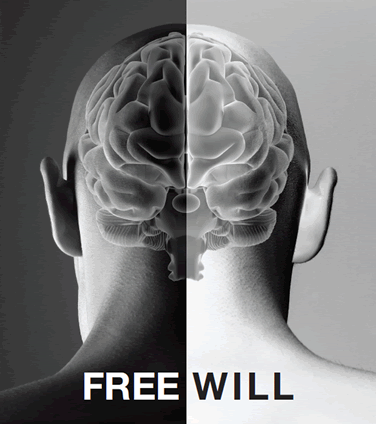
Dear Waffling: Yes, I can. And so can you. But first let me point something out: in the same way that you could not ever conceive dreaming if you’re never awake, so you can never conceive choice if you’re never actually able to choose. In other words, the fact that you’re even able to conceive of volition at all goes a very long way in proving it. Choice is an inherent — and definitional — part of the rational faculty, which humans alone possess.

While you’re at your computer right now, think of some small and inconsequential task you could perform — moving your mouse arrow to a certain quadrant of the screen, for instance, or tapping your spacebar once — but do not actually do it. Whatever the small task is that you conceive of, fix it in your mind for a moment. Observe yourself. Observe that in this moment you can choose to perform that small task, or you can choose not to perform it. You have an alternative, and your will alone is what will determine the outcome. Observe that what determines your choice is your decision to do it or not. That decision is your freedom of will. Quoting (again) the philosophical psychologist Rollo May:

When we analyze will with all the tools that modern psychology brings us, we shall find ourselves pushed back to the level of attention or inattention as the seat of will. The effort which goes into the exercise of will is really effort of attention; the strain in willing is the effort to keep the consciousness clear, i.e. the strain of keeping attention focused” (Rollo May, Love and Will, 1969).

Now, Waffling, decide, one way or the other, and then follow through with your decision.

That’s all the proof you need: direct observation. All knowledge starts and ends with observation.


1 comment » | epistemology, Free Will

New Entries

Newest comments

  • JJ: You mention “there is no connection between wealth and clean, healthy environments.” What data or...
  • Eaturownface: Bukowski is the ultimate artist. You guys have no sense of the kind of art he conjured, probably,...
  • T. D Wiley: Is that really a serious question? Is there anyone on this earth who can even get close to Mr Lynch?...
  • Mike Hosford: I remember in the 1960′s there was something called the Bellamy Award. It was named after Francis...
  • Ray: Merry Christmas, Maura.
  • Maura: Merry Christmas Ray!
  • redmond: doh page is down!
  • redmond: when the F is congress going to get some balls and do something about this mess!

Categories

Monthly Archives

Search


rayharvey.org Bio  |  Books  |  Contact  |  Blog

Back to top