The early reviews have been wonderful.
Hong Kong and Thanksgiving in America

On the eve of Thanksgiving in America, it is, I think, most appropriate to write about Hong Kong, and here is why I say so: How Laissez-Faire and Private Property Saved The Pilgrims
Recently, when Houston Rockets General Manager Daryl Morey voiced his excellent support of Hong Kong’s freedom demonstrations — “Fight for freedom,” he wrote, “stand with Hong Kong!” — in direct opposition to Communist China’s authoritarian regime, many of our garden-variety liberals who have been spoiled rotten by America (and for this reason take her entirely for granted) came out swinging at Daryl Morey, who was totally in the right.
Among the most prominent of those garden-variety progressives was none other than LeBron James, one of the many thousands of professional athletes whom the (relative) free-market of America has made into a phenomenally wealthy human. Or perhaps I should say: “African-American male, he/him.”
Please note that in China, LeBron James would not have the legal sanction to his wealth — the product of his labor and talent — nor to the freedom of expression he enjoys here.
Note also what he actually said:
“[Daryl Morey] was misinformed [and] wasn’t educated on the situation at hand.”
Unquote.
In fact, it’s the other way around. Daryl Morey was incontrovertibly educated on the situation at hand.
Hong Kong, as I’ve written about before, is unique among all cities and civilizations in the entirety of human history. The only other place that compares — and it compares for the same reason — is New York City.
The reason that Hong Kong — a small barren, resource-poor rock in the middle of the South China Sea — grew into one of the wealthiest, most civilized and sophisticated places on planet earth, in an incredibly short amount of time, may be summed up in a short phrase:
Hong Kong is an absolutely irrefutable testament to the elegant order of laissez faire — true laissez-faire. Which is not a mixed economy, nor a crony capitalist economy, both of which things, incidentally, in one way or another, no matter the continent or country, virtually all people today are calling for more of.
The person most responsible for Hong Kong’s meteoric rise to the greatness of an unmatched civilization (because of its explicit implementation of laissez-faire) is a person you’ve perhaps never heard of: Sir John James Cowperthwaite (1915–2006).
As Lawrence W. Reed — not the same Mr. Reed who wrote the timeless essay titled I, Pencil which, in many ways, is the only thing you’ll ever need to know — put it:
“Some of us just write about pro-freedom ideas. This guy actually made them public policy for millions.”
Quoting from:
The Man Behind the Hong Kong Miracle
If we are to believe the critics [of laissez-faire], Hong Kong must be a veritable Hell’s Kitchen of greed, poverty, exploitation and despair.
Not so. Not even close.
Maybe this is why socialists don’t like to talk about Hong Kong: It’s not only the freest economy, it’s also one of the richest. Its per capita income, at 264 percent of the world’s average, has more than doubled in the past 15 years. People don’t flee from Hong Kong. They flock to it. [Sounds a little like racist, fascist America.] At the close of World War II, the population numbered 750,000. Today it’s nearly ten times that, at 7.1 million.
Positive Non-Interventionism
The one man most responsible for [Hong Kong’s] perennial achievement: Sir John James Cowperthwaite should forever occupy top shelf in the pantheon of great free-thinkers….
Compare Britain—the birthplace of the Industrial Revolution, the nineteenth-century economic superpower on whose empire the sun never set—with Hong Kong, a spit of land, overcrowded, with no resources except for a great harbor. Yet within four decades the residents of this spit of overcrowded land had achieved a level of income one-third higher than that enjoyed by the residents of its former mother country.
A Scot by birth, Cowperthwaite attended Merchiston Castle School in Edinburgh and then studied classics at St Andrews University and at Christ’s College at Cambridge. He served in the British Colonial Administrative Service in Hong Kong during the early 1940s. After the war he was asked to come up with plans for the government to boost economic growth. To his credit, he had his eyes open and noticed that the economy was already recovering quite nicely without government direction. So while the mother country lurched in a socialist direction at home under Clement Attlee, Cowperthwaite became an advocate of what he called “positive non-interventionism” in Hong Kong. Later as the colony’s Financial Secretary from 1961 to 1971, he personally administered it.
“Over a wide field of our economy it is still the better course to rely on the nineteenth century’s ‘hidden hand’ than to thrust clumsy bureaucratic fingers into its sensitive mechanism,” Cowperthwaite declared in 1962. “In particular, we cannot afford to damage its mainspring, freedom of competitive enterprise.”
He didn’t like protectionism or subsidies even for new, so-called “infant” industries:
“An infant industry, if coddled, tends to remain an infant industry and never grows up or expands.” He believed firmly that “in the long run, the aggregate of the decisions of individual businessmen, exercising individual judgment in a free economy, even if often mistaken, is likely to do less harm than the centralized decisions of a Government; and certainly the harm is likely to be counteracted faster.”
Ever since the days of John Maynard Keynes, economics has been cursed by the notion that human action should be distilled into numbers, which then become a “pretense to knowledge” for central planner types. In many collegiate economics courses, it’s hard to tell where the math leaves off and the actual economics begins. To Cowperthwaite, the planner’s quest for statistics was anathema. So he refused to compile them. When the economist Milton Friedman asked him in 1963 about the “paucity of statistics,” Cowperthwaite answered:
“If I let them compute those statistics, they’ll want to use them for planning.”
If that sounds quaintly backward or archaic, let me remind you that the biggest economic flops of the past century were both centrally planned and infatuated with numbers. Whole ministries were devoted to their compilation because even lousy numbers gave the planners the illusion of control. But not in Hong Kong!
Statistics, no matter how accurate or voluminous, are no substitute for sound principles. Powered by an abundance of the latter under Cowperthwaite, the Hong Kong economy soared during his tenure. Writing in the November 2008 issue of The Freeman, Andrew P. Morriss noted that in his decade as financial secretary, “real wages rose by 50 percent and the portion of the population in acute poverty fell from 50 to 15 percent.” It’s hard to argue with success. After Cowperthwaite’s retirement in 1971, less principled successors dabbled in social welfare spending but they financed it through land sales, not increased taxation. Tax rates to this day are right where the old man left them.
Lebron James last year came out in support of former quarterback Colin Kaepernick, saying: “I stand with anyone who believes in change.”
“Anyone?,” David Harsanyi recently wrote in direct response to this robotic platitude, and continued: “Of course, LeBron’s stand, as with most acts of pretend celebrity bravery, resulted in hosannas being thrown at him by the press, and, more importantly, never costing him a penny. [Spoiled] Americans [who are so spoiled that they don’t know how good they’ve got it] tend to use word like ‘stand’ and ‘fight’ in their political disagreements, although they never really have to stand and fight for anything. Tank Man stood and fought. The Hong Kong protesters stand and fight. We take to social media and argue. Posting a Nike-approved picture on your Instagram account of Kaepernick—adorned with the $40-million market-test slogan, ‘Believe in something, Even if it means sacrificing everything’—is not an act of bravery, LeBron.”
I don’t know that truer words have ever been spoken.
Finally, there’s an even deeper benefit to laissez-faire — true laissez-faire — one that is an elaboration upon the elegance of laissez-faire’s economic order: that benefit is the genuine harmony and goodwill, the unity and non-factionalizing among people, which a policy of live-and-let live brings with it.
That is why Hong Kong’s current generation is fighting so furiously and uncompromisingly: because they knew freedom. They had it. They lived it. They saw its goodness firsthand, its rightness, its inherent, inalienable justice. And many of them know also that the moment those freedoms are stripped by an authoritarian regime and its immense propaganda machine takes hold, entrenchment will set in, and those beautiful civilizing freedoms will be gone forever.
They fight with so much passion and beauty because they know that to lose it will be to lose it irrevocably. They know they must win. And they must. It is do or die, and they sense this, and my admiration for them knows no bounds, because they are up against a leviathan-sized Borg, utterly mindless, the “coldest of all cold monsters,” as Nietzsche well said, “who bites with stolen teeth” — the state.
I’ve been watching Hong Kong every single day, sometimes minute-by-minute, and this recent thread, written by a native Hong-Kongian, captures precisely what I mean about the natural harmony that exists among humans when humans are left alone:
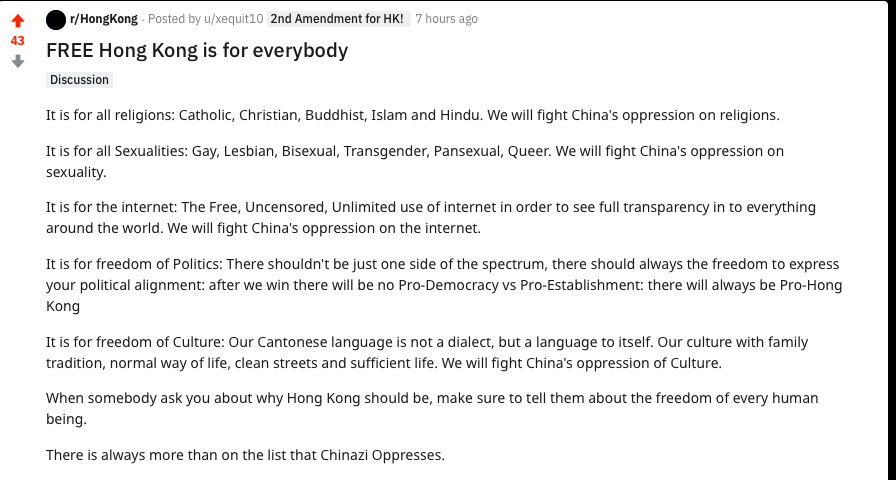
Compare these passionate, brave, freedom-loving people with the spoiled-rotten ANTIFA and Occupy illiterates — whom the police they hate are in this country protecting their right to free speech which ANTIFA would abolish, and who would have us emulate something much closer to China’s authoritarian government — and it will either enrage you, or bring you to your knees:
Happy Thanksgiving.
PayPal & Pornhub
For about ten years now, every time the owner of some platform or another decides, for whatever reason, to change its terms, you’ll almost immediately hear a wild outcry for “justice,” followed by a backlash against “robbing people of their livelihood,” and then there often begins the predictable protests against “late-stage capitalism” and “unregulated markets” and “disempowerment.” Et cetera.
(Please note and remember: nowhere have markets ever been completely unregulated, and they most certainly are not today.)
This phenomena happened with Google.
This happened with YouTube.
This happened with Bing.
This happened with Facebook.
This happened with Patreon.
This happened with Tumblr.
This happened with Reddit and confounded people with college educations.
This happened with Instagram and confused Erika Lust, the porn director mentioned below.
This happened with many, many other companies, some of which (and there is a clue here) went out of business for the decisions they made, and it will continue to happen.
Yesterday, it happened (again) with PayPal, so that as of yesterday PayPal now no longer “partners with” PornHub.
Very big deal, I know. And yet to judge from the outcry, you’d think it was armageddon.
PayPal’s decision may or may not have had something to do with the recent and horrifying story which hit headlines October 30th.
This story concerns a 15-year-old girl who’d been missing for a year and who was then spotted in 58 videos which had been uploaded to Pornhub — as well as Snapchat and Periscope — videos which show the girl, who’d been abducted, being repeatedly raped by her abductor. These videos proved sickeningly popular, and I have a very good idea about why precisely this is, but that’s a subject for a later post.
It is, I’m afraid, time again for me to state the obvious — the obvious and the fundamental — and I admit I find it exceptionally disheartening that such elementary things are so poorly understood:
These are privately owned companies. They can change their terms if they want, and they can change them whenever they want, as you can leave and delete them from your life whenever you want. Users did not use these platforms before they existed, and users do not now suddenly have claim to ownership or a say in how these privately owned companies choose to run their business. Users use these platforms by choice. If these platforms change their terms of service, they are allowed to. Users can write letters and can post as much as they’d like on their own platforms and on any other platforms that allow it, but there is nothing wrong with private companies doing this, and there’s (currently) nothing illegal about it, nor should there ever be. PayPal can choose to do business with Pornhub, or not.
This is not at all a complicated subject. The fact that so many putatively educated people don’t understand something so elementary is a sad testament to the world’s understanding of basic economic principle. You know what it’s like? It’s like a fucking joke to me.
Thanks entirely to social media, a whole new subculture and a whole new generation has recently discovered a term which, for the most part, they did not know anything about even ten years ago. This partially explains why so many among this generation and among this subculture use the old and venerable term as if it were somehow novel and even new.
But in actuality, this term — and, more precisely, the principle behind the term — is something which many have fought tirelessly for for decades and even centuries: fought for in full, I should say, by which I mean, in every aspect of human life.
That term is “decriminalization.”
Decriminalization is similar to deregulation and to legalization, but it is not synonymous.
You’ll be excused, by the way, if you don’t quite recognize the full word — decriminalization — since the term is these days most often used in truncated form, presumably to fit character-count and the trendy terminology of social-media speak: decrim.
Today, the overwhelming majority of people whom you’ll hear discussing decrim are referring to one and only one industry, and that industry is not, unfortunately, the healthcare industry with all its licensing-law monopolies and mandatory health-insurance laws and so forth.
Nor is it unfortunately in reference to zoning laws.
It is not in context of nationalizing and socializing and subsidizing any of the many arms of agriculture, nor any of its offshoot industries, and it’s not about decriminalizing property rights on Native American Indian Reservations.
It also, I regret, has nothing to do with government bailouts of banks or automobile companies, nor does it concern the thousands and thousands of bureaucratic pages added to the Federal Register each year, nor the preposterous gambling laws in America, which are often backed with equal fervor by left-wingers and right-wingers alike.
It’s not about decriminalizing those who don’t comply with mandatory solar-panel laws, or any other mandatory “renewable energy” laws, and it has nothing to do with emissions and the sheer stupidity of officially labeling CO2 (one of the building blocks of life) a “pollutant.”
Neither does it have anything to do with decriminalizing the building of new nuclear reactors, nor to hydraulic fracturing decrim, nor to decriminalizing waste-disposal — specifically by abolishing any and all mandatory recycling laws, which mandatory laws have generated astronomically more pollution and waste.
It’s not about decriminalizing our absurd drinking-age laws, which so many countries in the world do not have — to no detriment whatsoever — and it’s not any decrim related to drugs or alcohol or tobacco or firearms or firecrackers or compulsory education or military conscription or progressive taxation or mandatory licensing laws for any number of other industries, or anything like this. Nor is it about decriminalizing all marriage, so that this institution is separated from the state entirely. Neither is it about any and all forms of coercive welfare, including but certainly not limited to all publicly funded, non-voluntary healthcare subsidization. (You may, of course, voluntarily subsidize any form of welfare-pool or “safety net” you’d like, as was once the case, should anybody choose to organize one, instead of relying upon government compulsion to do it.)
Nor, I very much regret, is it about decrim of all interstate trade and all international trade by abolishing all trade tariffs and all prohibitions against such trade.
Today, rather, decrim is used almost exclusively in the context of the sex industry.
I, along with many others who advocate full unadulterated laissez-faire, have fought long for the total decriminalization of all voluntary trade and consensual transactions, which of course includes drugs, sex, rock-and-roll, gambling, et al, and I have done so for a very long time, and I’m on written record as having done so, and over this subject I’ve lost many people whom I thought were friends. My convictions remain.
When, however, any industry, no matter what that industry is, explicitly pedals pedophilia and rape and other atrocity exhibitions, it falls squarely within the proper jurisdiction of the law. This of course goes without saying, though perhaps not for some.
I am not, for the record, talking about the depiction of non-consensual strangulation and other acts of extreme violence (including snuff), unspeakably disgusting as I find it, which depictions of violence are everywhere in porn — so much so, incidentally, that a number of so-called sex-positives (a bullshit term if ever there was one, and I say that primarily because people who coin terms like this are precisely the people who can’t conceive that there are humans who are completely positive about sex, to the point of loving it — yes — who are open and experimental and not phobic in the least, and yet who nonetheless abhor violence and phoniness and, in addition to that, and more importantly, actually like to spend time thinking about and reading about and talking about a great many other things besides sex), such as Dan Savage now saying:
“There’s this normalization of strangulation and other violence during sex — strangulation without asking: one recent survey showed 13% of sexually active girls aged 14 to 17 had been choked nonconsensually.”
Yes, you read that age-range right: 14 years old to 17 years old, and the boys are statedly getting this from the “edgy” porn they watch.
Quoting porn director Erika Lust, who laments nominally — and only nominally — that “face slapping, choking, gagging, and spitting has become the alpha and omega of any porn scene and not just within a BDSM context. These are presented as standard ways to have sex when, in fact, they are niches…. Young people will go to the internet for answers. Many people’s first exposure to sex is hardcore porn. [It teaches children] that violence and degradation is standard.” (Niche? Hardcore? Violent? Degrading? But I regard “face slapping, choking, gagging, and spitting” as nonsense boring vanilla shit, strictly for squares. And don’t even get me started on the subject of actual “love” and emotional connection between two human beings who have brains and who delight in each other’s company even apart from sex. But if you lament it, Ms. Lust, one wonders why you yourself simply don’t stop contributing to it as “the standard,” and work instead to keep it, as you say, “niche.” Upon second thought, though, so what? Why not make it the standard? What’s the problem with that? What’s the problem with 14-year-old boys and girls watching mere depictions of extraordinarily violent nonconsensual sex acts, including staged snuff and necrophilia? Where’s the problem? I see none. What’s the problem with making depicted nonconsensual strangulation and any and all other forms of violence and brutality and “degradation,” as you say, standard and non-niche, since everyone knows that fantasy enactments, no matter how bloody and brutal and degrading and disgusting and pathological they may appear [to the prudish and religious, of course], are not real life, and that’s one of the main reasons for porn, isn’t it? And, anyway, sex-positivity forbids drawing any such patriarchal distinctions as “standard and non-standard” — because when you get right down to it, there isn’t a standard, and for a porn director to presume any sort of demarcation-of-standard, especially a white Scandinavian female porn director, is, if I may speak frankly, privileged, non-inclusive, hegemonistic, sexist, and quite possibly even racist.)
Other sex-positives, if you’ll permit me further use of this bullshit terminology, sex-positives who still work in porn, discuss sex-trafficking and the number of scenes that take place without the performer’s consent, and this, if you ever feel like making yourself sick and if you feel like implanting ghastly images inside your brain that you will never expunge, is a topic you may read about for weeks which stretch into months and months. But I don’t recommend it.
Yes, the porn industry would normalize this, just as Erika Lust correctly notes. They would normalize this and much more. Normalizing is a type of desensitization. Escalation of tastes is largely for this reason, particularly among men, commonplace, and this is not — not by any reasonable person of whom I know — denied.
Recently, in fact, the discussion — if it can even be called that — has fixated (to the point of absurdity) upon whether or not sex can be an “addiction,” or is it just “potentially compulsive.”
This is an absolute non-issue. It’s also stupidly basic.
All addictions involve compulsion — all of them — and virtually all pleasurable things are “potentially compulsive,” including something as fundamental as eating food.
Furthermore, some of the most difficult compulsions to treat and overcome are not technically “addictions,” anorexia and gambling being two of the most notorious. (I once had a customer — Dr. Berry, an M.D. in psychiatry, recently retired at the time that I knew him, who’d graduated top of his class from Stanford School of Medicine — tell me that in his decades of professional experience the toughest compulsion to treat “by far” [his words] was not heroin or meth or tobacco or any other drug or substance, but gambling.)
So please let me repeat this: PayPal, like any and every privately owned company, may partner with whomever they voluntarily, consensually fucking choose, and they can withdraw that consent, just as Pornhub can stop accepting credit cards or whatever, and just as they can all change their terms of service, and they can buy-out Venmo if Venmo chooses to sell (which Venmo consensually did), and you or I can start up a new payment-processing company or invent an app that people can download onto their phones and soon not be able to live without, or we can start-up a new porn platform — or all of the above — or whatever other 101 shit.
Note also that to the extent that laissez faire does exist, when a platform enacts a policy which causes users to leave, new businesses and companies are free to start up and fill this newly created void which, in enacting whatever policy, opened up a demand — and that’s exactly what we’ve always seen and will continue to see, until government and its advocates implement protectionism. (The rivers of tears had not finished drying over Patreon’s change-of-terms before a hundred new and better platforms sprung up, almost overnight, to take its place. Meanwhile, we watch Patreon’s popularity gradually but inexorably fade. It’s called Creative Destruction.)
It is worth noting here, as well, if only in passing and in closing, that the overwhelming majority of advocates for sex-industry decrim are leftist-progressive-socialists, who, as strident and hysterical as they are for decrim, would, however, CRIMINALIZE any number of other industries (including, for example, PayPal’s right not to do business with whomever they choose [see also most of the list above]); and this is especially true, I’ve noticed, of the psychologists and pseudo-neuropsychs arguing on behalf of the sex industry (but no other industry) for decrim, all of whom, without a single exception in my personal experience, are economically illiterate — one even going so far as to say that “there are no good billionaires.” (He wrote this on a phone or computer or tablet invented and brought into existence by a billionaire, in the comfort of a first-world society made possible by billionaire wealth, upon a platform created and popularized by a billionaire. But I’m quibbling, I know.)
This encapsulates why this group will never ultimately fully succeed in the cause — a cause I support though not in mere isolation without reference to its underpinnings — never fully, I say, because they don’t understand the principle behind the cause, which is this.
The 4th of July & the True Meaning of Human Freedom and Independence

Independence is autonomy. It is the freedom to govern yourself and to rely upon your own independent judgment.
Independence is the freedom to express your own individuality.
But what, finally, is freedom?
Freedom, in its most fundamental form, has only one meaning: it is the omission of force.
Freedom is the absence of compulsion.
It simply means that you are left alone.
It means that every individual, regardless of race, sex, sexual orientation, color, class, or creed, possesses the absolute right to her own life — and only her own life.
The thing that distinguishes the free person from the unfree person is voluntary action versus action that is compelled.
Freedom is one of those things that virtually everyone believes in — that is, until everyone finds out what freedom actually means. And then almost no one believes in it.
The difficult thing for many people to accept about freedom is that it doesn’t actually guarantee much of anything.
It doesn’t guarantee success or happiness, or shelter, or a certain income, or food, or healthcare, or a “level playing field” or a level training field, or anything else that must ultimately derive from the production or labor of others.
Freedom means only that you are free to pursue these things and that if you achieve them, they are yours unalienably, which in turns means: they cannot be taken, transferred, revoked, or made alien.
“The legitimate functions of government extend only to such acts as are injurious to others,” wrote Thomas Jefferson, in Notes on the State of Virginia (1785). Here, he’s speaking of — and against — the initiation of force.
Around the same time Thomas Jefferson was writing those words, another erudite fellow, a German named Wilhelm von Humboldt, independently came to the exact same conclusion:
“Any state interference into private affairs, where there is no reference to violence done to individual rights, should be absolutely condemned” (The Limits of State Action, 1791).
That — the absence of violence, the omission of force — is finally what Independence Day is all about.
Happy 4th of July.
What Is Independence?
Independence is autonomy. It’s the freedom to govern yourself and to rely upon your own independent judgment.
Independence is freedom.
But what, finally, is freedom?
In its fundamental form, freedom really has only one meaning: it’s the omission of force.
Freedom is the absence of compulsion.
It simply means that you are left alone.
The thing that distinguishes the free person from the unfree person is voluntary action versus action that is compelled.
Freedom is one of those things that virtually everyone believes in — that is, until everyone finds out what freedom actually means. And then almost no one believes in it.
The difficult thing for many people to accept about freedom is that it doesn’t actually guarantee you much of anything. It doesn’t guarantee success or happiness, or shelter, or a certain income, or food, or healthcare, or a level playing field, or a level training field, or anything else that must ultimately derive from the production or labor of others. Freedom simply means that you are free to pursue these things and that if you achieve them, they are yours unalienably — which means: they cannot be taken, transferred, revoked, or made alien.
As Thomas Jefferson put it: “The legitimate functions of government extend only to such acts as are injurious to others” (Notes on the State of Virginia, 1785). Here, he’s speaking of — and against — the initiation of force.
Right around the same time Thomas Jefferson was writing those words, another erudite fellow, a German named Wilhelm von Humboldt, independently came to much the same conclusion:
“Any state interference into private affairs, where there is no reference to violence done to individual rights, should be absolutely condemned” (The Limits of State Action, 1791).
That — the absence of violence, the omission of force — is finally what Independence Day is all about.
The Electric Tea Party Acid Test — by Zombie
Zombie, an anonymous San Francisco blogger and photographer whom I admire, recently wrote an article for Pajamas Media that echoes what I myself have been saying for years: the left/right, republican/democrat, conservative/liberal alternative is a false alternative, and those two ideologies are really just two sides of the same penny: the one espouses (nominal) economic freedom but advocates government intrusion in political issues (the Right), while the other espouses nominal political freedom but advocates complete government intrusion in economic affairs (the Left). This issue is not a marginal issue — and indeed becomes more and more relevant each passing day, as this country creeps closer to outright revolution.
Zombie’s article is worth reading in full, but if you don’t have the time or the inclination, please take a long look at his graph, which he calls the real political spectrum: collectivism-versus-individualism — or, in my words, freedom-versus-statism. It’s not quite the graph I would have made, but it’s pretty good; and if freedom is ever to win the day, it is this distinction that must be understood:
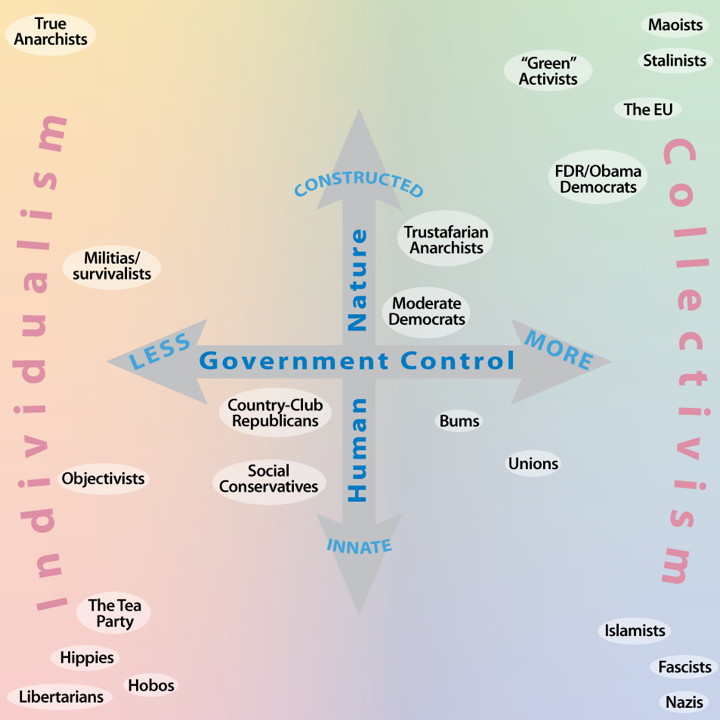
(Note: to see Zombie’s explanation for his categories, click here.)
I, Pencil — By Leonard Read

What goes into the making of a single pencil?
In 1958, Leonard E. Read asked himself that very question — and wrote an elegant explication:
I, Pencil, simple though I appear to be, have a profound lesson to teach. And I can teach this lesson better than can an automobile or an airplane or a mechanical dishwasher because—well, because I am seemingly so simple.
In his piece we’re taken step-by-step through the entire process of how a single pencil is produced.
First, there are the many materials required to make a single pencil, among them: wood, rubber, paint, lacquer, graphite, metal, zinc, wax, and many other things.
We are then shown how these materials are really only the beginning of the process, for a whole industry is in turn required to produce each of those materials.
There is, for example, the lumber industry needed to produce the wood; the mining industry to mine and mill and smelt the zinc and lead and metal; the rubber industry, of course, and the paint and graphite, and so on.
Then, within each of these industries, there are numerous sub-divisions, such as chemical industries, which make up the groundwork for paint and lacquer, and the engineering companies to supply all the tools, and the shipping and transportation companies, and even the lighthouse workers to guide the ships safely into port.
Of course there is also the singular fact that our solitary pencil could neither be manufactured nor produced without all the various other forms of transportation required to get the products from place to place, and of course this transportation requires its own set of industries (not just oil), and on and on, all of which industries — and please take a moment to process this — are, in turn, no less involved than the manufacturing of the wood or graphite or rubber.
So that when everything is said and done, the making of one pencil requires thousands and thousands of people, most of whom have specialized knowledge and specialized jobs, in thousands of different industries.
Furthermore, these people come from all over the world. No centralized planning committee or commune imaginable, even with an army of super-geniuses, could organize the countless factors that go into the making of that one small pencil.
And yet in this country, as in all developed countries, pencils are so cheap and abundant that nobody thinks twice about them.
How is this so?
The answer is devilishly simple: private property and the freedom to trade that property.
The freedom to produce and trade and then reap the subsequent rewards are what bring these thousands and thousands of people, from these thousands of different industries the wide-world over, into peaceful and mutually beneficial cooperation with one another.
Think about that.
Think long and hard about it, I beseech you.
In fact, I insist you do.
Your entire understanding of human existence — whether you’re a billionaire, a bartender, or an artist, and whether you live in a cult, condo, or commune — depends upon it.
Your life depends upon it, I submit.
Think about some of the things you use in your day-to-day existence. Think about your private path of least resistance.
Think of your eyeglasses, which Galileo and Spinoza would have given their eyeteeth for.
Think of the exercise mat upon your floor. Think of the ab-roller for your core.
Think about the utensils you use to cook and clean your food, the cups you use to drink your potable water, and the faucets you use to turn that water off and on.
Think of the hoses and the sprinklers for your lawn.
Think of sponges and your soap.
Think of rope.
Think of your chocolate truffle and think of the package that it comes in.
Think of packaging again and again (and again).
Think of your clothing, no matter how fine or how shabby it may or may not be. Think of your underwear, down to the tag we do not see.
Think critically.
Think about your toothbrush and your toothpaste, and its tube. And the cap that goes on that tube.
Think of your lube.
Think about your medicine: aspirin, ibuprofin, Pepto, Lipator, antihistamines for the cough and wheeze.
Think of braces for your elbows and your knees.
Think of your transportation — bicycle, train, plane, bus, boat, automobile, jumbo jet, or even your walking shoes — and think of the sheer number of discrete parts that each of these things contain, and which you use.
Think of other technological breakthroughs.
Can you?
How about your jacket and its worn buttons, the lovely denim of faded blue, the toothpicks and the gum you chew?
Your bedding and your hygiene and your make-up.
Think of the alarm clock that every morning helps you wake up.
Think of your books and your paints and paintbrushes. Your chisel and hammer.
Your megahertz of memory if your a computer programmer.
Think of your keyboard and your mouse, your voice-recognition software.
Think of filters for your water and air.
Think about your entertainment: wine and wine bottles, dark beer. Think of all the brandy that you’ve consumed or stored.
Think of your playing cards or tarot cards or magic cards, your hoops, your chess-or-checker-board.
Think of packaging again. Think of the packages that all your things arrive in.
Think of your gardening equipment, or any other metal or wood or plastic or glass items you may use.
Think of your ball-peen hammer and your nails and your screws.
Think of your tape measures and pliers, your wrenches, your saws and your multicolored chalks.
To say nothing of your electricity — the lights, the cameras, the watches, the clocks.
Your computers and modems, MP3’s and stereos, word-processors and photo-editing software — and of course your phone, your phone, without which you’d be alone.
And televisions and lights (“More light!” said Goethe, then died) and musical instruments and medical equipment and rocket ships and edible water bottles…
Think of anything. Think of airplane models.
Look around you. Is your chair metal or wood? Does your desk or table have bolts and nails?
Notice details.
I insist, I positively insist.
Think of me as a kind of oculist.
Because I promise you — I absolutely promise — that the filthy, hardcore industry, which I believe in and love so much, the industry that went into producing, for instance, just one small component of your phone, or your bicycle, or the paperback book in your hand, or the shoes on your feet, or the glasses on your face, or the contact lenses in your eyes, or the ring in your navel, nose, or nipples, or the needles which tattooed your skin, that industry was amplified a thousandfold compared with one solitary pencil, no matter how cheap or how thin.
So please take one more look — and then look again.
Take one more look at the blue-black ink across your skin.
There’s a moral to this story and that moral is this:
Embrace technology.
Look suspiciously on the buzzword ecology.
Technology got us to this point. Only technology can get us beyond.
It is a magic wand.
There’s something profoundly paradoxical in the quest for less technology and a more simple way of life, while flying the world in jumbo jets. In fact, it’s about as paradoxical as it gets.
Celebrate, rather, human progress and specialization.
Celebrate the division of labor that technology creates, thereby freeing us all to pursue the things we most enjoy and at which we excel, since we are no longer each yoked to the task of day-to-day, week-to-week, month-to-month survival, but can trade freely and peacefully with those who have the things we need and want, in exchange for the things we ourselves have in turn worked to produce — being no longer condemned to a life of drudgery and tedium.
(Money is only a medium.)
Celebrate individualization.
Celebrate civilization.
Civilization is the progress toward independent, private lives, wherein we are no longer dominated by the group, gang, tribe, or community but live freely: free to associate with others as we please, or not.
This is the fundamental thing you’ve never been taught.
It’s the only thing that’s truly sustainable. It’s what you’ll never hear from any of the postmodernists, the intellectuals, the politicos, the hipsters, the academic phonies and imposters:
Celebrate human freedom and the independent mind that freedom fosters.
Howard Zinn: Freedom Versus Equality
 Howard Zinn was born on August 24, 1922. He died January 27, 2010.
Zinn taught Political Science at Boston University from 1964 until 1988; he was an American historian, of sorts, a self-proclaimed Marxist who, by his own admission, did not believe in objective history:
I wanted my writing of history and my teaching of history to be a part of social struggle. I wanted to be a part of history and not just a recorder and teacher of history. So that kind of attitude towards history, history itself as a political act, has always informed my writing and my teaching….
Objectivity is impossible, and it is also undesirable. That is, if it were possible it would be undesirable, because if you have any kind of a social aim, if you think history should serve society in some way; should serve the progress of the human race; should serve justice in some way, then it requires that you make your selection on the basis of what you think will advance causes of humanity.
Howard Zinn is probably second only to Noam Chomsky in terms of the neo-Marxist influence he wields, and in light of Howard Zinn’s recent revivification, which began just prior to his death, the History Channel aired a program called The People Speak, which was a documentary written and produced by Matt Damon and based upon Howard Zinn’s propaganda publication A People’s History of the United States.
Quoting from his People’s History:
“The American system is the most ingenious system of control in world history, because it uses wealth to turn those in the 99 percent against one another” (A People’s History of the United States, Howard Zinn).
That is Howard Zinn’s philosophy in compendiated form: Ninety-nine out of one hundred of us are not actually free, even if we think we are, because income inequalities exist.
Howard Zinn never seriously asked why income inequalities exist in the first place — at least, not that I’ve ever seen — but the answer to that question is this: not everyone possesses the same degree of talent, skill, and most especially, ambition. (This point, incidentally, was dramatized persuasively in the late Kurt Vonnegut’s short story “Harrison Bergeron.”)
Inequality is inherent to freedom.
Humans left free naturally stratify, as several famous experiments have demonstrated. Why? Because of the reason just stated: humans possess varying degrees of talent, brains, and most of all, ambition.
Freedom, of course, does not guarantee wealth; it does not guarantee success. Freedom is one thing and one thing only: the absence of compulsion. It simply means that you are left alone. Freedom means no entitlements, no minimum guarantees, no help (or hindrance) at all, no public education, no free health care, no drinking laws, no illegalization of drugs, and so on.
Howard Zinn did not pretend to be an advocate of liberty. He, like all postmodernists and neo-Marxists, believed that “social equality” and “social justice” are more important than freedom, and, accordingly, individual rights (particularly the inalienable right to your own property — i.e. your money) can be lawfully expropriated by the government and redistributed.
To this day, Zinn’s A People’s History remains a staple among academics and other leftists — despite the fact that it is the only “academic” history book that doesn’t contain a single source citation, and despite the fact that it was refuted long ago, and devastatingly so, by the Harvard historian Oscar Handlin in the pages of the The American Scholar (49). Here’s an excerpt of that refutation:
It simply is not true that ‘what Columbus did to the Arawaks of the Bahamas, Cortez did to the Aztecs of Mexico, Pizarro to the Incas of Peru, and the English settlers of Virginia and Massachusetts to the Powhatans and the Pequots.’ It simply is not true that the farmers of the Chesapeake colonies in the seventeenth and early eighteenth centuries avidly desired the importation of black slaves, or that the gap between rich and poor widened in the eighteenth-century colonies. Zinn gulps down as literally true the proven hoax of Polly Baker and the improbable Plough Jogger, and he repeats uncritically the old charge that President Lincoln altered his views to suit his audience. The Geneva assembly of 1954 did not agree on elections in a unified Vietnam; that was simply the hope expressed by the British chairman when the parties concerned could not agree. The United States did not back Batista in 1959; it had ended aid to Cuba and washed its hands of him well before then. ‘Tet’ was not evidence of the unpopularity of the Saigon government, but a resounding rejection of the northern invaders (Dr. Oscar Handlin, The American Scholar, 49, 1980).
Ron Radosh has also very recently written an excellent article on Mr. Howard Zinn and Mr. Good Will Hunting.
Howard Zinn: 1922-2010