Calling The Obama Bluff

Just recently, Barack Obama said, for the five or sixth hundredth time in the last year and a half: “The worst thing we could do is to go back to the very same policies that created this mess in the first place.”

He was referring of course to the profligate policies instituted under George W. Bush — about whom I’ve written here — and yet the question remains: why then has Barack Obama, from the beginning of his term, “gone back to the very same policies” instituted by his favorite scapegoat, without whom he’d be lost?

Unfortunately, I have no good answer for that question, but here’s something everyone, including Barack Obama, should know:

The President of the United States can’t create budget deficits or budget surpluses.

All spending bills, without exception, are born in the House of Representatives, and all taxes are voted into law by Congress.

Quoting Thomas Sowell:

Democrats controlled both houses of Congress before Barack Obama became president. The deficit he inherited was created by the Congressional Democrats, including Senator Barack Obama, who did absolutely nothing to oppose the runaway spending. He was one of the biggest of the big spenders.

The last time the federal government had a budget surplus, Bill Clinton was president, so it was called “the Clinton surplus.” But Republicans controlled the House of Representatives, where all spending bills originate, for the first time in 40 years. It was also the first budget surplus in more than a quarter of a century.

The only direct power that any president has that can affect deficits and surpluses is the power to veto spending bills. President Bush did not veto enough spending bills but Senator Obama and his fellow Democrats in control of Congress were the ones who passed the spending bills.

Today, with Barack Obama in the White House, allied with Harry Reid and Nancy Pelosi in charge in Congress, the national debt is a bigger share of the national output than it has been in more than half a century. And its share is projected to continue going up for years to come, becoming larger than national output in 2012.

Having created this scary situation, President Obama now says, “Don’t give in to fear. Let’s reach for hope.” The voters reached for hope when they elected Obama. The fear comes from what he has done since taking office.

“The worst thing we could do is to go back to the very same policies that created this mess in the first place,” he said recently. “In November, you’re going to have that choice.”

Another political fable is that the current economic downturn is due to not enough government regulation of the housing and financial markets. But it was precisely the government regulators, under pressure from politicians, who forced banks and other lending institutions to lower their standards for making mortgage loans.

These risky loans, and the defaults that followed, were what set off a chain reaction of massive financial losses that brought down the whole economy.

Was this due to George W. Bush and the Republicans? Only partly. Most of those who pushed the lowering of mortgage lending standards were Democrats– notably Congressman Barney Frank and Senator Christopher Dodd, though too many Republicans went along.

At the heart of these policies were Fannie Mae and Freddie Mac, who bought huge amounts of risky mortgages, passing the risk on from the banks that lent the money (and made the profits) to the taxpayers who were not even aware that they would end up paying in the end.

When President Bush said in 2004 that Fannie Mae and Freddie Mac should be reined in, 76 members of the House of Representatives issued a statement to the contrary. These included Barney Frank, Nancy Pelosi, Maxine Waters and Charles Rangel.

If we are going to talk about “the policies that created this mess in the first place,” let’s at least get the facts straight and the names right.

The current policies of the Obama administration are a continuation of the same reckless policies that brought on the current economic problems– all in the name of “change.” Fannie Mae and Freddie Mac are still sacred cows in Washington, even though they have already required the biggest bailouts of all.

Why? Because they allow politicians to direct vast sums of money where it will do politicians the most good, either personally or in terms of buying votes in the next election.

(Link)


The Multiplier Theory


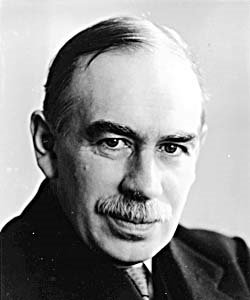
In the Concise Guide To Economics, author and economist Jim Cox correctly explains that the Multiplier is one of the major components of Keynesian policy. For those who still don’t know, Keynesian economics — named after the disastrously incorrect John Maynard Keynes — are what Barack Obama as well as George W. Bush (et al) espouse in full.

The following explanation of the Multiplier Theory, though exceptionally clear and cogent, gets a bit technical, but please read through it. It is short, and it is also crucial that everyone understands the degree to which economic illiteracy grips the political leaders who have power over us.

The multiplier effect can be defined as the greater resulting income generated from an initial increase in spending. (For example, an increase in spending of $100 will generate a total increase in income received of $500 as the initial income is respent by each succeeding recipient–these figures are based on an assumption that each income receiver spends 80% of his additional income and saves 20%, the formula being Multiplier = 1 / % Change in Saving.)

Fundamentally, the multiplier is theory run amok, as Henry Hazlitt has explained in The Failure of the New Economics:

If a community’s income, by definition, is equal to what it consumes plus what it invests, and if that community spends nine-tenths of its income on consumption and invests one-tenth, then its income must be ten times as great as its investment. If it spends nineteen-twentieths on consumption and invests one-twentieth, then its income must be twenty times as great as its investment….And so ad infinitum. These things are true simply because they are different ways of saying the same thing. The ordinary man in the street would understand this. But suppose you have a subtle man, trained in mathematics. He will then see that, given the fraction of the community’s income that goes into investment, the income itself can mathematically be called a “function” of that fraction. If investment is one-tenth of income, income will be ten times investment, etc. Then, by some wild leap, this “functional” and purely formal or terminological relationship is confused with a causal relationship. Next the causal relationship is stood on its head and the amazing conclusion emerges that the greater the proportion of income spent, and the smaller the fraction that represents investment, the more this investment must “multiply” itself to create the total income! p. 139

A bizarre but necessary implication of this theory is that a community which spends 100% of its income (and thus saves 0%) will have an infinite increase in its income–sure beats working!

A further reductio ad absurdum is provided by Hazlitt:

Let Y equal the income of the whole community. Let R equal your (the reader’s) income. Let V equal the income of everybody else. Then we find that V is a completely stable function of Y; whereas your income is the active, volatile, uncertain element in social income. Let us say the income arrived at is:

V = .99999 Y

Then, Y = .99999 Y + R

.00001 Y = R

Y = 100,000 R

Thus we see that your own personal multiplier is far more powerful than the investment multiplier, it is only necessary for the government to print a certain number of dollars and give them to you. Your spending will prime the pump for an increase in the national income 100,000 times as great as the amount of your spending itself. pp. 150 -151

The multiplier is based on a faulty theory of causation and is therefore in actuality nonexistent. Keynesians today will often admit to this but cling to their multiplier by citing the fact that it has a regional effect. Without them saying so explicitly, what this means is that if income is taken from citizens of Georgia and spent in Massachusetts it will benefit the Massachusetts economy(!).

The multiplier is an elaborate attempt to obfuscate the issues to excuse government spending. It and Keynesian theory are nothing more than an elaborate version of any monetary crank’s call for inflation; Keynes managed to dredge up the fallacies of the 17th century’s mercantilist views only to relabel them as the “new economics”!

(Link)

George W. Bush


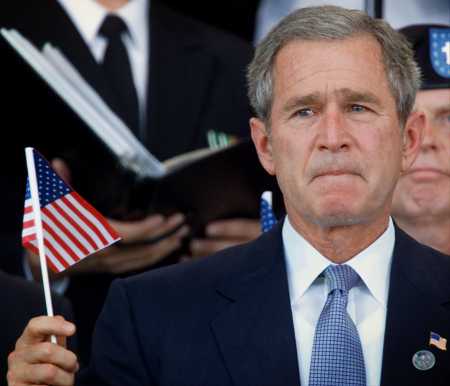
Under President George W. Bush, who was the Herbert Hoover of his day, appropriated government programs grew from $298 billion to $613 billion.

Under President George W. Bush, Social Security spending went from $406 billion to $662 billion.

Under President George W. Bush, Medicare spending went from $216 billion to $425 billion.
Under under President George W. Bush, Medicaid spending went from $117.9 billion to $259 billion.

Under President George W. Bush, “miscellaneous spending” went from $290 billion to $673 billion.

Under President George W. Bush, net interest dropped from $222.9 billion to $139 billion.

Under President George W. Bush, disaster cost went from $0 billion to $4 billion.

In George W. Bush’s eight years, government spending increased more than 55 percent.

Even when adjusted for inflation in constant dollars, federal expenditures under Bush soared by 29 percent.

During his Presidency, real Gross Domestic Product (GDP) only increased by 17.3 percent, and over the Bush years, real government spending went up nearly twice as fast as the actual U.S. economy.

The left should therefore be in love with George W. Bush. He, like his father and like Ronald Reagan, was a complete statist.

There’s more:

Under George W. Bush, Washington ran deficits almost every year. Total federal debt doubled and rose from 58 percent to 66 percent of GDP, for a 14 percent increase in taxpayer debt burden (in terms of the Gross Domestic Product).

Here’s a quick rundown:

• Payment for Individuals: $1054.6 billion in the year 2000 to $1397.1 billion in the year 2007.

• Social Security and Railroad Retirement: $410.5 billion in the year 2000 to $487.7 billion in the year 2007.

• Federal Employees Retirement and Insurance: $100.3 billion in the year 2000 to $116.0 billion in the year 2007.

• Unemployment Insurance: 21.1 billion in the year 2000 to 27.1 billion in the year 2007.

• Medical Care: $362.7 billion in the year 2000 to $559.9 billion in the year 2007.

• Student Assistance: $10.9 billion in the year 2000 to $24.9 billion in the year 2007.

• Housing Assistance: $24.1 billion in the year 2000 to $27.0 billion in the year 2007.

• Food and Nutrition Assistance: $32.4 billion in the year 2000 to $46.3 billion in the year 2007.

• Public Assistance and Related Programs: $88.3 billion in 2000 to $103.4 billion in 2007.

• Other Transfers to Individuals: $4.3 billion in 2000 to $4.7 billion in 2007.

Of course, there was also the $700 billion Troubled Relief Assets Program (also known as the TARP bailout), and yet if you think these figures are difficult to fathom and the expenditures over-the-top, I assure you they do not even begin to compare to the massive spending apparatus that Barack Obama has unleashed.

Indeed, next to Barack Obama, George W. Bush’s reckless spending is downright frugal.



New Entries

Newest comments

  • Nick: Most definitely.
  • Ray: Right?
  • Nick: Wow.
  • Ray: Thank you, Dale. It’s good to hear from you.
  • Dale: Okay, well, maybe the cave smelled like wine… maybe Dale just reacted to sensory evidence. Fun couple of...
  • Dale: The faces of stupid. Check out Corsi’s book on the usurper, who is most clearly not a natural born...
  • Maura: A bit like Zombie Apocalypse!
  • Ray: Green crap? Really? What exactly do you mean? Did you guys have tea?

Categories

Monthly Archives

Search


rayharvey.org Bio  |  Books  |  Contact  |  Blog

Back to top