Category: Capitalism


Communism, Socialism, And Welfare Statism

May 12th, 2010 — 8:40pm

A reader writes:

Dear Mr. Harvey: What is the difference between communism, democratic socialism, and welfare statism?

– Sincerely Confused

Dear Sincerely Confused: First of all, Mr. Harvey is my dad. Please call me Ray.

Communism is a species of the genus socialism; it is one of the many variations on that tired theme. Communism explicitly calls for the violent overthrow of government. In theory, it is an anarchist ideology, believing that the state will one day magically “wither away,” as Karl Marx famously phrased it, though only after an unspecified period of gigantic bureaucratic control. Of course, in the long and blood-soaked history of communism, the state has never withered away, and never will. Why? Once entrenched, bureaucracy is impossible to retrogress away from.

Democratic socialism, on the other hand, doesn’t advocate the violent overthrow of government but intends to use force peacefully. By definition, by its very nature, socialism must resort to force because it must expropriate people’s money and other property in order to redistribute it. That is the distinguishing characteristic of any and all forms of socialism: government control of property and the means of production (which is one of the reasons so-called corporatism is another variation on socialism).

One must never forget: socialism is by definition an ideology of force.

Not all liberals are socialists — in large part because most of them don’t even know what “socialism” means, and it is for this reason also that many liberals, and, for that matter, many conservatives, are socialists and do not even know it.

Welfare statism is not exactly the same thing as democratic socialism. Welfare statism wants all the wealth and advantages that capitalism and private property creates, but at the same time, it wants to undermine the very things that makes all that wealth possible. Welfare statism takes for granted the advantages of capitalism — it wants to hold power over the producers of wealth — yet it wants those same wealth-producers to keep producing it for them. It is a short-sighted ideology the prevalence of which dominates academia from sea to shining sea.

The welfare state, which is what we live in today and have for some time, is the result of what von Mises called the “hampered or mixed market economy.” It is not identical to socialism proper, primarily because it is not explicit enough, but it too is a variation on the same theme.


4 comments » | Capitalism, Political philosophy, communism, socialism

The Hard Rock Miner

April 28th, 2010 — 1:05am

The hard rock miner died last night, a beefy man, a strong man, with the soft-sad eyes of a thoughtful child.

His name was Neil. He’d been a miner most of his life. He chewed Copenhagen and played guitar (he loved hard rock). In Vietnam he’d been awarded the Silver Star for an act of great courage.

After the war, at twenty-five, he went to work in a uranium mine outside Moab called The Gentleman Sloan. Two years later, he moved into the coal-mining country of east-central Wyoming. Then, at age thirty-one, he drove into the spiky mountains of southwestern Colorado and began working in a gold mine called The Equity, which is where he remained for the rest of his life.

His end began suddenly, less than ten months ago, when he was only fifty-eight-years-old. He found, one unforgettable evening, a terrifying eruption of crystal-like growths all along his ribcage. His doctors punched cylindrical core samples out his skin. They drilled him full of holes and loaded him with tubes like tiny sticks of dynamite, blasting caps of pinkish-blue. Cancer is what they found. Cancer blooming like clusters of quartz everywhere beneath his skin.

The strangeness of this was not lost on him: that something so small could take down a man his size—a man so living and vital, a man, in short, like him. He hadn’t expected to die this way. He thought his end would come in the cold dark caves among the echo-drip of black water, or from blacklung.

Or perhaps on his way home from work one star-sprent frozen night, a wall of white would come pounding down out of the galactic blackness above, building in a moment a skyscraper of snow atop him and his jeep. But it had not been so.

Enraged, he cursed at first. And overnight his skin went totally slack, the flesh about the bones—a padding—melting like candlewax. His temples grew indrawn, clustered with silver veins. For reasons the doctors could not explain, the cave of his mouth began to morph so that his palate became a ceiling of ribbed rock, tasting of sulfur and sprouting miniature stalactites of limey tissue, or bone. The gold-and-copper of his hair, which had lasted him his whole life, now faded to galena threads, threads of winking lead.

Over the years, the mines had exacted heavy tolls upon his health, as mines so often will. A chronic cough plagued him the last decade of his life. He had poor blood circulation, his veins dying like underground streams inside his skin, and his skin, from head-to-toe, transparent, mica-thin.

Twenty years previous, on a cold autumn morning, while he was exploring an abandoned shaft, he was brought up short by an iron fist clenching inside his chest; it sent him running back in the direction he had come. He’d barely made it. Lack of oxygen, they said, had caused a small heart attack. Thereafter his “ticker” (as he termed it) was never again the same.

And who could forget the time, early on in his mining career, when a stone slab the size of a boxcar busted loose from the low rock ceiling above and mashed him face-first into the soggy ground. He lay like that for two days and two nights, unable to move at all, while his headlamp subsided into ultimate black, and he, half-delirious, heard the whole time the purling of underground streams rocking gently by. This, he thought, is it; this is how I die.

His rescuers told him later that the softness of the earth and the freezing cold had, in part, saved him, but mainly, they whispered among themselves, it was the sheer strength of his will, and the strength of his muscle and bone.

Still, for all this, he loved his work. He loved the whole lifestyle, loved it with his body and soul. He loved the sound of sluicing water, the smell of wet mineral and adamantine stone. He loved the vitreous air where he worked (and worked), the air itself exuding sparseness, the reek of ozone and pine. He loved the sandy tailing ponds, their poisonous waters, the sound of the ravens grokking at him from the firs all around the mine, and the firs themselves stunted and dark and weird, crepitating with human-like moans. He loved all the magpie and the chipmunks and the fat brown marmots – “whistle pigs,” he called them – sunning themselves in the sharp western sunlight the short summers long; he loved the arsenic-burned rocks they scorched their bellies on.

He loved the massive gray shadows that tilted the ground, and the white dusty earth that the ubiquitous mountains cast their shadows upon.

He loved Sugarloaf peak in spring, with its necktie of mist and wig of snow, and the ragged mountains beyond poking the sky – and that sky forever, in his memory, tarnished like zinc, or a verdigris stone.

The rarified air he could never get enough of: the glassy gales in autumn and the mean winter wind pouring down from the milky sky above, rushing through the conifers in sporadic bursts and blowing the black cliffs bare of vapor and snow, showing naked chines of rock – rock everywhere, the smell of rock, rock rearing up into the high-altitude air, angular walls all along the roads that led up to the mines.

To him this was worth ten years of life.

And his life was not yours, or mine.

Our final meeting came on my last day of work, before I moved out of the San Juans for good. He was just coming on shift, swing. He stood at the entrance of the shaft, half turned away. A long shadow from the mouth of the cave fell diagonally across him, and in his hardhat and yellow slicker, the hard rock miner looked like one about ready to fight fires, or cyclones. His headlamp was not turned on yet. His boots were covered in year-old muck; his gloves poked partially out his bib. For some reason, then, I do not know why, he turned to me and waved goodbye. Then he swiveled back around and lumbered alone into the black dripping shaft, where no light shone at all, and then he disappeared forever from my site,
underground.


5 comments » | America, Capitalism

Trivia

April 24th, 2010 — 8:35pm

The United States is not a democracy and was never intended to be. Democracy means majority rule. The rights of each individual, however, regardless of race, sex, sexual orientation, color, class, or creed, are inalienable in the literal sense (i.e. cannot be transferred, revoked, or be made alien) and are thus never subject to vote or the “whims of the majority.”

Which is why the word “democracy” does not appear one time in either the Constitution or the Declaration of Independence.

The United States is, as Benjamin Franklin said, a Constitutional Republic.

Calvin Coolidge had a pet pygmy hippo, which he kept in the White House.

Whereas Teddy Roosevelt kept a pet hyena.

Ronald Reagan was once given an honorary doctorate in professional football.

The largest scientific study ever conducted on acid rain (National Acid Precipitation Assessment Program, Integrated Assessment, External Review Draft) didn’t find any real evidence that acid rain destroys forests.

As a teaching method, the National Wildlife Federation routinely had students dump highly acidic water on plants to, quote, “simulate acid rain.” Thus, when the plants died, the kids naturally assumed that acid rain kills forests in this same manner.

In 1992, a man in Carson City, Nevada, ran in the Democratic primarily as, quote, “God Almighty!” And did not win.

Dichloro-diphenyl-trichloroethane (DDT) was invented to protect American troops in WWII from insect-borne disease.

Despite numerous studies, DDT has never once been shown to be harmful. On the contrary, it has saved more lives than any other chemical invention in the history of the world, with the possible exception of antibiotics.

One spraying of DDT lasts longer than all other pesticides combined. Which is one of the many reasons mosquitoes are less resistant to it.

Since DDT was banned, more pesticides are now required, because none are as effective as DDT.

Which is one of the biggest reasons malaria has come back with such a vengeance.

During the final rush to get the first shipment of DDT out the door to American Troops, a valve at the bottom of a large vessel of DDT accidentally came open. Chemist Joseph Jacobs, who was standing under the vessel when it opened, was covered with hot DDT. “When it dried,” he says, in his autobiography, The Anatomy of an Entrepreneur, “I had DDT an inch thick all over me. In my hair, in my ears, and in my mouth and nose. I took off my clothes, showered, and scrubbed, but probably ingested more DDT during that one incident than is today considered safe to absorb over many years.”

Rachel Carson, author of Silent Spring, which singlehandedly succeeded in getting DDT banned, believed that one touch of DDT could kill you.

Chemist Joseph Jacobs lived another sixty years with no adverse health effects whatsoever.

Joseph Jacobs routinely lectured on the utter safety of DDT. In fact, he began each lecture by eating a spoonful of raw DDT at the podium.

He was awarded the Nobel Prize for his DDT work and was eighty-eight when he died, in 2004.

“In all the previous wars of history,” wrote chemical engineer O.T. Zimmerman, in 1946, “the louse [singular for lice] has killed more men than ever died from bullets, swords, or other weapons.”

The Audubon Society, though sympathetic to Rachel Carson’s claims, has stated publicly that no extinction or significant loss to bird populations came about through the use of DDT: “of the 40 birds Carson said might by now be extinct or nearly so, 19 have stable populations, 14 have increasing populations, and 7 are declining” (Easterbrook, 1995, p. 82). It should be noted furthermore that the 7 listed as “declining” declined only slightly, and not through any demonstrable link with DDT.

After President Bush senior banned broccoli from the White House in 1990, California broccoli growers delivered nine tons of it to Washington DC.

Science is in large part government-funded. Thus, scientists improve their access to research money if they can show politicians that they are “saving the planet.”

Statistically speaking, scientists who don’t propagate the fear-factor receive far less money than those who do, regardless of the actual truth.

Melvin Shapiro, for instance, head of research at the National Oceanic and Atmospheric Administration, told Insight Magazine: “If there were no dollars attached to the game, you’d see it played on intellect and integrity. When you say the ozone threat is a scam, you’re not only attacking people’s scientific integrity, you’re going after their pocketbook as well.”

After that interview, Shapiro stopped taking phone calls. Word circulated that his supervisors censored him for fear of hurting their own funding.

Bureaucrats realize this as well: “When the Superfund Law was passed in 1980 … the EPA’s budget went up almost instantly by hundreds of millions of dollars, and ultimately billions…. The EPA administrator actively campaigned for the Superfund Law…. And, in fact, the law that emerged was largely written by members of the agency” (Facts Not Fear, p. 8).

The Superfund Law has achieved next to nothing — apart, that is, from spending billions in taxpayer dollars.

George Washington carried a sundial instead of a watch to tell time.

More timber grows each year than is cut.

“In the time it takes you to read this letter, nine hundred acres of rainforest will have been destroyed forever,” said Russell E. Train, of the World Wildlife Fund & The Conservation Foundation, back in 1992, a complete fiction, we now know.

The famous statement made by biologist Norman Myers, which sent environmentalists everywhere scurrying to their soapboxes, that “2 percent of all tropical forest was being destroyed per year,” and that by “2000 we will have lost a third of the world’s tropical forest” (Myers cited in Goudie 1993:46.), has proved inanely inaccurate.

The Food and Agriculture Organization (FAO) puts tropical deforestation in the 1980s at 0.8 percent. In 2001, satellite imagery, which is precise, shows that tropical deforestation had declined to 0.46 percent.

Lack of property rights — i.e. private property — makes tropical deforestation worse.

The snows of Kilimanjaro, one of Al Gore’s pet props, have been receding for a very long time, a well-known fact among scientists, who, additionally, are also quick to note that the temperature on Kilimanjaro has not been going up. Why, then, the recession of Kilimanjaro’s snows? Ice requires cold and moisture. And it’s precisely the latter that’s lacking.

As climate scientist Robert Balling says: “Gore does not acknowledge the two major articles on the subject published in 2004 in the International Journal of Climatology and the Journal of Geophysical Research showing that modern glacier retreat on Kilimanjaro was initiated by a reduction in precipitation at the end of the nineteenth century and not by local or global warming.”

I.e. the local climate shift on Kilimanjaro began a century ago.

About a decade ago, Doctor R.J. Braithwaite wrote an article that appeared in Progress in Physical Geography.

In that article, which was peer-reviewed, Doctor Braithwaite tells us how he analyzed 246 glaciers, sampled from both hemispheres and latitudes, between the years 1946 and 1995. This “mass balance analysis” he conducted found that “some glaciers were melting, while a nearly equal number were growing in size, and still others remained stable.” Doctor Braithwaite’s unequivocal conclusion:

“There is no obvious common or global trend of increasing glacier melt in recent years.”

“By some estimates, 160,000 glaciers exist on Earth. Only 63,000 have been inventoried, and only a few hundred have been studied in the detail described by Braithwaite” (“It Would Be Nice to Know More about Ice,” Jay Lehr).

On the basis of that logical fallacy known as the fallacy of insufficient evidence, all glacier fears are stopped cold right there.

But in fact that’s only the tip of the iceberg.

Keith Echelmeyer, a glaciologist at the University of Alaska’s Geophysical Institute, says this:

“To make a case that glaciers are retreating, and that the problem is global warming, is very hard to do… The physics are very complex. There is much more involved than just the climate response.”

Mr. Echelmeyer goes on to tell us that in Alaska there are large glaciers advancing in the very same areas where others are retreating.

Quoting Doctor Martin Beniston of the Institute of Geography at the University of Fribourg, Switzerland:

Numerous climatological details of mountains are overlooked by the climate models, which thus makes it difficult to estimate the exact response of glaciers to global warming, because glacier dynamics are influenced by numerous factors other than climate, even though temperature and cloudiness may be the dominant controlling factors. According to the size, exposure and altitude of glaciers, different response times can be expected for the same climatic forcing.

According to the excellent glacier program at Rice University, those response times run something like this:

Ice sheet: 100,000 to 10,000 years

Large valley glacier: 10,000 to 1,000 years

Small valley glacier: 1,000 to 100 years

“Glaciers are influenced by a variety of local and regional natural phenomena that scientists do not fully comprehend. Besides temperature changes, glaciers also respond to changes in the amount and type of precipitation, changes in sea level and changes in ocean circulation patterns. As a result, glaciers do not necessarily advance during colder weather and retreat during warmer weather” (John Carlisle, National Center for Public Policy).

Grist magazine: There’s a lot of debate right now over the best way to communicate about global warming and get people motivated. Do you scare people or give them hope? What’s the right mix?

Al Gore: I think the answer to that depends on where your audience’s head is. In the United States of America, unfortunately we still live in a bubble of unreality. And the Category 5 denial is an enormous obstacle to any discussion of solutions. Nobody is interested in solutions if they don’t think there’s a problem. Given that starting point, I believe it is appropriate to have an over-representation of factual presentations on how dangerous it is, as a predicate for opening up the audience to listen to what the solutions are, and how hopeful it is that we are going to solve this crisis. Over time that mix will change. As the country comes to more accept the reality of the crisis, there’s going to be much more receptivity to a full-blown discussion of the solutions. (Source of this astonishing exchange: Grist Magazine[boldface mine].)

John Quincy Adams (1767-1848) was a foreign diplomat at age 14.

Teddy Roosevelt once delivered a one-hour speech, despite the fact that he had just been shot by a would-be assassin.

Quondam senator Barry Goldwater recommended peanut butter for shaving cream.

The tenth President of the United States, John Tyler (1790-1862), was unable to get a job after leaving office and so worked at a village pound tending cows and horses.

All the trash produced by the United States for the next one thousand years could fit into a landfill forty-four miles square by 120 feet deep—one tenth of 1 percent of all this country’s entire land area. (“A Consumer’s Guide to Environmental Myths and Realities,” Policy Report #99, National Center for Policy Analysis, Dallas, TX, September 1991, 3, quoting Clark Wiseman of Gonzaga University.)

“It is entirely possible that we may be the last generation of humans to know this wondrous earth as it was meant to be,” said the Sierra Club Legal Defense Fund, many years ago.

“Nearly every habitat is at risk,” said Time Magazine, almost two decades ago. “Swarms of people are running out of food and space …” Which is another statement that time and the facts have exposed as completely false. Thus:

Every man, woman, and child on the planet could fit shoulder-to-shoulder in a space no bigger than Jacksonville, Florida.

Article 1, Section 8, of the Constitution says Congress has only these powers. To borrow money (not the same thing as taxation); regulate commerce with foreign nations; establish rules for naturalization; coin money and fix standards of weights and measures; punish counterfeiting; establish a post office; promote science with patents; establish the lower courts; punish pirates; declare war; raise and support armies, but only for a term of two years; provide a navy; regulate naval and land forces; call forth the militia; and administer capital.

“It would be impossible to construct a logical argument that these powers permit the massive welfare state and regulatory state that exists today in America,” said Doctor Thomas Dilorenzo, in 2006.

“The United States is not a Christian Nation,” said President John Adams, in the Treaty of Tripoli.

“Private property is the guardian of every other right” said James Madison, the father of the Constitution.

“I precisely advocate the abolition of private property,” said Karl Marx.

“Capitalism is a social system based on the recognition of individual rights, including property rights, in which all property is privately owned,” said Ludwig von Mises.

“The only alternative to private property is government ownership — that is, socialism,” says Doctor Dilorenzo.

Peter Cooper, inventor of a gelatinous dessert called Jell-O, once ran for the Presidency of the United States.

And lost.


10 comments » | America, Capitalism, Political Trivia, Political philosophy, environmentalism

Earth Day

April 22nd, 2010 — 7:07pm

This year rather than celebrating Earth Day by advocating still more government bureaus, which will then determine for the rest of us what we can do with our property, let us instead celebrate the only real way to clean up and beautify the planet: private property rights and private stewardship.

From Chapter 2 of Leave Us Alone:

The right to property is, as James Madison said, “the guardian” of every other right. Freedom and private property are inseparable. Property is freedom: you cannot be free if you are not free to produce, use, and dispose of those things necessary to your life.

“Control the property, control the person,” said Lenin, correctly.

Property, like every other right, is first and foremost the right to act: specifically, it is the right to produce, exchange, and use.

“Property is not only money and other tangible things of value, but also includes any intangible right considered as a source or element of income or wealth…. It is the right to enjoy and to dispose of certain things in the most absolute manner” (Electric Law Library).

Money is property.

The only alternative to private property is government or communal ownership of property, both of which amount to the same thing in the end: a bureau of centralized planners controlling the property.

If you desire to know precisely what someone’s political viewpoint is, all you need do is find out his or her stance on property; for it is through the stance on property that the entire political philosophy is disclosed. You needn’t listen to anything anyone says about “freedom” or “liberty” or any of these other easy platitudes: no one in her or his right mind will go against those things. Instead, simply check the stance on property. If someone doesn’t believe in full private property rights, that person is, to the exact extent he or she denies private property rights, a statist.

Property is the sine-qua-non of human freedom.

To defend freedom, therefore, you must start by defending the unalienable right to property.

The diversity in the faculties of men, from which the rights of property originate, is not less an insuperable obstacle to a uniformity of interests. The protection of these faculties is the first object of government (James Madison, Federal Papers 10).

Government is instituted no less for protection of the PROPERTY, than of the persons (James Madison, Federalist Paper #54, emphasis in the original).

The true foundation of republican government is the equal right of every citizen in his person and property and in their management (Thomas Jefferson to Samuel Kercheval).

A right to property is founded in our natural wants, in the means with which we are endowed to satisfy these wants, and the right to what we acquire by those means without violating the similar rights of other sensible beings (Thomas Jefferson to Pierre Samuel Dupont de Nemours).

The political institutions of America, its various soils and climates, opened a certain resource to the unfortunate and to the enterprising of every country and insured to them the acquisition and free possession of property (Thomas Jefferson: Declaration on Taking Up Arms).

The moment the idea is admitted into society, that property is not as sacred as the laws of God and that there is not a force of law and public justice to protect it, anarchy and tyranny commence (John Adams).


Comment » | America, Capitalism, Property Rights, environmentalism

Middle-of-the-Road Policy Leads to Socialism

April 15th, 2010 — 9:02pm

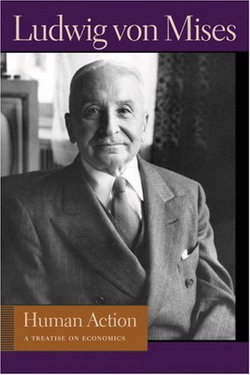
Economics deals with society’s fundamental problems; it concerns everyone and belongs to all. It is the main and proper study of every citizen (Ludwig von Mises, Human Action).

The following address was delivered before the University Club of New York, April 18, 1950, by Doctor Ludwig von Mises:

How Middle-of-the-Road Policy Leads to Socialism

The fundamental dogma of all brands of socialism and communism is that the market economy or capitalism is a system that hurts the vital interests of the immense majority of people for the sole benefit of a small minority of rugged individualists. It condemns the masses to progressing impoverishment. It brings about misery, slavery, oppression, degradation and exploitation of the working men, while it enriches a class of idle and useless parasites.

This doctrine was not the work of Karl Marx. It had been developed long before Marx entered the scene. Its most successful propagators were not the Marxian authors, but such men as Carlyle and Ruskin, the British Fabians, the German professors and the American Institutionalists. And it is a very significant fact that the correctness of this dogma was contested only by a few economists who were very soon silenced and barred from access to the universities, the press, the leadership of political parties and, first of all, public office. Public opinion by and large accepted the condemnation of capitalism without any reservation.

1. Socialism

But, of course, the practical political conclusions which people drew from this dogma were not uniform. One group declared that there is but one way to wipe out these evils, namely to abolish capitalism entirely. They advocate the substitution of public control of the means of production for private control. They aim at the establishment of what is called socialism, communism, planning, or state capitalism. All these terms signify the same thing. No longer should the consumers, by their buying and abstention from buying, determine what should be produced, in what quantity and of what quality. Henceforth a central authority alone should direct all production activities.

2. Interventionism, Allegedly a Middle-of-the-Road Policy

A second group seems to be less radical. They reject socialism no less than capitalism. They recommend a third system, which, as they say, is as far from capitalism as it is from socialism, which as a third system of society’s economic organization, stands midway between the two other systems, and while retaining the advantages of both, avoids the disadvantages inherent in each. This third system is known as the system of interventionism. In the terminology of American politics it is often referred to as the middle-of-the-road policy. What makes this third system popular with many people is the particular way they choose to look upon the problems involved. As they see it, two classes, the capitalists and entrepreneurs on the one hand and the wage earners on the other hand, are arguing about the distribution of the yield of capital and entrepreneurial activities. Both parties are claiming the whole cake for themselves. Now, suggest these mediators, let us make peace by splitting the disputed value equally between the two classes. The State as an impartial arbiter should interfere, and should curb the greed of the capitalists and assign a part of the profits to the working classes. Thus it will be possible to dethrone the moloch capitalism without enthroning the moloch of totalitarian socialism.

Yet this mode of judging the issue is entirely fallacious. The antagonism between capitalism and socialism is not a dispute about the distribution of booty. It is a controversy about which two schemes for society’s economic organization, capitalism or socialism, is conducive to the better attainment of those ends which all people consider as the ultimate aim of activities commonly called economic, viz., the best possible supply of useful commodities and services. Capitalism wants to attain these ends by private enterprise and initiative, subject to the supremacy of the public’s buying and abstention from buying on the market. The socialists want to substitute the unique plan of a central authority for the plans of the various individuals. They want to put in place of what Marx called the “anarchy of production” the exclusive monopoly of the government. The antagonism does not refer to the mode of distributing a fixed amount of amenities. It refers to the mode of producing all those goods which people want to enjoy.

The conflict of the two principles is irreconcilable and does not allow for any compromise. Control is indivisible. Either the consumers’ demand as manifested on the market decides for what purposes and how the factors of production should be employed, or the government takes care of these matters. There is nothing that could mitigate the opposition between these two contradictory principles. They preclude each other. Interventionism is not a golden mean between capitalism and socialism. It is the design of a third system of society’s economic organization and must be appreciated as such.

3. How Interventionism Works

It is not the task of today’s discussion to raise any questions about the merits either of capitalism or of socialism. I am dealing today with interventionism alone. And I do not intend to enter into an arbitrary evaluation of interventionism from any preconceived point of view. My only concern is to show how interventionism works and whether or not it can be considered as a pattern of a permanent system for society’s economic organization.

The interventionists emphasize that they plan to retain private ownership of the means of production, entrepreneurship and market exchange. But, they go on to say, it is peremptory to prevent these capitalist institutions from spreading havoc and unfairly exploiting the majority of people. It is the duty of government to restrain, by orders and prohibitions, the greed of the propertied classes lest their acquisitiveness harm the poorer classes. Unhampered or laissez-faire capitalism is an evil. But in order to eliminate its evils, there is no need to abolish capitalism entirely. It is possible to improve the capitalist system by government interference with the actions of the capitalists and entrepreneurs. Such government regulation and regimentation of business is the only method to keep off totalitarian socialism and to salvage those features of capitalism which are worth preserving.

On the ground of this philosophy, the interventionists advocate a galaxy of various measures. Let us pick out one of them, the very popular scheme of price control.

4. How Price Control Leads to Socialism

The government believes that the price of a definite commodity, e.g., milk, is too high. It wants to make it possible for the poor to give their children more milk. Thus it resorts to a price ceiling and fixes the price of milk at a lower rate than that prevailing on the free market. The result is that the marginal producers of milk, those producing at the highest cost, now incur losses. As no individual farmer or businessman can go on producing at a loss, these marginal producers stop producing and selling milk on the market. They will use their cows and their skill for other more profitable purposes. They will, for example, produce butter, cheese or meat. There will be less milk available for the consumers, not more.

This, or course, is contrary to the intentions of the government. It wanted to make it easier for some people to buy more milk. But, as an outcome of its interference, the supply available drops. The measure proves abortive from the very point of view of the government and the groups it was eager to favor. It brings about a state of affairs, which again, from the point of view of the government, is even less desirable than the previous state of affairs which it was designed to improve.

Now, the government is faced with an alternative. It can abrogate its decree and refrain from any further endeavors to control the price of milk. But if it insists upon its intention to
keep the price of milk below the rate the unhampered market would have determined and wants nonetheless to avoid a drop in the supply of milk, it must try to eliminate the causes
that render the marginal producers’ business unremunerative.

It must add to the first decree concerning only the price of milk a second decree fixing the prices of the factors of production necessary for the production of milk at such a low rate that the marginal producers of milk will no longer suffer losses and will therefore abstain from restricting output. But then the same story repeats itself on a remoter plane. The
supply of the factors of production required for the production of milk drops, and again the government is back where it started. If it does not want to admit defeat and to abstain from any meddling with prices, it must push further and fix the prices of those factors of production which are needed for the production of the factors necessary for the production of milk. Thus the government is forced to go further and further, fixing step by step the prices of all consumers’ goods and of all factors of production, both human, i.e., labor, and material, and to order every entrepreneur and every worker to continue work at these
prices and wages.

No branch of industry can be omitted from this all-round fixing of prices and wages and from this obligation to produce those quantities which the government wants to see produced. If some branches were to be left free out of regard for the fact that they produce only goods qualified as non-vital or even as luxuries, capital and labor would tend to flow into them and the result would be a drop in the supply of those goods, the prices of which government has fixed precisely because it considers them as indispensable for the satisfaction of the needs of the masses. But when this state of all-round control of business is attained, there can no longer be any question of a market economy. No longer do the citizens by their buying and abstention from buying determine what should be produced and how.

The power to decide these matters has devolved upon the government. This is no longer capitalism; it is all-round planning by the government, it is socialism.

Please read the rest of this brief but edifying essay here.


3 comments » | Capitalism, socialism

Waitress

April 1st, 2010 — 6:49pm

Full many a flower is born to blush unseen and waste its sweetness on the desert air (Thomas Gray “Elegy Written in a Country Churchyard”).

She works in a diner called the Desert Rose on the northwestern edge of Colorado, near the Utah border. The diner is small and undistinguished, clean and lit up in an American wasteland. Triangles of cherry sit bleeding in the pie case and honey-yellow flypaper spirals back and forth above the cash register. She grew up in a mountain town, drinking beer and smoking cigarettes with all the other small-town girls and boys. She began working when she was in the 11th grade, and she’s not stopped working since. Waiting tables is what she’s done for most of her life. She graduated high school but never matriculated. After school, she drifted; where she lives now is not where she grew up.

By age thirty, she’d already buried two husbands, both miners, one killed in a car crash. No longer young, she is not yet old, and she is pretty still. She’s single. She has two teenage children who love her. She smokes mentholated cigarettes and rents an apartment too small for three, but it’s what she can afford.

There have been other jobs – night auditor, bankteller, housecleaner – but waitressing is the one she always comes back to. There are no special skills in her repertoire, no trade. She’s reasonably well-read, her mind is of a naturally speculative cast. At twilight she invariably feels a sense of sadness creep over her.

Fifty feet behind the Desert Rose, a cluster of cottonwoods grows along the banks of a sloppy canal. They are ancient and massive trees. Wind moves sluggishly through their dusty boughs. Moonlike globes of cotton orbit the bodies of the trees and fall soundlessly into the molecular green water. Sparse grass grows along the desert floor, and the desert stretches off into an intricate horizon. At the end of her shift, she likes to stand at the back porch of the café and listen to the wind sifting softly through the grass. Pretty blue flowers grow among the stalks, and she feels them wasting their sweetness on the desert air. The bone-colored moon rises in the east and fills a small quadrant of the sky, suffusing the clouds with its yellow and sulfurous light.


1 comment » | America, Capitalism

Myths About Markets

March 31st, 2010 — 7:21pm

There are approximately twenty million myths about markets and market capitalism, one of the most common being this:

Markets don’t work well (or are inefficient) when there are negative or positive “externalities.”

Here’s how Tom Palmer, philosopher and economist, bunks that canard:

The mere existence of an externality is no argument for having the state take over some activity or displace private choices. Fashionable clothes and good grooming generate plenty of positive externalities, as others admire those who are well clothed or groomed, but that’s no reason to turn choice of or provision of clothing and grooming over to the state. Gardening, architecture, and many other activities generate positive externalities on others, but people undertake to beautify their gardens and their building just the same. In all those cases, the benefits to the producers alone — including the approbations of those on whom the positive externalities are showered — are sufficient to induce them to produce the goods. In other cases, such as the provision of television and radio broadcasts, the public good is “tied” to the provision of other goods, such as advertising for firms….

More commonly, however, it is the existence of NEGATIVE externalities that leads people to question the efficacy or justice of market mechanisms. Pollution is the most commonly cited example. If a producer can produce products profitably because he or she imposes the costs of production on others who have not consented to be a part of the production process, say, by throwing huge amounts of smoke into the air or chemicals into a river, he will probably do so. Those who breathe the air or drink the toxic water will bear the costs of producing the product, while the producer will get the benefits from the sale of the product. The problem in such cases, however, is not that markets have failed, but that they are absent. Markets rest on private property and cannot function when property rights are not defined or enforced. Cases of pollution are precisely cases not of market failure but of government failure to define and defend the property rights of others, such as those who breathe polluted air, or drink polluted water (source).

Under true laissez-faire capitalism, in other words, which is the only system that fully protects property and person — thereby forbidding the instigation of force in any form — you are not allowed to poison anyone.

In a socialistic, protectionist society, such as the one we now live in, no such rule of law exists because property is not regarded as private but communal.

The proof is ultimately in the water.


14 comments » | Capitalism, Water, economics, environmentalism

How Capitalism Enriches The Poor And The Working Class

March 20th, 2010 — 2:26am

When portable radios first appeared in American stores, the average American worker had to labor 13 hours to buy one; today he or she toils for about 1 hour.

In the 1920s it took 79 hours of work to buy a nice men’s suit; today it takes less than half that.

At the beginning of the twentieth century the average American family spent three-quarters of its income on food, clothing, and shelter; today it spends about one-third on those items, and spends and even greater proportion on taxes (source).

That principle is the exact principle whereby capitalism enriches any and every society that implements it.

The insidious myth that capitalism “exploits the workers” while a few capitalist pigs get rich at the workers’ expense is a canard that’s been bunked a billion times.

But there’s even more:

Electric light was first deployed along Pearl Street in downtown Manhattan in 1882, powered by America’s first commercial electric grid. Electric lighting initially cost much more than gas lighting (the dominant form of lighting at the time) and was available only to multi-millionaire JP Morgan and a handful of businesses in New York’s financial district. By 1932, however, the price of electricity had fallen to one-third its former level, and 70 percent of Americans had electricity. Within fifty years of Edison introducing the electric grid, gas light was all but forgotten, and electricity emerged as the power source for the masses. Electricity not only provided clean, odorless, and safe lighting compared to its predecessor; it also powered refrigerators, fans, heaters, irons, and ovens, and it quickly became the dominant source of motive power in factories (source).

Capitalism lowers the cost of every new technology. It does so by taking products — cars, cotton, electricity, phones, computers, it doesn’t matter — and through constant innovation and the ingenuity that free markets foster, mass producing these items, which lowers and lowers the costs. That is why in this country even those below the poverty level own televisions, phones, microwaves, toasters, and so on. That is why no one starves to death in the United States.

The locus of wealth is production and free exchange. The locus of production and free exchange is private property. And that is why private property is the most important ingredient to capitalism.

Consider that government cannot redistribute or spend a single penny without first either taxing, borrowing, or printing, all three of which deplete real wealth. In this way, government intervention, in any of its multifarious forms, is by definition self-defeating: It can only end in wealth destruction. It’s also why labor unions cannot, over the long run, increase real wages and living standards, and only advances in technology can.

“Historically, real wages (wages adjusted for the effects of inflation) rose at about 2 percent per year before the advent of unions, and at a similar rate afterward” (Morgan Reynolds, Power and Privilege: Labor Unions in America, 1984).

Says Dr. Dilorezo:

If labor unions were responsible for the historical rise in wages, then the solution to world poverty would be self-evident: unionize all the poorest nations on earth. [And yet] private-sector unions reached their peak in terms of membership in the 1950s, when they accounted for about a third of the workforce. Today, they represent barely 10 percent of the private-sector workforce. All during this time of declining union memberships, influence, and power, wages and living standards have risen substantially. All of the ‘declining industries’ in America from the 1970s on tended to be the highly unionized ones, whereas the growing industries, especially in the high-technology fields, are almost exclusively nonunion. At best, unions can improve the standards of living of some of their members, but only at the expense of other, nonunion workers, consumers, and others. When unions use their power to go on strike, or threaten to strike, and succeed in increasing their members’ wages above what they could earn on the free market, they inevitably cause some union members to lose their jobs.

The reason? When wages rise, it makes labor more costly; therefore, to keep turning a profit, employers simply cannot employ as many workers.


23 comments » | America, Capitalism

Vasily Grossman

March 12th, 2010 — 6:00pm

The following is from Chapter 30 of Leave Us Alone — A Capitalist Credo:

The Russian writer Vasily Grossman was born in 1905 in what is now the Ukrainian town of Berdichev. At that time, Berdichev was still part of the Russian Empire. Vasily Grossman attended high school in Kiev and then the University of Moscow. He graduated from University in 1929 with a degree in chemical engineering. He worked as an engineer for five years, after which he devoted himself to writing full-time.

He published his first news article in 1928, his first fictional story in 1934.

During the middle and latter 1930’s Vasily Grossman was exceptionally prolific, and even more so after the start of World War II. At that point he became a correspondent for Red Star (Krasnaya Zvezda). He spent the entire war on the treacherous front, covering the blood-soaked siege of Stalingrad in minute detail. In popularity his war reportage was second to none (well, maybe one: the famous Ehrenburg), and Grossman is loosely portrayed by actor Joseph Fiennes in the inaccurate movie Enemy at the Gates.

In his youth and well into his thirties, Vasily Grossman was devoted to the communist philosophy. But during and immediately after the war, he became increasingly disillusioned with the socialist system, so that, starting in 1943, he began explicitly challenging the whole Soviet ideal — both for its repression of freedom and for its anti-Semitism.

His war fiction at this time also began to generate criticism from high Soviet officials. In a matter of months, thus, his writings were suppressed. Over the course of his latter years, Vasily Grossman became an outright opponent of socialism. His writings are, at times, not consistently, among the most eloquent expression of freedom of any person in any era.

Stomach cancer killed him in 1964.

What follows is a short passage from his last novel Forever Flowing. It is one side of a brief dialogue spoken, in part, by the novel’s protagonist Ivan Grigoryevich, who has just been released from the Russian Gulag, after thirty years of imprisonment. I quote it as a tribute to freedom, to be sure, but also as a tribute to the man who came to understand the philosophical roots of freedom — and that in a country where freedom was not allowed; in a country where philosophies and freedom were replaced by blind obedience and dogma. It’s important that people like Vasily Grossman are not forgotten.
Please think of the following passage the next time you hear an environmentalist talk about more centralized government and more government ownership of land for the sake of “our endangered environment.”

Please think of it next time you see someone wearing a Che Guevara T-shirt (or necklace) in glorification of Che Guevara’s communistic ideals, or romanticizing communist Cuba and Castro for their healthcare system, or Chairman Mao with the blood of billions on his hands:

I used to think freedom was freedom of speech, freedom of press, freedom of conscience. But freedom is the whole life of everyone. Here is what it amounts to: you have to have the right to sow what you wish to, to make shoes or coats, to bake into bread the flour ground from the grain you have sown, and to sell it or not sell it as you wish; for the lathe operator, the steelworker, and the artist it’s a matter of being able to live as you wish and work as you wish and not as they order you to. And in our country there is no freedom – not for those who write books nor for those who sow grain nor for those who make shoes.

Forever Flowing

Vasily Grossman (1905–1964)


Comment » | Capitalism, communism, socialism

Are Organic Foods Worth The Price?

March 5th, 2010 — 9:27am

In February of 2007, the Los Angeles Times ran an article that said, among other things, the following:

Since 1989, when organic-food activists raised a [bunked] nationwide scare over the pesticide alar in apples, many scientists have seethed quietly at what they perceive as a campaign of scare tactics, innuendo and shoddy science perpetrated by organic food producers and their allies.

Indeed, organic food activists are increasingly open about their fraudulent agenda. Organic Valley Marketing Director Theresa Marquez, for instance, laid out, in no uncertain terms, her strategy of falsifying data to dupe the masses into thinking organics are worth their premium price:

“We think it’s important that people pay more for food,” she said. “The question is: ‘Will consumers pay more for that?’ and ‘How can we convince them to do that?’”

And yet: “Organic food has no higher nutritional value compared to conventional food,” says Nutrition and Diet Professor Tom Sanders, of Kings College London.

Which is hardly news, however.

In fact, Professor Sanders is merely echoing what science has been saying for years.

The only people who really disagree are environmental groups and animal rights activists, with all their agendas and quackery — in response to which quackery, food science professor Joseph Rosen, of Rutgers University, says this: “Most [of their studies] are not designed, conducted or published according to accepted scientific standards, and many were done by groups that openly promote organic foods.”

Where, then, is all the proof that organic food is better and better for you?

“The short answer, food safety and nutrition scientists say, is that such proof does not exist” (Los Angeles Times, February, 2007).

Indeed, the very word “organic” has been commandeered by phonies, so that the term, which was once legitimate, has now become a conceptual void. Quoting, at length, the erudite R.I. Throckmorton, Dean of Kansas State College:

This cult has sought to appropriate a good word “organic,” and has twisted its meaning to cover a whole crazy doctrine. The facts are that organic matter in its true sense is an important component of the soil — but soil fertility and the kind of crops you grow on a soil are not determined by humus alone.

Soil fertility is determined by the amount of active organic matter, the amount of available mineral nutrients, the activities of soil organisms, chemical activities in the soil solution and the physical condition of the soil. Ever since we have had soil scientists, they have recognized the values of organic matter. The loss of soil humus through cultivation has long been a matter of concern. So the faddists have nothing new to offer on that score.

Organic matter is often called “the life of the soil” because it supplies most of the food needs of the soil organisms which aid in changing nonavailable plant food materials into forms-that are available to the plants, and contains small quantities of practically all plant nutrients….

The antichemical-fertilizer doctrine makes a great point of the fact that plant food in organic matter is in a “natural” form, while in chemical form fertilizer it is “unnatural” and thus supposedly is harmful, if not downright poisonous. The logic of this escapes me. Science completely disproved the conclusion. The facts are that any plant foods, whether from organic matter, or from a bag of commercial fertilizer, necessarily came from Nature in the first place. Why is one more “natural” than another?

A Plant takes in a given nutrient in the same chemical form whether it came from organic matter, or from a bag of commercial fertilizer. The facts are that practically all plant-food elements carried by organic matter are not used in their organic form; they are changed by microorganisms to the simple chemical forms which the plants can use — the same form in which these elements become available to plants when applied as chemical fertilizers. For example, it is foolish to say that nitrogen in commercial fertilizer is “poisonous” while nitrogen from organic matter is beneficial. The basic nitrogen is the same in either case (“The Organic Farming Myths,” R.I. Throckmorton).

Muck soil, as it’s called, holds as much as 50 percent organic matter — “organic” in the real sense of the word — and yet, according to organic pseudoscience, “You could do little to improve such soils.”

But in fact all that these soils need is fertilizer, as Doctor J.F. Davis, of Michigan State University, discovered:

The yield of wheat on unfertilized muck soils was 5.7 bushels an acre, while the yield on plots receiving the chemical phosphorus and potash was 29.2 bushels per acre. The yield of potatoes was increased from 97 bushels an acre with no treatment, to 697 with commercial fertilizer carrying phosphorus and potash. Cabbage yields were boosted by the same means from 1/2 ton to 27 tons.

And if you believe, as many people do, that “inorganic” food contains more cancer-causing pesticides, think again:

It’s a well-known fact that so-called organic farmers routinely spray pesticides on crops — albeit naturally occurring pesticides — one of which, pyrethrum, the Environmental Protection Agency (EPA) has classified as a “likely human carcinogen.”

This, along with a number of other findings, calls into question the very philosophy behind “organic farming.” Beware the scare-mongering, I beg. Read this exceptionally well-written article, from an exceptionally well-informed lady.

For a long time now, environmentalists have alleged that organic food is healthier. In addition to this, environmentalists have told us over and over that organic farming is better for the environment because our laid-back green farmers use no “synthetic” pesticides.

What they don’t tell you, however, is that these same laid-back organic farmers are permitted to use (”permitted” in the sense that they can spray with it and still qualify as “organic”) a number of so-called natural chemicals to kill pests, which natural chemicals are neither as expedient nor as purely benign as you might think. For instance, it was discovered almost a decade ago, in the year 1999, that rotenone, a natural insecticide squeezed from roots of tropical plants, causes symptoms of Parkinson’s disease in rats. That discovery came in addition to the previously mentioned pyrethrum data. It is true that in tests, these pesticides are administered in extraordinarily high doses, but so too is the dosage for synthetic pesticides. The fact is, neither are what you could legitimately call dangerous.

From the New York Post:

The EPA’s Cancer Assessment Review Committee based its 1999 decision on the same high-dose rat tests long used by eco-activists to condemn synthetic pesticides. Because no one knows just how pyrethrum causes tumors, the committee also recommended assuming that even the tiniest dose can be deadly. (The same logic is used to brand hundreds of other chemicals as carcinogens.) Charles Benbrook, a long-time organic activist, notes that pyrethrum is applied to crops at low rates and that pyrethrum degrades relatively rapidly, minimizing consumer exposure. He’s right, but all this is true of today’s non-persistent synthetic pesticides as well. Pyrethrum and modern synthetic pesticides break down so rapidly that consumers are rarely exposed to any at all. Two-thirds of all fruits and vegetables tested as they leave the farm in the U.S. have no detectable pesticide residues — despite our being able to detect chemicals at parts per trillion levels.

Pyrethrum is extracted from a type of chrysanthemum grown mainly in Africa. It is literally a nerve poison that these plants evolved to fight off munching insects. The dried, ground-up flowers were used in the early 19th century to control body lice.In fact, many of the widely used synthetic pesticides are based on natural plant-defense chemicals. Synthetic versions of pyrethrum (known as pyrethroids) make it possible to protect a crop with one or two sprays instead of spraying natural pyrethrum five to seven times at higher volumes. Organic activists hold to the twisted logic that if a toxic chemical can be squeezed from a plant or mined from the earth, it’s OK — but a safer chemical synthesized in a lab is unacceptable. It is possible to farm without pesticides, as demonstrated by a farm family recently highlighted in Organic Gardening magazine. They use a Shop-Vac and a portable generator in a wheelbarrow to daily suck insects off crops. And even that won’t fight fungal or bacterial diseases, or insects that eat crops from the inside out. Organic coffee growers in Guatemala spray coffee trees with fermented urine as a primitive fungicide. Bruce Ames, noted cancer expert and recent winner of the National Medal of Science, notes that more than half of the natural food chemicals he tests come up carcinogenic — the same proportion as synthetic chemicals. These natural chemicals are collectively present in large amounts in the very fruits and vegetables that are our biggest defense against cancer (June, 2001).

The main thing for you to remember is this:

It’s not that which goes into a human that defiles her, but only that which comes out — for out of the abundance of the heart, the mouth speaks.

Our lives consist of more than the vegetables and meat.

The food snobbery of the vegetarian, the vegan, or the organic-only nut is every bit as beastly as the food snobbery of the gourmand — and ultimately every bit as dangerous.

It’s all a form of gourmandizing.


“And gourmandizing,” as Karl Shapiro once sagely said, “is a sure sign of stupidity.”

13 comments » | Capitalism, Health, environmentalism

Legalizing Drugs

February 28th, 2010 — 9:41am

Everyone believes in freedom — until everyone finds out what freedom actually means. Then almost no one believes in it.

Freedom means you are left alone; you are neither helped nor hindered. That’s all it means.

Rightwing politicos and leftwing politicos don’t usually agree on specifics, but they do often agree on principle: namely, that government’s proper sphere of authority does extend beyond protection against the initiation of force.

Humans, say today’s politicians, both right and left, aren’t capable of flourishing without the aid of bureaucrats; so these bureaucrats must help us live our lives for us.

Nowhere is this (unquestioned) conviction made clearer than in the issue of drugs.

Drugs, like prostitution, provide us with a good example of how the rightwing and the left are not fundamentally opposed but merely disagree on superficialities, insofar as both sides agree that not all drugs should be legal.

This notion is so ingrained into the mind’s of Americans that to question its legitimacy at all is considered lunatic-fringe thinking.

True, there are representatives on both sides of the political spectrum who support legalizing marijuana and perhaps a few other drugs. But start talking about legalizing all drugs on principle, or mention doing away with drinking-age laws on principle, and all liquor laws on principle, or speak of legalizing gambling and prostitution in all states and cities — and then you really begin to sort out the men from the boys.

That principle is the principle that it is not within the proper sphere of government to be involved in these aspects of human lives.

If we each possess the right to our own life and only our own life — and we do — then using drugs is obviously the right of each individual. The fact that it has become unquestionable to the majority that we do not possess the right to use drugs is we choose is a sad testament to the power of custom.

It is a sad testament to how people get so used to thinking about something in one way that changing minds becomes absolutely out of the question.

Yet if you believe in freedom, you not only should but must believe in the legalization of all drugs. If you do not, then you do not believe in freedom, and you must choose: freedom or statism.

This point can be made on principle alone, and it is a foolproof argument, the first and strongest line of defense. But it will not satisfy those who believe the proper scope of government does extend into telling us how we may and may not live.

It is frequently argued, for example, by the religious contingent, that if you legalize drugs, the usage of drugs will increase.

“Common sense and common experience tell us this,” says lawyer and radio talk-show host Dan Caplis, incessantly.

Next, we’re offered as evidence that the number of drinkers did increase after prohibition — a statement which is, at best, misleading, and here’s why:

Prior to prohibition, when drinking was still legal, the number of drinkers in this country was on a significant downward trend. For a decade leading up to prohibition, fewer and fewer people were drinking.

This fact is clear and not in dispute. But when, in 1920, the moralizers and busybodies got their way and legislated that the rest of the country must live as they deemed appropriate, and prohibition was then made into law, drinking still continued its downward trend. This went on for about three years.

It is very important to reiterate that the downward trend in drinking began long before drinking had been made illegal.

In the middle of prohibition — when drinking was still illegal — the number of drinkers began gradually to rise.

It continued to do so throughout the rest of prohibition, so that when, in December of 1933, prohibition was finally repealed, that upward trend continued for about a decade. But it was only the continuation of a trend that had already begun while drinking was illegal. This is a critical fact, but one you’ll never hear mention of when you hear people talking about “the number of drinkers increasing after prohibition.”

The next time someone says that “repealing prohibition increased the number of drinkers in this country,” be clear what that means: it means the number of drinkers was already increasing throughout the latter two-thirds of prohibition, and that the upward trend plateaued and then declined a decade after drinking was legalized anew.

Ask yourself also these questions: if, as the religious propound, making substances illegal prevents their usage, how is it that the number of drinkers began rising when alcohol was still illegal?

How is it that in Holland, where many drugs are legal and even subsidized(!), how is it that usage has decreased?

What does this tell us about “common sense and common experience”?

How is it that in Switzerland, marijuana usage has decreased even though it’s been made legal? And Spain?

There are those, of course, who argue that if drugs are legal, crime will increase. This is the biggest canard of them all.

Rest assured, if crime is your concern, illegalization should be what you want done away with.

There exists right now a multi-trillion-dollar underworld built up around illegal drugs, which legalizing would instantaneously crush, and which, as it stands, no amount of law, legislation, or litigation can come close to stopping. Why? The law of supply and demand is unstoppable: if there is a demand for something, supply will meet it, no matter what. All the conservative legislation imaginable cannot negate this fact. One might just as well try legislating against the tide.

When cigarettes and alcohol became so staggeringly taxed, do you know what happened? A gigantic blackmarket swept into the country. That meant more crime. People were smuggling in alcohol and cigarettes because these things could be sold for much cheaper on the blackmarket. They still are to this day.

Decriminalizing brings less crime.

For those who believe that if drugs are legalized, your kids are then more likely to use drugs, I urge you to remember that children have brains. Human beings have brains. We can learn, and we can be educated. We can be taught why not to use drugs. If you doubt the effectiveness of this, observe that cigarettes were legal for any age group until fairly recently, and the number of young smokers was sharply decreasing, and had been since the dangers of smoking were made known. Now that’s it’s illegal, teen smoking is on the rise again, and criminalizing doesn’t help.

Ask any honest school kid if he or she would have trouble getting drugs. Every honest school kid will tell you no. This despite the fact that drugs are illegal.

The inescapable law of supply and demand is why: if there’s a demand, supply will meet it. And no government bureaucracy and no middle-class morality can successfully fight it.

Making something illegal won’t decrease the supply of anything. It will only increase the underworld that provides the supply. This is a economic axiom.

Here’s another:

The only way to decrease supply is to curb demand.

The only way to curb demand is to inform, to educate, to decriminalize.

Each person must choose if he or she wants to use drugs or not, and whether those drugs are legal or illegal has little to do with the choice. There are many things that are legal and that every person has instant access to, but not everyone chooses to partake of. Why so?

The so-called war on drugs is a monumental waste of resources and money; it will continue to be so until the end of time. When something is made illegal, it develops a mystique. It entices. When something is legal, it becomes commonplace and mundane. It becomes no big deal. It is demystified.

Take, for instance, a person who’s grown up in an ultra-sheltered society and compare him or her to a person who’s grown up in the inner-city. Now drop them both off in downtown New York where there’s legal XXX shops on every street corner. Whom do you think will be more curious? And for whom do you think this will be more of a novelty?

And finally, for all the tax-happy liberals out there, think about this: if you legalize drugs, you can tax the living hell out of them. You can then use that tax money to educate with all your half-assed liberal programs, which benefit the “common good.” What more motivation do you need?

It is often said:

“Legalizing pot might be okay, but legalizing cocaine and methadrine, no way. I’ve known wealthy, white-collar, healthy, normal, successful businesspeople who’ve gotten so caught up in amphetamines that they’ve never been able to get off. They died. Suicide. OD. They’ve ruined their lives and the lives of their families. No way you should make these drugs legal.”

This is a repackaged version of the legalizing-creates-more-usage argument. It’s the same argument that drugs shouldn’t be legal because look at all the children born severely retarded and deformed because the mothers used crack throughout the pregnancy.

The first thing we must obviously note here is that all this happened (and still happens) even though drugs are illegal. Observe that making them illegal did not prevent these things from happening. Now ask yourself why.

Remember also that cigarettes and alcohol have ruined more lives and more families by far than every amphetamine combined. Should we therefore make alcohol and cigarettes illegal? And if not, why not? If it’s within the proper jurisdiction of government to run our lives, why shouldn’t we illegalize them?

And why, if that is government’s legitimate jurisdiction, draw the line at amphetamines, alcohol, and cigarettes? Why not let government run everything we consume — be it bacon, beer, or brats?

When gin made it into mainstream London, should it have been illegalized because it created such staggering addiction rates and ruined so many thousands of families?

We often hear: since alcohol can be and often is used in moderation, it should therefore be legal, whereas drugs cannot be used in moderation, and so should be illegal.

Leaving aside the questionable verity of such statements, since when did moderation become the standard for legalization versus illegalizing? That means, then, among other things, that for all those who can’t use alcohol or tobacco in moderation — for all, in other words, who are addicted (roughly half of all drinkers and more than ninety-five percent of all tobacco users) — these substances should be illegal? But for the rest, fine?

Freedom means you are left alone. It means you are neither helped nor hindered.

In this country, as in any just country, government’s proper role is not to be proscriptive or preventative.

In the words of Frederic Bastiat (1801 – 1850):

The nature of law is to maintain justice. There is in all of us a strong disposition to believe that anything lawful is also legitimate. This belief is so widespread that many persons have erroneously held that things are ‘just’ because the law makes them so (Frederic Bastiat, The Law).


10 comments » | Capitalism, Individual rights, Political philosophy, economics, ethics

Famine and Private Property

February 11th, 2010 — 8:43am

There’s never been a famine in the United States, and one thing alone is responsible for this: private property rights.

Capitalistic societies are the wealthiest societies in the history of the world, and it is the absence of fully protected property that creates poverty. As the Peruvian economist Hernando de Soto puts it in his instructive book The Mystery of Capital:

Many of the poorest countries in the world possess enormous amounts of capital, but their ownership is insecure because of faulty or nonexistent property law or property rights protection. The value of private savings in the ‘poor’ countries of the world is forty times the amount of foreign aid they have received since 1945. [The citizens of poorer countries] hold these resources in defective forms: houses built on land whose ownership rights are not adequately recorded, unincorporated businesses with undefined liability, industries located where financiers and investors cannot see them. Because the rights to these possessions are not adequately documented, these assets cannot readily be turned into capital, cannot be traded outside of narrow local circles, cannot be used as collateral…

Compare that to property laws in the west “where every parcel of land, every building, every piece of equipment, or store of inventories is represented in a property document that is the visible sign of a vast hidden process that connects all these assets to the rest of the economy.”

Private property is the crux of wealth. And property is nothing more, or less, than an extension of person.

What is capitalism? Capitalism is a social system based upon private ownership of the means of production and the preeminence of the individual over the group.

The hour of capitalism’s greatest triumph is its hour of crisis. The fall of the Berlin Wall ended more than a century of political competition between capitalism and communism. Capitalism stands alone as the only feasible way to rationally organize a modern economy. At this moment in history, no responsible nation has a choice (ibid).


Comment » | America, Capitalism, Property Rights

The Great Overpopulation Myth

February 10th, 2010 — 6:51am

The population of the entire world could fit shoulder-to-shoulder in a space about the size of Jacksonville, Florida.

Ninety-seven percent of the earth’s land surface is empty.

If you allotted to each person 1,250 square feet (which is quite a bit), all the people in the world would fit into the state of Texas.

According to the Food and Agriculture Organization, world food supplies exceed requirements in all world areas, amounting to a surplus approaching 50% in 1990 in the developed countries, and 17% in the developing regions.

Problems commonly blamed on ‘overpopulation’ are the result of bad economic policy. For example, Western journalists blamed the Ethiopian famine on ‘overpopulation,’ but that was simply not true. The Ethiopian government caused it by confiscating the food stocks of traders and farmers and exporting them to buy arms. That country’s leftist regime, not its population, caused the tragedy. In fact, Africa, beset with problems often blamed on ‘overpopulation,’ has only one-fifth the population density of Europe, and has an unexploited food-raising potential that could feed twice the present population of the world, according to estimates by Roger Revelle of Harvard and the University of San Diego. Economists writing for the International Monetary Fund in 1994 said that African economic problems result from excessive government spending, high taxes on farmers, inflation, restrictions on trade, too much government ownership, and over-regulation of private economic activity. There was no mention of overpopulation.

The government of the Philippines relies on foreign aid to control population growth, but protects monopolies which buy farmers’ outputs at artificially low prices, and sell them inputs at artificially high prices, causing widespread poverty. Advocates of population control blame “overpopulation” for poverty in Bangladesh. But the government dominates the buying and processing of jute, the major cash crop, so that farmers receive less for their efforts than they would in a free market. Impoverished farmers flee to the city, but the government owns 40% of industry and regulates the rest with price controls, high taxes and unpublished rules administered by a huge, corrupt, foreign-aid dependent bureaucracy (Dr. Jacqueline R. Kasun).

The world’s population is expected to max out at around 8 billion by 2050. Then it starts to decline.

That’s when the real trouble begins.


19 comments » | Capitalism, Political philosophy, economics

Reader Mail

February 4th, 2010 — 9:54pm

A reader writes:

Dear Ray Harvey! You are a true friend to the workingman, such as me. Your book Leave Us Alone should be required reading in our schools.

Don’t you get sick and tired of capitalism being everyone’s escape goat, like I do? The halls of congress are crowded with representatives of the “X” industry, saying The “X” industry is sick and dying. The “X” industry must be saved!! Only tariffs and subsidies can save the X industry, and if the X industry dies, workers will be thrown out onto the streets. But if congress acts promply (LOL!!) the X industry can be saved, and then it will buy equiptment from other industries, and more men will be employed. But congress once tried to “save silver” in just such a way to “help the East” when one of its results was to force China into deflation and force China off that basis? The United States Treasury was forced to acquire hoards of unnecessary silver to store in its vaults, at ridiculous prices, the essential aims of the “silver senators” achievable at a fraction of the harm by the payment of the frank subsidy to the mine owners or to there workers. But congress would never have approved a naked steal of this sort unaccompanied by ideological flimflam regarding “silver’s essential role in the currency” as with the Guffey Act under which the coal mines (in which I work) were not permitted but compelled to conspire together to NOT sell below fixed minimum prices fixed by the government. Though congress had started out to fix “the” price of coal, the government soon found itself (because of different sizes, 1000s of mines, and 1000s of different destinations by rail, truck, and barge) fixing 350,000 separate prices for coal! One affect this had of trying to keep coal prices above the competitive market prices was to accelerate the tendency by consumers toward the substitution of other energy sources such as natural gas and oil. If people didn’t expect to be feed off the government “teet” all the time this wouldn’t happen, I feel. Don’t you?

Keep up the great work, Ray Harvey!

John

Comment » | America, Capitalism, Reader Mail

Depression Before the Great Depression

February 3rd, 2010 — 8:12am

Martin van Buren

The following is Chapter 21 of Leave Us Alone:

Before the Great Depression of the 1930’s and 1940’s, there were a number of depressions and recessions in this country, two of the most notable being the Panic of 1819 and the depression of 1837. In every instance prior to the Great Depression, the government policy was essentially a policy of hands-off.

Which was exactly as it should have been, since depressions are not caused by the private sector but by government interference in the marketplace, and only that.

What were the results of these hands-off policies prior to the Great Depression?

Answer: a drastic reduction in the amount of time the depression lasted.

Let us reiterate and emphasize that the only way to create wealth and jobs is through production.

That is why capitalism, true laissez-faire capitalism, is the only possible way to end an economic depression or recession.

Government spending will always compound problems. Why? Because government can only obtain money by taxing or borrowing or printing.

Always remember: government by definition is not an agency of production: it is a mechanism of force. That is its defining characteristic.

Thus the money that government takes away from the private sector depletes money that would otherwise have by choice (as opposed to by coercion) been saved or spent upon other things.

Private money, in other words, is diverted from the capital sector into the hands of bureaucrats. Which is exactly the thing that exacerbates and prolongs the preexisting economic problem.

It is so very easy to spend money that is not yours, money that you’re not fully accountable for, money that you obtain through force or the threat of force. Whereas, on the other hand, cutting governmental borrowing and spending and taxation and printing, it frees private money and private resources, which in the end is the one and only thing that can produce genuine wealth.

Printing more and more money to cover the cost of government spending will only ever bring inflation. It can happen in no other way.

Economic law cannot be abolished, just as mathematical law cannot be abolished, and for the exact same reasons. It doesn’t even matter how many politicians wish to abolish these economic laws, or how charismatic the masses find these bureaucrats: economic laws will not be subverted. One might just as well try turning back the tide with one’s own two hands.

Here, then, is how to end a recession or depression as swiftly as possible:

Slash government spending.

Slash taxes.

Stop the inflationary process that fiat money (i.e. money printing) inevitably brings.

Deregulate private enterprises so that the private sector can function – which is to say, free the market so that businesspeople can start up businesses, produce products, and create more and more jobs.

That’s all there is to it. And yet it’s a pill that bureaucrats simply cannot swallow.

The depression of 1837 was the biggest depression this country had seen prior to the Great Depression. The good President Martin Van Buren and his administration did exactly the right thing: they stepped back and let the market correct itself, which indeed it did, so that the depression lasted less than a year.

Martin Van Buren stated in his inaugural address that he advocated a policy of laissez faire.

Two months later, the United States experienced a banking crisis. President Van Buren stuck to his guns.

“All but six of the nation’s eight hundred or so banks had ceased redeeming their bank notes in gold or silver, but in his first message to Congress the President proclaimed that his policy would be one of governmental retrenchment” (Dr. Thomas Dilorenzo, How Capitalism Saved America, p. 158).

In President Van Buren’s own words:

“All communities are apt to look to government for too much, especially at periods of sudden embarrassment and distress…. All former attempts on the part of Government to assume management of domestic or foreign exchange have proved injurious.”

President Van Buren added that the solution is “a system founded on private interest, enterprise and competition, without the aid of legislative grants or regulations by law” (James D. Richardson, A Compilation of the Messages and Papers of the Presidents, New York: Bureau of National Literature, 1922).

It should be noted that Van Buren had to fight every step of the way against governmental intervention by such notable statists as Daniel Webster, Henry Clay, and the young Abraham Lincoln, all of whom remained statists until the day they died.

President Van Buren waged a tireless war for deregulation of finance, and he thereby created the Independent Treasury System in which all bank notes were redeemable in gold and silver.
In so doing, he brought this country the strongest and most stable monetary system it’s perhaps ever had.

President Van Buren also, in the words of historian Jeffrey Hummel, “thwarted all attempts to use economic depression as an excuse for expanding governments role.”

Conversely, interventionists like Henry Clay and his young protégé Abe Lincoln saw this economic downturn as a political opportunity to create pork-barrels for so-called internal improvements. Sound familiar?

These same statists also attempted to get the federal government to bail out the states, but President Van Buren fought them tooth-and-nail and eventually won; so that government spending actually fell during his term, and the debt remained steady, the free-market price system allowed to operate without intervention.

That is why the depression of 1837 lasted only one year.

That is why it never spun out of control, as today’s crisis has.

By refusing to pile up debt, President Van Buren thereby refused to drag out the economic downturn, which by necessity steals money from the private sector.

Compare that to, in the next chapter, the brief but by-no-means exhaustive list of extraordinarily destructive policies followed first by Herbert Hoover, who was an admirer of Soviet Russia and “believed that human manipulation could triumph over any alleged ‘laws’ of economics,” and then the even more brutal Franklin Delano Roosevelt, a discussion of whom will come in the chapter after the next.

2 comments » | Capitalism, economics

New Entries

Newest comments

  • Ray: Coming from someone who uses “Ugh” and “douche baggy” in the same breath, one can feel...
  • Ray: You’re preaching to the converted about nuclear energy: http://rayharvey.org/index....
  • Elijah: Ugh. I feel sorry for the guy who asked the question. That may be the most douche baggy answer I’ve...
  • Phil: I think your definition of a “clean” environment is suspect. I agree that Fossil Fuel has brought...
  • Ray: Actually, we can’t use all the coal in the US — there’s too much of it to use. Fossil fuel has...

Categories

Monthly Archives

Search


rayharvey.org Bio  |  Books  |  Contact  |  Blog

Back to top