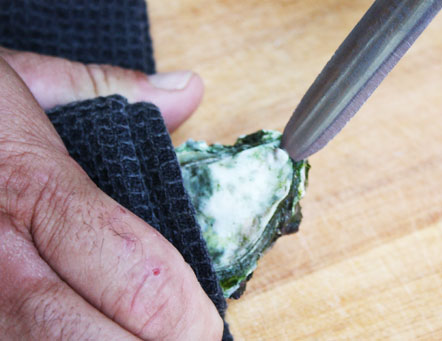
Who in their right mind would turn up their nose at these beauties?



Who in their right mind would turn up their nose at these beauties?
Forever Yours
He trudged into the desert, taking almost
nothing with him but water and a ghost-
ly old photo
of a lady beside the ocean.
That first night,
he lay above a dry creek bed. Below,
he heard vipers moving through the sand
with a side-winding motion,
and
he did not sleep.
He’d grown obsessed with the notion
of walking deep
and deeper into the wilderness. By
the third day, his lips were swollen and dry.
Now he was completely isolated,
surrounded by a desert that dominated
with its glittering sand
and
not high above, a sky so huge and blue
that it scared him to look too long upon.
There was nothing new
now under his sun. By now, his water was gone.
Day five, he quit moving altogether
and sat instead for hours, with his photo and leather
flask, coughing in the cool valley of a dune,
watching the daytime moon,
gibbous and gorged, roll by like an eroded stone.
The sky was biblical. The sun was white as bone.
Finally, on the evening of his sixth day,
when his strength had all but slipped away,
a willowy woman in a white dress appeared.
She had long black hair, which stirred in the xeric
air, and though his eyes were watery and bleared,
he knew for certain who it was. And so
it was that she beckoned him. He rose, sure but slow,
up from the ferric
and rust-colored sand,
as if this is what he’d been waiting for all
along. And,
leaving his shoes and other belongings
behind, he followed her into
the drifted dunes, beneath a sky of melting blue.
And that was it. Days later when they found his things,
they saw the photo half-buried in the sand.
It was a black-and-white of a black-
haired woman, very elegant, tall,
whose short life,
two years back,
had been eaten away in a strange
Patagonian land, below a mountain range.
That woman was his wife.
 Thirty-one years after Leonardo da Vinci’s death, Giorgio Vasari wrote Leonardo’s biography, from which the famous painting got its name: The Mona Lisa — or, as it’s known in Italian, La Gioconda, and in French La Joconde.
Before Vasari, the painting had been referred to as “a certain Florentine lady.” Later, in the collection at Fontainebleau, “a courtesan in a gauze veil.”
Leonardo’s panel is undated and unsigned, and although most portraits of that time included something to indicate the sitter’s family name or social status, no such emblem can be found in the Mona Lisa…. Some speculate that the Mona Lisa is not a portrait of one woman, but an artful composite of many, Leonardo’s idealization of all womanhood. Others suggest it may have been one of Da Vinci’s young male models in drag. Some even believe that the Mona Lisa is not a portrait at all, but instead what is known as a “finzione,” an invention of Leonardo’s extraordinary imagination (source).
According to Vasari, Leonardo devoted four full years to painting the Mona Lisa — which, however, covers only a fraction more than five-and-a-half square feet of surface.
Worthy of the painting itself is Walter Pater’s unforgettable description of the Mona Lisa:
“She is older than the rocks among which she sits; like the vampire, she has been dead many times, and learned the secrets of the grave.”
 A reader writes:
Dear Ray Harvey: I’m one of these guys with a big belly and an extremely small penis. I’m heterosexual, and I drive a truck for a living. I do not get a lot of exercise. For as long as I can remember, I’ve been pained by the size of my penis. I’m seriously considering surgical augmentation (in my late thirties). Do you have particular thoughts on this issue? Should I, or shouldn’t I?
— Dick Weed
P.S. Pumps don’t work.
Dear Dick Weed: Indeed, I do have very particular thoughts on this issue, despite the fact that, as fate would have it, my problem is the opposite of yours. My thoughts are these:
Don’t do it.
Quoting from the gospels:
“A man’s life consisteth of more than the size of his dick” (The Gospel According to Ray, Chapter 1, Verse 1).
Didn’t you hear about the plastic surgeon who hung himself?
Listen, Mr. Weed, when it comes to satisfying a woman, you know the commandments:
Don’t stampede the clitoris.
Don’t neglect the labia.
I give you a new commandment now: The journey is the way.
Truckdriver, that’s an old German dictum, and what it means is something I’d like for you to take with you from here on out, every time you enter your bedroom, your wife, or your rig:
Sex is not a race, and intercourse isn’t the only kind of sex. There are plenty of things you can do with your lug nuts, your digits, your tungsten wires, and I’m not just blowing your horn when I say that.
At a bar where I once worked, a customer told me that his penis was only three inches — but he swore up and down that most women didn’t like it that thick.
Mainly, Mr. Weed, what I’m suggesting to you is this: learn to enjoy the journey, because the journey is the way; your penis is only a small part of it (so to say).
Slow her down, friend, and I promise that your extremely small penis will be all the penis she needs. It’s not as if you’re trying to make Amarillo by morning (or are you?) Enjoy the process, soup-to-nuts, because as you know, the end will come soon enough, and all ends are bitter.
Now keep on trucking, big daddy.

A reader writes:
Dear Ray Harvey: Is Charles Bukowski a great artist?
— Billy Badass
Dear Billy Badass: No, he’s not. Bukowski is too sloppy to be a great artist. He lacks vision. He lacks depth and he lacks focus. Reading him, one is reminded of Truman Capote’s criticism of Jack Kerouac’s On the Road: “That’s not writing; it’s typing.”
Here’s what I regard as a quintessential Bukowski poem:
A RADIO WITH GUTS
it was on the 2nd floor on Coronado Street
I used to get drunk
and throw the radio through the window
while it was playing, and, of course,
it would break the glass in the window
and the radio would sit there on the roof
still playing
and I’d tell my woman,
“Ah, what a marvelous radio!”
the next morning I’d take the window
off the hinges
and carry it down the street
to the glass man
who would put in another pane.
I kept throwing that radio through the window
each time I got drunk
and it would sit there on the roof
still playing-
a magic radio
a radio with guts,
and each morning I’d take the window
back to the glass man.
I don’t remember how it ended exactly
though I do remember
we finally moved out.
there was a woman downstairs who worked in
the garden in her bathing suit,
she really dug with that trowel
and she put her behind up in the air
and I used to sit in the window
and watch the sun shine all over that thing
while the music played.
What do you think?
I think Bukowski does possess something — which is to say, he’s not devoid of skill or talent, and I admire his devotion to the sacred art of literature. For one, as you can glimpse above, he does possess a genuine sense for beauty, though it doesn’t consistently come through. And I think he’s genuinely intelligent. His all-time favorite movie was Eraserhead by David Lynch, which I think is interesting. But in the end, Bukowski’s talent remains largely fallow. I like drunken tortured writers as much as anyone, and I am as susceptible as anyone to the romantic quality we see and sense in that sort of writer. Still, I regard Bukowski as over-focused on alcohol and therefore limited.
In short: If you’ve read a few Bukowski poems or stories, you’ve pretty much read them all, and a little Bukowski goes a very long way.
Here’s Bukowski at his best (and I do love this movie which he wrote):
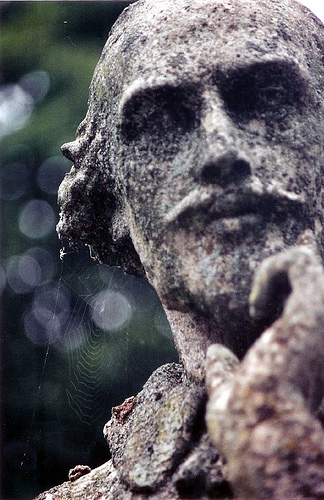 A reader writes:
Dear Ray Harvey: Is Shakespeare all that?
— Slo Readuh
Dear Slo Readuh: No, he’s not all that. He’s all that and more.
It’s impossible to overstate Shakespeare’s genius. Forget that his plots were largely borrowed; forget that he never created a major character who didn’t have significant flaws. None of that is where Shakespeare’s genius lies. As Vladimir Nabokov — who was at times (not consistently) an insightful critic — once expressed it: “The verbal poetical texture of Shakespeare is the greatest the world has ever known, and is immensely superior to the structure of his plays as plays. With Shakespeare, it is the metaphor that’s the thing, not the play.”
Aristotle believed the creation of metaphor to be the highest mark of literary genius. Shakespeare’s metaphoric-poetic skill is virtually bottomless. Even if you were to take away his plays, he’d still rank as one of the greatest sonneteers of all time.
It is, I admit, a tragedy that the Elizabethan language has become to our modern eyes and ears so difficult. Much of Shakespeare does indeed require footnotes, which of course can make for some very rough going. I do understand that. Yet when you push past that — which is to say, when you begin at last to penetrate Shakespeare — you’ll glimpse something you can’t believe.
John Keats was not speaking hyperbolically when he said that Shakespeare “smacks of the divine.” Nor was Samuel Taylor Coleridge when he said that Shakespeare “possessed myriad minds.” Shakespeare’s words contain the kind of truth that seems otherworldly. Neither is it an accident that Shakespeare is quoted more widely than the Bible.
But it was Herman Melville, who thought Shakespeare “the profoundest of thinkers,” that captures the locus of his genius most appositely of all. Melville said that Shakespeare was “master at the art of telling truth even though it be covertly, and by snatches…. It is those deep far-away things that make Shakespeare, Shakespeare.”
Like Nabokov, Melville believed that it is neither the tragedies nor the comedies that make Shakespeare great: it’s the insights into humanity, which come at you constantly from among his plays and sonnets “like flashes of lightning illuminating the mysteries below.”
That’s not all: Shakespeare’s greatest living admirer (and arguably the world’s best-read human being) the critic Harold Bloom (not to be confused, as he so often is, with that hack Howard Bloom), honestly believes that in creating so many convincing characters, Shakespeare went far in creating our modern-day conception of humanity itself. It is an incredible statement, and yet I, for one, won’t argue it. In Harold Bloom’s own words:
“Shakespeare, who at the least changed our ways of presenting human nature, if not human nature itself, does not portray himself anywhere in his plays.”
Even more interestingly, perhaps, Mr. Bloom goes on to say this:
If I could question any dead author, it would be Shakespeare, and I would not waste my seconds by asking the identity of the Dark Lady or the precisely nuanced elements of homoeroticism in the relationship with Southhampton (or another). Naively, I would blurt out: did it comfort you to have fashioned woman and men more real than living men and women? (Harold Bloom, Genius, p. 18).
The profundity of his question is, I believe, the truest test of Bloom’s sincerity, for that question is almost frighteningly subtle — and as a writer of fiction, I can personally testify that there is much to that: I am deeply comforted by the women and men I fashion. But apart from the insight it provides us into Bloom’s own brain, it illustrates something even more significant:
It’s long been observed that one of the best measures of literature is when you can discuss the characters of a story or play as if those characters were real people: when you can talk about their personalities; when you can psychologize over them, their choice of careers, their deeds; when you can pick their brains and discuss their addictions and predispositions as if these characters were actual human beings. Many playwrights and novelists, and even many modern day screenplay-writers, have created characters that meet this criteria. But no one — and I mean no one — has come close to creating the sheer number of these characters that Shakespeare did. Love these people or hate them, Shakespeare brought to life a gallery of women and men who are completely human — and he did it in a language whose prosody for practitioners still astounds.
That is the real power of art, and of Shakespeare.
So no, gentle Slo Readuh, Shakespeare is not overrated. He is, if anything, vastly underrated.
 A reader writes:
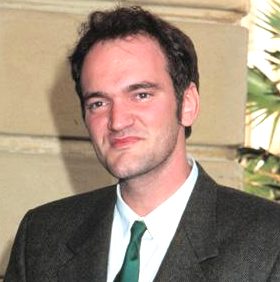
Dear Ray Harvey: Who’s the better filmmaker, Quentin Tarantino or David Lynch?
P. Durango
 Dear P. Durango: Are you kidding me? But there’s no comparison. That’s like asking me: who of those two has better hair?
As a filmmaker, David Lynch possesses innumerable shortcomings, foremost of which is the fact that he’s an obscurantist extraordinaire — and this is no small thing.
The symbolic in art, you see, must never supersede the literal — or to put that another way, the symbolic meaning must always remain secondary to the literal meaning, and the literal must hold up on its own without reference to the symbolic. When an artist makes the symbolic meaning the tail that wags the dog, as David Lynch so often does, she defaults on art’s primary function: making the abstract concrete.
Yet for all this, David Lynch is not only the better filmmaker: he’s better by light years.
Quentin Tarantino barely makes it above average. He makes good B movies.
It’s true that Tarantino can tell a story (at times, not consistently). This isn’t really his problem.
His problem is that he lacks depth.
If theme is the meaning that a story’s events add up to — and it is — then Tarantino’s movies are almost all themeless because they add up to nothing. They’re action movies, which, even as action movies go, are often boring and wildly gratuitous. (Inglorious Basterds was a notable exception.)
Tarantino’s dialogue at its best is good, but it, too, is inconsistent. Pulp Fiction, slightly campy now, remains by far his best movie.
Reservoir Dogs? You can see skill there, in flashes, despite its wobbly plot. But there’s no getting around the fact that Quentin Tarantino could never in a million years create Wild at Heart and Sailor Ripley, let alone the John Merrick that David Lynch gave us in his awesome version of the Elephant Man — John Merrick dancing alone in his room with tophat and cane, the pure poignancy of which scene is unforgettable.
Tarantino has yet to match Pulp Fiction. It seems to me now that he never will.
Pulp Fiction spawned a thousand imitators — and for good reason: it was funny and it was original. And yet its appeal has dated a little: many scenes still hold up and are as fresh today as they were fifteen years ago. But an almost equal number (i.e. “The Bonnie Situation”) have grown stale and are unconvincing. Time has sunk them.
The David Lynch of Twin Peaks and the David Lynch of Blue Velvet has a depth and intelligence that Tarantino cannot match. Wild at Heart, which is half a decade older than Pulp Fiction, has proven more durable by far.
Just incidentally, Quentin Tarantino’s “The Man From Hollywood” (his Four Rooms contribution) was taken from a Roald Dahl short story called “The Gambler,” and if you want to see where Tarantino got his idea for the ending of Reservoir Dogs, please watch this movie, which was based on the novel by Lawrence Block.