Category: Individual rights


Jack Kevorkian R.I.P: Doctor Death Dies At Age 83

June 5th, 2011 — 3:02pm

Jack Kevorkian, who was born May 26, 1928, died two days ago, at age 83.

In the latter phase of his life, Kevorkian campaigned tirelessly to legalize physician-assisted suicide — a subject about which he was intensely passionate (too passionate, some believed) and even served eight years in prison for “acts of euthanasia.”

From 1990 to 2000, Jack Kevorkian was arrested many, many times for helping more than 100 patients commit suicide. He used injections, carbon monoxide, and his now-infamous “suicide machine,” which he hammered together from scraps for approximately $30.

“Those he aided had terminal conditions such as multiple sclerosis, amyotrophic lateral sclerosis and malignant brain tumors. When asked in a 2010 interview about how it felt to take a patient’s life, Dr. Kevorkian said, ‘I didn’t do it to end a life. I did it to end the suffering the patient’s going through. The patient’s obviously suffering — what’s a doctor supposed to do, turn his back?’

“Dying, he believed, should be an intimate and dignified process, something that many terminally ill people are denied, he said.

“He garnered a fair amount of support from other medical practitioners, although most thought he was an extremist. In 1995, a group of doctors in Michigan publicly voiced their support for Dr. Kevorkian’s philosophy, stating that they supported a ‘merciful, dignified, medically assisted termination of life.’

“Shortly after, a study in the New England Journal of Medicine found that many doctors in Oregon and Michigan supported some form of physician-assisted suicide in certain cases.

“One of his greatest victories occurred in March 1996 when a U.S. Circuit Court of Appeals in California ruled that mentally competent, terminally ill adults have a constitutional right to die with the aid of medical experts and family members. It was the first federal endorsement of its kind” (source).

Arguably, Jack Kevorkian’s lasting legacy will be in the fact that he (with the invaluable help of his smart and charismatic lawyer Mayer Morganroth) so thoroughly raised the world’s awareness about euthanasia, and I, for one, was a supporter of him: obviously, if we each possess the right to our own life — and we do — we also (therefore) possess the corollary right to end that life when we choose.

Death, where is thy sting?

Jack Kevorkian, MD, jazz musician, oil-painter, euthanasianist: May 26, 1928 – June 3, 2011


1 comment » | Individual rights

UN Document Would Give ‘Mother Earth’ Same Rights As Humans

April 12th, 2011 — 2:59pm

This is for all the folks out there — you know who you are — who over the years have told me that I caricaturize environmentalism and environmentalists; that I present the environmental position “unfairly,” as “too extreme” when I call it what it actually is: namely, neo-Marxism at its blackest, a quasi-secular religion that hates human beings and worships at the shrine of death — e.g.: “Human beings, as a species, have no more value than slugs” (John Davis, editor of Earth First! Journal).

“In searching for a new enemy to unite us, we came up with the idea that pollution, the threat of global warming, water shortages, famine and the like would fit the bill. All these dangers are caused by human intervention, and it is only through changed attitudes and behavior that they can be overcome. The real enemy then, is humanity itself” (Al Gore, Club of Rome executive member).

“Mankind is a cancer; we’re the biggest blight on the face of the earth” (president of PETA and environmental activist Ingrid Newkirk).

“If you haven’t given voluntary human extinction much thought before, the idea of a world with no people in it may seem strange. But, if you give it a chance, I think you might agree that the extinction of Homo Sapiens would mean survival for millions, if not billions, of Earth-dwelling species…. Phasing out the human race will solve every problem on earth, social and environmental” (Ibid).

Quoting Richard Conniff, in the pages of Audubon magazine (September, 1990): “Among environmentalists sharing two or three beers, the notion is quite common that if only some calamity could wipe out the entire human race, other species might once again have a chance.”

Environmental theorist Christopher Manes (writing under the nom-de-guerre Miss Ann Thropy): “If radical environmentalists were to invent a disease to bring human population back to ecological sanity, it would probably be something like AIDS.”

Environmental guru “Reverend” Thomas Berry, proclaims that “humans are an affliction of the world, its demonic presence. We are the violators of Earth’s most sacred aspects.”

A speaker at one of Earth First!’s little cult gatherings: “Optimal human population: zero.”

“Ours is an ecological perspective that views Earth as a community and recognizes such apparent enemies as ‘disease’ (e.g., malaria) and ‘pests’ (e.g., mosquitoes) not as manifestations of evil to be overcome but rather as vital and necessary components of a complex and vibrant biosphere … [We have] an antipathy to ‘progress’ and ‘technology.’ We can accept the pejoratives of ‘Luddite’ and ‘Neanderthal’ with pride…. There is no hope for reform of industrial empire…. We humans have become a disease: the Humanpox” (Dave Foreman, past head of Earth First!)

“Human happiness [is] not as important as a wild and healthy planet. I know social scientists who remind me that people are part of nature, but it isn’t true. Somewhere along the line we … became a cancer. We have become a plague upon ourselves and upon the Earth…. Until such time as Homo Sapiens should decide to rejoin nature, some of us can only hope for the right virus to come along.” (Biologist David Graber, “Mother Nature as a Hothouse Flower” Los Angles Times Book Review).

“The ending of the human epoch on Earth would most likely be greeted with a hearty ‘Good riddance!’”(Paul Taylor, “Respect for Nature: A Theory of Environmental Ethics”).

“If we don’t overthrow capitalism, we don’t have a chance of saving the world ecologically. I think it is possible to have an ecologically sound society under socialism. I don’t think it is possible under capitalism” (Judi Bari, of Earth First!).

“Isn’t the only hope for the planet that the industrialized civilizations collapse? Isn’t it our responsibility to bring that about?” (Maurice Strong, Earth Summit 91).

David Brower, former head of the Sierra Club and founder of Friends of the Earth, calls for developers to be “shot with tranquilizer guns.”

Why?

“Human suffering is much less important than the suffering of the planet,” he explains.

Also from David Brower, Executive Director of the socialist Sierra Club: “The goal now is a socialist, redistributionist society, which is nature’s proper steward and society’s only hope.”

Quoting the Green Party’s first Presidential candidate Barry Commoner:

“Nothing less than a change in the political and social system, including revision of the Constitution, is necessary to save the country from destroying the natural environment…. Capitalism is the earth’s number one enemy.”

From Barry Commoner again:

“Environmental pollution is a sign of major incompatibility between our system of production and the environmental system that supports it. [The socialist way is better because] the theory of socialist economics does not appear to require that growth should continue indefinitely.”

So much for your unalienable right to life, liberty, and the pursuit of happiness. Indeed:

“Individual rights will have to take a back seat to the collective” (Harvey Ruvin, International Council for Local Environmental Initiatives, Dade County Florida).

Sierra Club cofounder David Brower, pushing for his own brand of eugenics:

“Childbearing [should be] a punishable crime against society, unless the parents hold a government license. All potential parents [should be] required to use contraceptive chemicals, the government issuing antidotes to citizens chosen for childbearing.”

That, if you don’t know, is limited government environmentalist style.

“There’s nothing wrong with being a terrorist, as long as you win. Then you write history” (Sierra Club board member Paul Watson).

Again from Paul Watson, writing in that propaganda rag Earth First! Journal: “Right now we’re in the early stages of World War III…. It’s the war to save the planet. The environmental movement doesn’t have many deserters and has a high level of recruitment. Eventually there will be open war.”

And:

“By every means necessary we will bring this and every other empire down! Mutiny and sabotage in defense of Mother Earth!”

And so on.

But, Ray, this is just the extremist fringe; these folks do not represent the true spirit of the environmental movement, as a reader of this website once told me.

Uh-huh. I suggest you keep telling yourself that so that you don’t have to confront the totality of the philosophy you’ve accepted.

And now there’s this:

UN document would give ‘Mother Earth’ same rights as humans:

UNITED NATIONS — Bolivia will this month table a draft United Nations treaty giving “Mother Earth” the same rights as humans — having just passed a domestic law that does the same for bugs, trees and all other natural things in the South American country.

The bid aims to have the UN recognize the Earth as a living entity that humans have sought to “dominate and exploit” — to the point that the “well-being and existence of many beings” is now threatened.

The wording may yet evolve, but the general structure is meant to mirror Bolivia’s Law of the Rights of Mother Earth, which Bolivian President Evo Morales enacted in January.

That document speaks of the country’s natural resources as “blessings,” and grants the Earth a series of specific rights that include rights to life, water and clean air; the right to repair livelihoods affected by human activities; and the right to be free from pollution.

It also establishes a Ministry of Mother Earth, and provides the planet with an ombudsman whose job is to hear nature’s complaints as voiced by activist and other groups, including the state.

“If you want to have balance, and you think that the only (entities) who have rights are humans or companies, then how can you reach balance?” Pablo Salon, Bolivia’s ambassador to the UN, told Postmedia News. “But if you recognize that nature too has rights, and (if you provide) legal forms to protect and preserve those rights, then you can achieve balance.”

The application of the law appears destined to pose new challenges for companies operating in the country, which is rich in natural resources, including natural gas and lithium, but remains one of the poorest in Latin America.

Read the full article here.

This, what you just read above, is merely the logical elaboration of the mainstream environmental philosophy, and, among many, many other things, it demonstrates a profound and fatal misunderstanding of the concept of rights, which by definition are compossible.


7 comments » | Al Gore, environmentalism, Individual rights, Property Rights

“Fetal Rights,” Abortion, And Public Funding Of Abortion

April 9th, 2011 — 3:07pm

By definition, a fetus does not possess rights because the things in nature that give rise to rights are human individuation and the power of choice, which in turn gives rise to moral agency.

A fetus, however, is the diametric opposite of individuated: it lives parasitically (in a literal sense) off of an individuated host. For this reason, the right belongs exclusively to the host — i.e. the woman — from whom that fetus derives life entirely. When the fetus is born, it becomes individuated, and that is when rights begin.

On this issue, as on many others, I am in complete disagreement with the so-called rightwing and am more aligned with the so-called left. And yet here’s one thing I’d like for someone to tell me:

How does it then follow that because a woman does possess the inalienable right to choose abortion or not, I or anyone else should therefore be forced to fund the abortions of others, as Barack Obama and the leftwing all believe?

Answer: it does not follow.

My rights, your rights, everyone’s rights stop where another’s begin.


8 comments » | Abortion, Individual rights

Individual Rights

March 3rd, 2011 — 2:09am

Rights are a formal codification of human freedom.

Rights state explicitly the fact that no other person or institution has rightful jurisdiction over the person or property of another.

Justice — also known as equity — is nothing more or less than the legal recognition of each and every individual’s right to her own life and her own property.

The Oxford Dictionary defines the term rights as, in part, “A justifiable claim, on legal or moral grounds, to have or obtain something, or to act in a certain way.”

Freedom is the absence of compulsion.

The primary thing that distinguishes the free person from the unfree person is voluntary action versus action that is compelled.

Compulsory taxation, for instance, means that you are not free to do whatever you wish with your own money, because the government may at any time legally compel you to give to government any amount it specifies.

Voluntary action hinges upon the principle of individual rights:
Are we each free to live as we choose, provided we do not infringe upon the equal rights of others? Or not?

The most fundamental political question is this: Do we rightfully own ourselves, or do others rightfully have jurisdiction over us?

To ask that question is to answer it.

America is the only country in the history of the world founded explicitly and principally upon the concept of individual rights.

At root, there’s really only one way to infringe upon another’s rights, and that is through the instigation of force. Quoting the 19th century political thinker Auberon Herbert:

Nobody has the moral right to seek his own advantage by force. That is the one unalterable, inviolable condition of a true society. Whether we are many, or whether we are few, we must learn only to use the weapons of reason, discussion, and persuasion…. As long as men are willing to make use of force for their own ends, or to make use of fraud, which is only force in disguise, wearing a mask, and evading our consent, just as force with violence openly disregards it – so long we must use force to restrain force. That is the one and only one right employment of force … force in the defense of the plain simple rights of property, public or private, in a world, of all the rights of self-ownership – force used defensively against force used aggressively (Auberon Herbert, The Principles of Voluntaryism, 1897).

As Auberon Herbert notes, force can be direct, as in assault and rape, or indirect, as in fraud or extortion. There’s no other way to breach rights than through the (direct or indirect) instigation of force.

Laws that restrict freedom of production and trade (such as cap-and-trade laws) are an indirect use of force.

Trade tariffs are an indirect use of force.

Military conscription is a direct use of force.

Rights, I repeat, are a formal codification of human freedom.
This includes the freedom to trade.

Rights are ethical principles, and they are political principles. As such, rights delimit human freedom in large groups.

This latter thing is emphasized because rights would not need to be discovered if you lived alone, or even if you lived in a small and insular society.

Rights derive from three things: human individuation, human society, and the power of choice which gives rise to moral agency.

Rights are discoveries, not inventions.

One proof of this is found in the fact that the only alternative to acting by right is acting by permission. Whose permission?

Answering that question is where you’ll begin to glimpse the true nature of rights; for if humans only act by permission, who gives permission to those whose permission the rest of us are acting under? And who gives permission to those above, and so on?

Answer: no one — because rights are inalienable in the literal sense: they are not granted, and they cannot be revoked or transferred.

In the final analysis, there’s only the right to your own life: all others – from liberty, to property, to the pursuit of happiness – are an extension of that one.

Those who hold that life is valuable, hold, by implication, that men ought not to be prevented from carrying on life-sustaining activities. In other words, if it is said to be ‘right’ that they should carry them on, then, by permutation, we get the assertion that they ‘have a right’ to carry them on. Clearly the conception of ‘natural rights’ originates in recognition of the truth that if life is justifiable, there must be a justification for the performance of acts essential to its preservation; and, therefore, a justification for those liberties and claims which make such acts possible (Herbert Spencer, The Man Versus the State, 1884).

The crux of freedom is rights.

The crux of rights is human individuation and moral agency.

A deep connection exists between the right to life and the right to property. The importance of this connection cannot be overstated, yet it is precisely this connection that the leftwing and rightwing are both equally ignorant of.

Quoting Claude Frédéric Bastiat:

Each of us has a natural right to defend his person, his liberty, and his property. These are the three basic requirements of life, and the preservation of any one of them is completely dependent upon the preservation of the other two. For what are our faculties but the extension of our individuality? And what is property but an extension of our faculties? … Man can live and satisfy his wants only by ceaseless labor, and by the ceaseless application of his faculties to natural resources. This process is property (Claude Frédéric Bastiat, The Law, 1848).

Property is “not only money and other tangible things of value, but also includes any intangible right considered as a source or element of income or wealth. The right and interest which a man has in lands and chattels to the exclusion of others. It is the right to enjoy and to dispose of certain things in the most absolute manner as he pleases” (Lectric Law Library).

That is precisely why the crux of freedom and free markets is private property.

It is also why environmentalism, as all other forms of socialism, is inherently anti-freedom.

The reason that laissez faire is the proper social system is not because it “works best,” as many nominal defenders of free markets never tire of telling us. Laissez faire is proper, rather, because it is just. Laissez-faire capitalism is the only economic system that respects and protects the inalienable right to life, liberty, property, and free exchange.

One must never forget: money is property. Money is the symbol of your labor.

The root of real wealth is production.

Compulsory (as opposed to voluntary) taxation is a breach of property rights. It is also, again in the words of Bastiat, “legalized plunder.”

Individual rights have been under siege since the moment they were first brought into the light. And yet they’ve remained remarkably resilient. The reason they’ve remained resilient is that they are in a certain sense self-evident: we each, as John Locke said, “have a property in our own person.”

That is the fundamental principle behind rights, and property is an extension of person, nothing more and nothing less.

If you believe in human freedom, you perforce believe in the freedom to trade – fully. For if humans are not allowed to trade freely, humans are not truly free.

No freedom or justice can exist if rights, including property rights, do not exist.

Indeed, the very word rights has its origins in ancient Roman law and is related to the Roman word jus, as in justice. According to historian J. Stuart Jackson, jus “is wider than that of positive law laid down by authority, and denotes an order morally binding on the members of the community.” In the Roman sense of the word, “right” meant “what is just.”

Rights entitle holders to certain freedoms – specifically, the freedom to act in a certain way. Notice the phrase “freedom to act”; it is a crucial distinction because rights do not assure you of anything except the freedom to try.

What, though, fundamentally, is the stuff of rights? Of what are they made of?

To begin with, rights are not primaries: they are second-order principles that derive from something deeper. And that something is a thing which is very specific within the human condition. It is the faculty of choice.

If human behavior were automatic, as it is with animals, there would be no question of rights because any action we undertook would not be chosen. Human action would be neither moral nor immoral but amoral, and rights would therefore not exist.

The grizzly bear who mauls the innocent child is not evil. The man who mauls the innocent child is.

Thus rights are the link between ethics and politics.

Which is why Herbert Spencer and other freethinkers regarded rights as “ethical-political precepts.”

Quoting Samuel Adams:

Among the natural rights are these: First a right to life, secondly to liberty, thirdly to property; together with the right to defend them in the best manner they can…. Rights are evident branches of, rather than deductions from, the duty of self-preservation, commonly called the first law of nature.

Rights are another of these things that everyone thinks he understands, but which in fact almost nobody does.

To get some idea of how poorly understood the nature of rights is, one need only look at the United Nations Universal Declaration of Human Rights and observe the sheer number of times one would have to breach the rights (usually in the form of property expropriation – i.e.: “Everyone has the right to rest and leisure, including reasonable limitation of working hours and periodic holidays with pay”) of some individual somewhere to achieve even a fraction of that Declaration’s stated goals. The UN’s Declaration of Human Rights is a tour-de-force of postmodern, multicultural, neo-Marxist non-thought.

Leftwingers tell us we have the right to healthcare, the right to a job, the right to a smoke-free work environment, and so on.

Rightwingers, on the other hand, say we do not have the right to open our liquor stores on Sunday, we do not have the right to consensual sex with prostitutes, we do not have the right to gamble, et cetera.

Despite what you’ve been told, these views are not opposites; they are a variation on an identical theme, and their common denominator is this: Humans do not possess the inalienable right to life and property, and government bureaucrats are better suited than we ourselves to tell us how we must live. Yet the fact is, there is nothing in nature, neither human nature nor nature apart from humans, that gives government bureaucrats legitimate authority over the person or property of any other human being.

To say that we have the “right to healthcare,” or the “right to a job,” or the “right to a smoke-free work environment” is the same as saying we have the right to the life, labor, and property of another, which we do not and cannot – by virtue of what rights are.

Rights by definition preclude any claim to the person and property of another, even if that person is a doctor.

To say that humans do not have the right to open their liquor stores on Sunday if they choose, or to say that humans do not have the right to have consensual sex with prostitutes if they choose, or to say that humans do not have the right to gamble and use drugs if they choose, is the same as saying your life is not yours by right but belongs in some measure to bureaucrats, and that humans to that extent exist only by those bureaucrats’ permission — this in spite of the fact that no government and no governmental bureaucracy in the history of the world has ever proved itself more capable of running the individual’s life better than the individual herself.

Government compulsion, rightwing or left, is the antithesis of individual rights.

There is no such thing as a “collective right,” not in any variation.

Rights, by definition, can only belong to the individuals who make up any “collective.”

That is why the very term individual rights is pleonastic in the ultimate purport, albeit necessarily so: the very definition of the word presupposes individual, since it is only individuals who can properly possess rights.

Quoting George Reisman, who is echoing his friend and mentor Ludwig von Mises:

Only individuals exist; collectives consist of nothing but individuals. Only the individual thinks; only the individual acts; only the life of the individual has value and is important. All rights are rights of individuals.

As it happens, there’s an absolutely foolproof method that exists for determining if something is a right or not:

Your rights, my rights, everyone’s rights stop where another’s begin.

If you follow that simple principle, and if you remember that property is nothing more than an extension of person, and that money is also property, you’ll never confuse the issue of rights.


[This article appeared, in a slightly altered form, in Chapter 30 of my book].

8 comments » | Individual rights, Property Rights

Barack Obama Is Suddenly Concerned With Individual Rights

February 28th, 2011 — 3:09pm

Barack Obama — who, in 2008, at the Philadelphia primary, shocked and sickened so many of us when he said (and I quote) “Just because you have an individual right does not mean that state or local government can’t constrain the exercise of that right” — has suddenly, it seems, developed an inexplicable regard for individual rights, stating publicly this morning:

“I don’t think it does anybody any good when public employees are denigrated or vilified or their rights are infringed upon.”

Presumably, he’s forgetting his aforementioned conviction that “state and local governments [may legitimately] constrain the exercise of rights” — an ignorant and extraordinarily dangerous conviction which statists of every stripe have unsuccessfully tried to defend since the dawn of humankind, with spectacularly devastating results, and yet for once I agree with him: it is not ever good when individual rights are infringed upon. The real question, of course, which he could never answer, is this:

Why is it then okay that my rights are infringed upon — when I am forced, in other words, under threat of fine or imprisonment, to subsidize these public employees whom you champion?

Why must I be forced by government to live for others?

Says who? And why?

No good answer has ever been given to that question because no good answer for it exists.

On a related note, Barack Obama disclosed in that same speech this morning his economic illiteracy once again, telling state governors:

“As the Recovery Act funds that saw through many states over the last two years are phasing out and it is undeniable that the Recovery Act helped every single state represented in this room manage your budgets, whether you admit it or not.”

The refutation of this is sometimes referred to as the Broken Window Fallacy, a term that comes to us from a parable coined by the great French economist Frederic Bastiat (1801 – 1850), which parable demonstrates that wealth cannot come from destruction, that money taken by force — i.e. TARP and the so-called stimulus package — necessarily siphons money which would otherwise have been spent voluntarily on other things, thereby wreaking havoc on economies in an unseen way (indeed, Bastiat himself called this principle “That Which is Seen, and That Which is Not Seen”).

Here’s a two-minute explanation of the Broken Window Fallacy, by an economist and philosopher whom I admire named Dr. Tom Palmer:

And another:


4 comments » | Barack Obama, Individual rights

Castro Pot Bust Goes Awry, Law Professor Converts, Threatens to Sue

February 18th, 2011 — 2:30pm

Professor Clark Freshman: Convert

One year ago, I wrote in a previous post that virtually everyone believes in freedom — that is, until everyone finds out what freedom actually means. Then almost no one believes in it. Freedom simply means you are left alone: you are neither helped nor hindered. And that’s all it means.

Rightwing politicos and leftwing politicos don’t usually agree on specifics, but they do often agree on principle: namely, that government’s proper sphere of authority does extend beyond protection against the initiation of force.

Like most politicians, today’s politicians, both right and left, believe that human beings are not capable of flourishing without the aid of bureaucrats; these bureaucrats therefore believe they must help us live our lives for us. And nowhere is this unquestioned conviction made clearer than in the issue of drugs.

Drugs, like prostitution, provide us with an excellent example of how the rightwing and the left are not fundamentally opposed but merely disagree on superficialities, insofar as both sides agree that not all drugs should be legal.

This notion is so entrenched in the mind’s of Americans that to question its legitimacy at all is considered lunatic-fringe thinking.

True, there are representatives on both sides of the political spectrum who support legalizing marijuana and perhaps a few other drugs. But start talking about legalizing all drugs on principle, or mention doing away with all drinking-age laws on principle, and all liquor laws on principle, or speak of legalizing gambling and prostitution in all states and cities — and then you really begin to sort out the men from the boys.

The principle I’m speaking of is of course the principle that it is not within the proper sphere of government to be involved in these aspects of human lives.

If we each possess the right to our own life and only our own life — and we do — then drug usage is obviously the right of each individual. The fact that it has become unquestionable to the majority that we do not possess the right to use drugs is we choose is a sad testament to the power of entrenchment.

It is a sad testament to how people get so used to thinking about something in one way that changing minds becomes absolutely out of the question. Yet if you truly believe in freedom, which the overwhelming majority of people don’t, you not only should but must believe in the legalization of all drugs. If you do not, then you do not believe in freedom, and you must choose: freedom or statism.

This point can be made on principle alone, and it is a foolproof argument, the first and strongest line of defense. But it will not satisfy those who believe the proper scope of government does extend into telling us how we may and may not live.

This point was very recently hammered home to a UC Hastings law professor named Clark Freshman, who, in his own words, had “been on the fence for years about the legalization of drugs … and now I’m a victim of this crazy war on drugs.”

The full article, which appeared in this week’s San Francisco Weekly, is entitled “Castro Pot Bust Goes Awry and a Law Professor Threatens to Sue.”

So we have another convert. The only question I have is for Mr. Freshman is this: what the hell took you so long?

(Hat tip Timothy Sandefur.)


15 comments » | Drugs, Individual rights

Mandatory Health Insurance And Car Insurance — “A Stupid Analogy”

December 23rd, 2010 — 1:56am

Tibor Machan

The following article, which I reprint only in part and which destroys the mandatory-car-insurance-mandatory-health-insurance canard, was written by Tibor Machan, who teaches business ethics and general philosophy at Chapman University in Orange, CA:


A Stupid Analogy

Now that Judge Henry E. Hudson of the Virginia district court ruled that the Obama health care measure violates the U. S. Constitution by forcing people to make purchases they may not want to make, there are innumerable sophists who want to refute the rationale for the ruling. They trot out the “argument” that since people living in states may be required to carry auto insurance, they can also be made to purchase anything the government, including the feds, decides they must.

But this analogy fails because people do not have to drive! Yet under Obamacare by simply being living citizens, they would have to purchase health insurance. Never even mind that the state regulations requiring people to purchases auto insurance aren’t universal across the country and different states have the constitutional authority to handle the issues involved in their own way, with no federal mandate dictating to them what they must do.

Furthermore, one rationale in support of the state requirement that citizens who choose to drive carry insurance is that nearly all driving happens on state roads. There is no requirement to get insurance if one stays off them and confines one’s driving to private thoroughfares. And this is because it is the states that claim legal ownership of roads and they then get to set the standards for what those using the roads need to do for the privilege. (Yes, it is deemed a privilege, not a right, because of the state’s collective ownership of most roads.)

So the analogy with state requirements to carry driver’s insurance is fallacious. But when that’s pointed out, another tack is put forth, namely, that ill health is contagious like the plague or leprosy. This is desperate since it is blatantly wrong. One can have all sorts of ailments that will not be communicated to anyone near or far. One can contract ill health, injuries, maladies and so forth without the involvement of others. Sometimes it is just misfortune that brings this about, sometimes it is one’s own reckless conduct, sometimes the recklessness of people with whom one freely associates and rarely because of injuries sustained from what others do. In no such cases are those left out implicated and thus no one should be legally required to foot the bill of the health care measures, including insurance, that may be need to fix or treat things.

The sophists who bring up this line of shabby reasoning are capitalizing on the common sense idea that when people emit harm from their private activities–such as manufacture, smoking, reckless driving, and so forth–they ought to shoulder the burden that befalls others in consequences of it all. In short, no one ought to dump on other people the cost and liabilities of one’s own malpractice.

(Read the full article here.)

5 comments » | Health, Healthcare, Individual rights

Natural Law

November 5th, 2010 — 2:55pm

Bill Whittle gives a good explanation of natural law:


13 comments » | Individual rights, Natural Law

The Electric Tea Party Acid Test — by Zombie

October 22nd, 2010 — 3:11pm

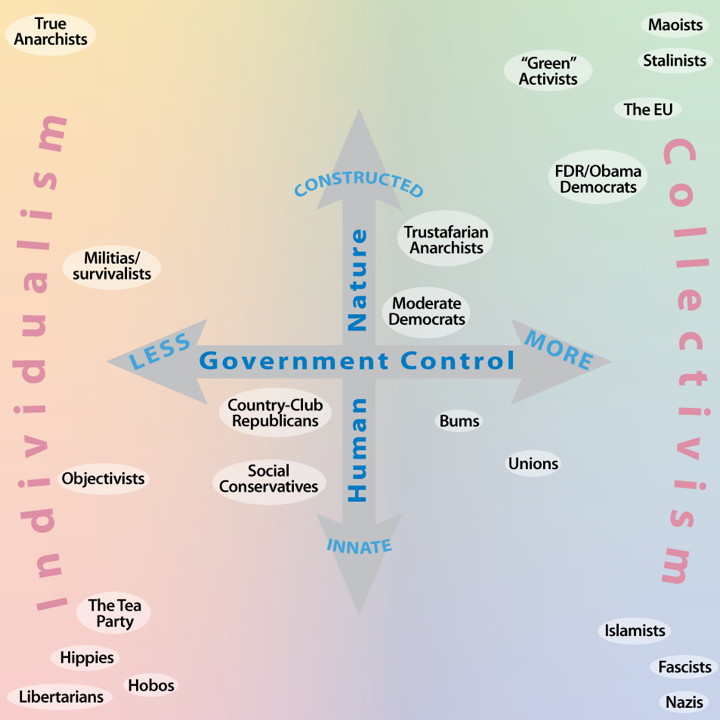
Zombie, an anonymous San Francisco blogger and photographer whom I admire, recently wrote an article for Pajamas Media that echoes what I myself have been saying for years: the left/right, republican/democrat, conservative/liberal alternative is a false alternative, and those two ideologies are really just two sides of the same penny: the one espouses (nominal) economic freedom but advocates government intrusion in political issues (the Right), while the other espouses nominal political freedom but advocates complete government intrusion in economic affairs (the Left). This issue is not a marginal issue — and indeed becomes more and more relevant each passing day, as this country creeps closer to outright revolution.

Zombie’s article is worth reading in full, but if you don’t have the time or the inclination, please take a long look at his graph, which he calls the real political spectrum: collectivism-versus-individualism — or, in my words, freedom-versus-statism. It’s not quite the graph I would have made, but it’s pretty good; and if freedom is ever to win the day, it is this distinction that must be understood:

(Note: to see Zombie’s explanation for his categories, click here.)


25 comments » | Individual rights, Tea Party

Massachusetts Governor Deval Patrick Wishes America Wasn’t A Free Country

September 2nd, 2010 — 2:13pm

Pretty hard to equivocate this one, no matter how liberal your viewpoint.

Here’s the Governor’s exact words:

“It’s a free country. I wish it weren’t, but . . . it’s a free country. You know, you got to, you got to respect that freedom.”

Deval Patrick said this on the “Jim & Margery Show” (WTKK-FM, Boston) September 1st, 2010.

Here, on video, is the audio:

As Doug Powers drolly notes:

Every now and then, a politician goofs and reveals more than he or she intended, providing a window into the true motives or beliefs. Michigan’s John Dingell claiming that Obamacare is a peachy way to “control the people,” and President Obama saying that America is a world super power “whether we like it or not” are recent examples.

Reader, do the world a favor and send this son-of-a-bitch Deval Patrick a message. Here is his contact form.


34 comments » | America, Individual rights

Legalizing Drugs

February 28th, 2010 — 9:41am

Everyone believes in freedom — until everyone finds out what freedom actually means. Then almost no one believes in it.

Freedom means you are left alone; you are neither helped nor hindered. And that’s all it means.

Rightwing politicos and leftwing politicos don’t usually agree on specifics, but they do often agree on principle: namely, that government’s proper sphere of authority does extend beyond protection against the initiation of force.

Humans, say today’s politicians, both right and left, aren’t capable of flourishing without the aid of bureaucrats; so these bureaucrats must help us live our lives for us.

Nowhere is this (unquestioned) conviction made clearer than in the issue of drugs.

Drugs, like prostitution, provide us with a good example of how the rightwing and the left are not fundamentally opposed but merely disagree on superficialities, insofar as both sides agree that not all drugs should be legal.

This notion is so ingrained into the mind’s of Americans that to question its legitimacy at all is considered lunatic-fringe thinking.

True, there are representatives on both sides of the political spectrum who support legalizing marijuana and perhaps a few other drugs. But start talking about legalizing all drugs on principle, or mention doing away with drinking-age laws on principle, and all liquor laws on principle, or speak of legalizing gambling and prostitution in all states and cities — and then you really begin to sort out the men from the boys.

That principle is the principle that it is not within the proper sphere of government to be involved in these aspects of human lives.

If we each possess the right to our own life and only our own life — and we do — then using drugs is obviously the right of each individual. The fact that it has become unquestionable to the majority that we do not possess the right to use drugs is we choose is a sad testament to the power of custom.

It is a sad testament to how people get so used to thinking about something in one way that changing minds becomes absolutely out of the question.

Yet if you believe in freedom, you not only should but must believe in the legalization of all drugs. If you do not, then you do not believe in freedom, and you must choose: freedom or statism.

This point can be made on principle alone, and it is a foolproof argument, the first and strongest line of defense. But it will not satisfy those who believe the proper scope of government does extend into telling us how we may and may not live.

It is frequently argued, for example, by the religious contingent, that if you legalize drugs, the usage of drugs will increase.

“Common sense and common experience tell us this,” says lawyer and radio talk-show host Dan Caplis, incessantly.

Next, we’re offered as evidence that the number of drinkers did increase after prohibition — a statement which is, at best, misleading, and here’s why:

Prior to prohibition, when drinking was still legal, the number of drinkers in this country was on a significant downward trend. For a decade leading up to prohibition, fewer and fewer people were drinking.

This fact is clear and not in dispute. But when, in 1920, the moralizers and busybodies got their way and legislated that the rest of the country must live as they deemed appropriate, and prohibition was then made into law, drinking still continued its downward trend. This went on for about three years.

It is very important to reiterate that the downward trend in drinking began long before drinking had been made illegal.

In the middle of prohibition — when drinking was still illegal — the number of drinkers began gradually to rise.

It continued to do so throughout the rest of prohibition, so that when, in December of 1933, prohibition was finally repealed, that upward trend continued for about a decade. But it was only the continuation of a trend that had already begun while drinking was illegal. This is a critical fact, but one you’ll never hear mention of when you hear people talking about “the number of drinkers increasing after prohibition.”

The next time someone says that “repealing prohibition increased the number of drinkers in this country,” be clear what that means: it means the number of drinkers was already increasing throughout the latter two-thirds of prohibition, and that the upward trend plateaued and then declined a decade after drinking was legalized anew.

Ask yourself also these questions: if, as the religious propound, making substances illegal prevents their usage, how is it that the number of drinkers began rising when alcohol was still illegal?

How is it that in Holland, where many drugs are legal and even subsidized(!), how is it that usage has decreased?

What does this tell us about “common sense and common experience”?

How is it that in Switzerland, marijuana usage has decreased even though it’s been made legal? And Spain?

There are those, of course, who argue that if drugs are legal, crime will increase. This is the biggest canard of them all.

Rest assured, if crime is your concern, illegalization should be what you want done away with.

There exists right now a multi-trillion-dollar underworld built up around illegal drugs, which legalizing would instantaneously crush, and which, as it stands, no amount of law, legislation, or litigation can come close to stopping. Why? The law of supply and demand is unstoppable: if there is a demand for something, supply will meet it, no matter what. All the conservative legislation imaginable cannot negate this fact. One might just as well try legislating against the tide.

When cigarettes and alcohol became so staggeringly taxed, do you know what happened? A gigantic blackmarket swept into the country. That meant more crime. People were smuggling in alcohol and cigarettes because these things could be sold for much cheaper on the blackmarket. They still are to this day.

Decriminalizing brings less crime.

For those who believe that if drugs are legalized, your kids are then more likely to use drugs, I urge you to remember that children have brains. Human beings have brains. We can learn, and we can be educated. We can be taught why not to use drugs. If you doubt the effectiveness of this, observe that cigarettes were legal for any age group until fairly recently, and the number of young smokers was sharply decreasing, and had been since the dangers of smoking were made known. Now that’s it’s illegal, teen smoking is on the rise again, and criminalizing doesn’t help.

Ask any honest school kid if he or she would have trouble getting drugs. Every honest school kid will tell you no. This despite the fact that drugs are illegal.

The inescapable law of supply and demand is why: if there’s a demand, supply will meet it. And no government bureaucracy and no middle-class morality can successfully fight it.

Making something illegal won’t decrease the supply of anything. It will only increase the underworld that provides the supply. This is a economic axiom.

Here’s another:

The only way to decrease supply is to curb demand.

The only way to curb demand is to inform, to educate, to decriminalize.

Each person must choose if he or she wants to use drugs or not, and whether those drugs are legal or illegal has little to do with the choice. There are many things that are legal and that every person has instant access to, but not everyone chooses to partake of. Why so?

The so-called war on drugs is a monumental waste of resources and money; it will continue to be so until the end of time. When something is made illegal, it develops a mystique. It entices. When something is legal, it becomes commonplace and mundane. It becomes no big deal. It is demystified.

Take, for instance, a person who’s grown up in an ultra-sheltered society and compare him or her to a person who’s grown up in the inner-city. Now drop them both off in downtown New York where there’s legal XXX shops on every street corner. Whom do you think will be more curious? And for whom do you think this will be more of a novelty?

And finally, for all the tax-happy liberals out there, think about this: if you legalize drugs, you can tax the living hell out of them. You can then use that tax money to educate with all your half-assed liberal programs, which benefit the “common good.” What more motivation do you need?

It is often said:

“Legalizing pot might be okay, but legalizing cocaine and methadrine, no way. I’ve known wealthy, white-collar, healthy, normal, successful businesspeople who’ve gotten so caught up in amphetamines that they’ve never been able to get off. They died. Suicide. OD. They’ve ruined their lives and the lives of their families. No way you should make these drugs legal.”

This is a repackaged version of the legalizing-creates-more-usage argument. It’s the same argument that drugs shouldn’t be legal because look at all the children born severely retarded and deformed because the mothers used crack throughout the pregnancy.

The first thing we must obviously note here is that all this happened (and still happens) even though drugs are illegal. Observe that making them illegal did not prevent these things from happening. Now ask yourself why.

Remember also that cigarettes and alcohol have ruined more lives and more families by far than every amphetamine combined. Should we therefore make alcohol and cigarettes illegal? And if not, why not? If it’s within the proper jurisdiction of government to run our lives, why shouldn’t we illegalize them?

And why, if that is government’s legitimate jurisdiction, draw the line at amphetamines, alcohol, and cigarettes? Why not let government run everything we consume — be it bacon, beer, or brats?

When gin made it into mainstream London, should it have been illegalized because it created such staggering addiction rates and ruined so many thousands of families?

We often hear: since alcohol can be and often is used in moderation, it should therefore be legal, whereas drugs cannot be used in moderation, and so should be illegal.

Leaving aside the questionable verity of such statements, since when did moderation become the standard for legalization versus illegalizing? That means, then, among other things, that for all those who can’t use alcohol or tobacco in moderation — for all, in other words, who are addicted (roughly half of all drinkers and more than ninety-five percent of all tobacco users) — these substances should be illegal? But for the rest, fine?

Freedom means you are left alone. It means you are neither helped nor hindered.

In this country, as in any just country, government’s proper role is not to be proscriptive or preventative.

In the words of Frederic Bastiat (1801 – 1850):

The nature of law is to maintain justice. There is in all of us a strong disposition to believe that anything lawful is also legitimate. This belief is so widespread that many persons have erroneously held that things are ‘just’ because the law makes them so (Frederic Bastiat, The Law).


10 comments » | Capitalism, economics, ethics, Individual rights, Political philosophy

How Did Slavery Ever Become A Legal Institution?

February 8th, 2010 — 7:06am

In the beginning, and for several decades afterward, slavery was not primarily a governmental institution, neither in Europe, nor the United States.

Initially, the enslavement of Africans was almost all done privately. There were, to be sure, a handful of governmental charters, but in the early days, the preponderating number of slaves were traded by private entrepreneurs who exchanged rum, spices, and other items to tribal chiefs for Africans whom these same tribal chiefs had already enslaved. In essence, they were merely relocated.

Make no mistake, however: the European traders were indeed responsible for perpetuating that barbaric institution; but they were not the people responsible for “enslaving the tribe that had lost a war or the man who had fallen into debt or the child sold by the family,” as historian Roger McGrath put it. That blame goes directly to the tribal African chiefs.

In fact, slavery was not for a very long time recognized as a legal institution in the colonies of this country. Thus, the first Africans were not, strictly speaking, slaves but rather indentured servants.

The fact of it becoming a legalized institution in the United States was actually brought about by a black man named Anthony Johnson, himself an erstwhile slave back in Africa, and then an indentured servant in the American colonies. After his indentured servitude had expired, Mr. Johnson was granted land in Virginia, where he subsequently acquired several indentured servants of his own – among them, one John Castor, an African who had been sold to him while already in the American colonies.

It was these same men, John Castor and Anthony Johnson, both black, who were initially responsible for the institution of slavery becoming recognized legally in this country.

When John Castor’s years of indentured servitude were finished, he was not immediately granted his freedom. And so he sued for it, as well he should have, as you and I would have too.

But Anthony Johnson, his owner, fought back, alleging in court that John Castor had never entered into what they called a “contract of indenture” but had been bought in toto as a slave in Africa. In a landmark decision, in 1654, the high court of the colony of Virginia found in Anthony Johnson’s favor, pronouncing that “John Castor was a servant for life.”

Chilling words, which no human should ever have to hear.

This was a monumental and precedent-setting case, later cited to weariness by the Southern colonies, so that slavery was soon officially institutionalized.

The fact that two black men are in large part the authors of American slavery is a piece of American history well worth teaching, no matter how postmodern the curriculum.

It is also a fact that black Americans held slaves all throughout the Civil War.

“In 1860, some 3,000 blacks owned nearly 20,000 black slaves. In South Carolina alone, more than 10,000 blacks were owned by black slaveholders. Born a slave in 1790, William Ellison owned 63 slaves by 1860, making him one of Charleston’s leading slaveholders. In the 1850 census for Charleston City, the port of Charleston, there were 68 black men and 123 black women who owned slaves. In Louisiana’s St. Landry Parish, according to the 1860 census, black planter Auguste Donatto owned 70 slaves and farmed 500 acres of cotton fields” (“Slavery’s Inconvenient Facts,” Chronicles, November 2001).

In terms of total population, white or black, the majority of people of either color did not own slaves in the south. In fact, “75 percent of Southerners neither owned slaves themselves nor were members of families who did” (Ibid).

44 comments » | America, Individual rights

Do Animals Possess Rights?

January 16th, 2010 — 9:45pm

A reader writes:

Dear Ray: I recently read a synopsis of a book about the question of animal rights, and I’m curious to know your take. Do animals possess rights? If so, where do these rights reside?

Thanks,

Pig Bodine

Dear Pig Bodine: Rights are a formal codification of human freedom.

Rights, as Herbert Spencer said, are “politico-ethical precepts” that define and delimit human freedom in large groups.

This last thing is emphasized because rights would not be necessary if you lived alone, or even if you lived in a small and insular society. Rights derive from three things: human individuation, human society, and the power of choice, which gives rise to moral agency.

Rights are discoveries, not inventions. One proof of this is found in the fact that the only alternative to acting by right is acting by permission. Whose permission? Answering that question is where you’ll first begin to glimpse the true nature of rights. Indeed, rights are not only not invented: they are an outgrowth of a crucial human need: morality.

Those who would deny rights consistently must, in order to remain consistent, espouse amoralism. Amoralism means no good and no bad. Amoralism does not mean a different standard of good and bad. It means that there is no such thing as good or bad. In the same way, and for the same reason, that you can’t describe a lizard’s behavior as right or wrong because the lizard is amoral, so it is, according to the amoralist, with human beings. Chronic lying, rape, genocide, coprophilia — these, to the amoralist, are all neither bad nor good; they just are. Conversely, self-control, courage, honesty, happiness — these also are neither good nor bad; they just are. To an amoralist, all human actions are exactly equal because from her or his viewpoint morality simply does not exist: morality is an arbitrary human invention without any referent in reality.

Amoralism is the end result of denying the existence of rights.

If humans do not exist by right, humans exist by permission. Whose permission? Whoever holds control. Force therefore becomes the standard.

Rights have been under siege since the moment they were first brought into the light, and yet they’ve remained remarkably resilient. The reason rights have remained resilient is that in some sense they are self-evident: we each own ourselves.

No freedom and no justice can exist if rights don’t exist — or, in other words, if rights are invented. Indeed, one of the definitions that Oxford gives for rights is the following: “A justifiable claim, on legal or moral grounds, to have or obtain something, or to act in a certain way.” Another definition that Oxford gives is this: “Righteousness, truth, or justice; esp. the cause of truth or justice.”

The very word rights in this context has its origins in ancient Roman law and is related to the Roman word jus. According to historian J. Stuart Jackson, “jus is wider than that of positive law laid down by authority, and denotes an order morally binding on the members of the community.” In the Roman sense of the word, “right” meant “what is just.” The Roman juris Ulpian considered a person’s right “that which is due him [or her] given his [or her] status as a human being.” (Cambridge Ancient History: The Primitive Institutions of Rome, H. Stuart Jackson.)

Rights entitle holders to certain freedoms — specifically, the freedom to move and act in a certain way. Notice that phrase “freedom to act.” It is a crucial distinction because rights do not assure you of anything except the freedom to try.

But what is the stuff of rights? Of what are they made?

To begin with, rights are not primaries. They are precipitated by something. This means that rights derive from something more fundamental. And that something is a thing which is very specific within the human condition: the faculty of choice.

Choice is a prerequisite of morality: there can be no good or bad if there is no freedom to choose a certain course of action. Rights, in turn, are an elaboration upon morality — specifically, morality within a societal framework. That is the link between ethics and politics, which rights supply us with. It is for this reason that rights have been described by Herbert Spencer as “politico-ethical precepts.”

Rights, then, are ultimately grounded in the human capacity of choice — which is to say, free will — because human action is not automatic; and so, therefore, human survival is not automatic but entails choice. As Samual Adams expressed it:

Among the natural rights … are these: First a right to life, secondly to liberty, thirdly to property; together with the right to defend them in the best manner they can…. Rights are evident branches of, rather than deductions from, the duty of self-preservation, commonly called the first law of nature.

Rights are necessary for the full exercise of morality, because coercion is the opposite of choice. Some humans may flourish best under coercion, and some humans may even prefer coercion to freedom, but that’s not the point. In any case, it is no argument against rights. The point here is that if you believe humans possess moral agency, you believe, perforce, that rights are inherently part of each (healthy) human: without rights, we would not each have the authority in which to choose moral (or immoral) action. And if you don’t believe that humans possess moral agency, then you don’t believe that humans possess the faculty of choice, in which case you don’t believe that humans can think, but live and act amorally.

Individuation is the crux of rights.

What individuation refers to is the fact that we each have the potential to decide (or not) whether to engage the brain. As the philosophical psychologist Rollo May said:

When we analyze will with all the tools that modern psychology brings us, we shall find ourselves pushed back to the level of attention or inattention as the seat of will.” (Emphases added). “The effort which goes into the exercise of will is really effort of attention; the strain in willing is the effort to keep the consciousness clear, i.e. the strain of keeping attention focused (Rollo May, Love and Will, 1969).

That is the fundamental act of will — or, if you prefer, the fundamental choice — that determines individuation. It is an act of will which the individual alone can perform, and which the individual alone is responsible for. It is the locus of human sovereignty. (It is also, incidentally, the reason a fetus does not possess rights, but the woman carrying the fetus does: she is individuated; the fetus is not.)

The stuff of rights, then, is the faculty of choice, which gives rise to right and wrong courses of action. But choice comes first. Without choice, there is no morality, and thus there are no rights.

I’m sometimes asked: where do rights reside? Do they dwell as ghosts inside us? The answer is, no, they do not dwell as ghosts inside us. Rights are principles. They reside within the human condition — specifically, the human brain, which operates by means of reason, the activation of which is chosen: it must be willed by each individual. If human action were not chosen but automatic, as it is with the beasts of our animal kingdom, then there would be no such thing as rights, because our actions would be automatic. We would live as those beasts — neither moral nor immoral, but amoral. But human action is chosen. And that is what necessitates the freedom to choose.

The evolution of the human brain is the thing that created rights. How so? Because this evolution created a rational animal called a human being — which is to say, it created the freedom of the will. In slightly more religious terms than I’m comfortable with, Dante Alighieri (1265-1321) otherwise put it well:

The greatest gift that God in His bounty made in creation, and the most conformable to His goodness, and that which He prizes the most, was the freedom of will, with which the creatures with intelligence, they all and they alone, were and are endowed (“Paradiso,” Canto V, lines 19-24).

Animals do not possess rights because animals are not moral agents — i.e. they are not rational agents. Animals act by genetic predilection or genetic proclivity. The action of animals is not chosen in the full sense of the word. For this reason, the action of animals is amoral.

The grizzly that mauls the innocent child is not evil. The man who mauls the innocent child is.

So it is here the question inevitably arises that if animals do not possess rights, neither, therefore, do babies — or, at least, those babies who only have a few months to live — and nor, for the same reason, do severely brain-damaged people, who are unable to exercise a rational faculty. This flimsy peg (the so-called “argument from marginal cases”) is the postmodern peg that animal rights activists are now hanging their entire case upon.

The first thing to be said about it is that it’s a non sequitur.

The second thing to be said is that severely brain-damaged people do not possess actual rights, for the very reason that we outlined above: they are not able to think and reason. The unalienable right to life, liberty, and property hinges upon the capacity to think, which implies choice, and also upon one’s knowledge. In the same way that healthy children develop the moral faculty gradually, over a span of years, (healthy) children develop rights gradually as they mature into independent beings. Brain-damaged humans who cannot exercise the power of rationality — which is to say, morality — cannot, obviously, exercise their rights, because those rights reside in the very thing these people lack. Thus she (or he) does not possess actual rights. The protection of these people is something granted them for being a part of the human species (and, of course, the chance of medical breakthroughs).

In any case, the attempt to grant animals rights on the basis of so-called marginal human cases does not follow. In fact, it is to negate the very term rights by assuming that marginal cases are the norm and therefore the standard. To grant, for instance, an animal “the right to be left alone” (as it’s often phrased these days) means, among many other things, that there can be no such thing as meat-eating (even under dire conditions), but more than that: there can be no such thing as the domestication of animals, and no such thing as pet ownership: obviously, rights preclude any sort of humans-eating-or-owning-other-humans. If, moreover, it were proven that plants also feel pain and also possess sentience, as many people believe, then plants too possess the “right to be left alone,” and human beings starve because we possess moral agency, while the rest of the animal (and plant) kingdom does not starve, because they are held to no such standards — for the very reason that humans are held to such standards: the rational mind.

(If you think plant rights is a far-fetched idea, don’t read this.)

What this positions amounts to is a stupendous contradiction: animals have the right to be left alone, even though they don’t possess the very thing that necessitates rights: moral agency and the power of reason. And because they don’t possess this, they are incapable of respecting the rights of other animals (including humans); and yet their “rights” must still be respected — by humans alone, because we alone possess the very thing that gives rise to rights. This is a grave and dangerous misunderstanding of the word rights — most specifically of the human need that gives rise to rights, which need is not, incidentally, marginal case at all. If this philosophy were adopted, it would obliterate the idea of rights entirely. To say nothing of the vast legal apparatus that would be required in order to codify, systematize, and institute every animal’s “right to be left alone,” as well as the absurd spectacle of humans presuming to speak for the “wronged” animals, which does have historical precedent, and which, in fact, someone once made a movie about.

There would also, of course, be the not insignificant necessity of human punishment meted out (by humans), for that wronged beast, which beast, however, does not survive by reason but must have justice (i.e.the respect for rights) delivered unto it, even though that beast has absolutely no conception of justice, and never will. This is wrong, all wrong. The distinguishing characteristic of rights is compossibility. Thus there is a very simple, and entirely foolproof, method for determining if something is a right or not: Your rights, my rights, every person’s rights, stop where another’s begin. If you follow that maxim, you’ll never confuse the issue.

10 comments » | ethics, Individual rights, Political philosophy

New Entries

Newest comments

  • Ray: Hello cousin Joseph! What a pleasant surprise to see you here. Thank you. That’s a different EJ, by the...
  • Joseph: Oops! Upon further review I see that it’s “Mr. Harvey” that’s up so early … no...
  • Joseph: Oh, and WTF is EJ doing on the interweb at quarter to four in the friggin morning?
  • Joseph: Ok, so you know whazzup behind the bar, cuz. I’ll have to taste the Frisco and Sidecar head-to-head to...
  • micky: Hey Ray, a while back, maybe 3 or 4 years ago, you wrote a piece where the last line asked: “why cant...
  • micky: Dont get me wrong Dave, as far back as I can remember my dad and I always talked about our own island, as have...
  • Dave Cochrane: Wouldn’t be long before the UN made up some bullshit about your countrys activities being a threat to...
  • micky: “As long as there’s anyone with any influence in this world that thinks world peace is conceivable no...

Categories

Monthly Archives

Search


rayharvey.org Bio  |  Books  |  Contact  |  Blog

Back to top