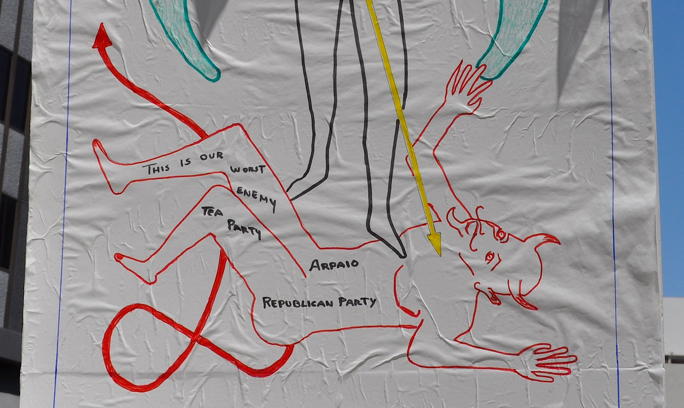
Happy Thanksgiving

Occupier Bianca Piemonte, 21, above, will be spending Thanksgiving with family away from tent city (photo courtesy of the Boston Herald).

It looks as though even some of the Occupy Wall Street people can’t resist the warm allure of heading home for the holidays — despite the fact that these folks are against the true spirit of Thanksgiving:


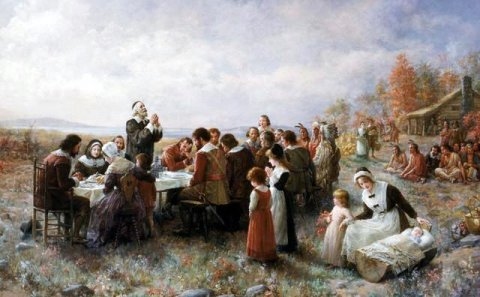
Happy Thanksgiving, everyone.


Michael Moore: Old Fashioned Capitalism When “Wealth Was Shared”

In a recent interview with CNN’s Piers Morgan, socialist documentarian Michael Moore — who, not coincidentally, made a socialist propaganda movie called Capitalism: A Love Story — revealed Monday (September 27th, 2011) what we all already knew: he has no understanding whatsoever of what capitalism really is.

The video clip won’t embed, but you can watch it here (and I suggest you do).

This is what Michael Moore said:

When you say the word capitalism, you have to talk about it in its current sense. You can’t told about the old days or the way maybe, you know, Adam Smith. The sort of old capitalism….

[In the] old days when you worked hard and prospered, everyone else prospered as well. And not only that, as you prospered, the wealth was shared with your employees, with the government. Everybody had a piece of the pie. You, who started the business or invented the light bulb or whatever, you got a bigger piece of the pie. And you know what, nobody cared because you invented the light bulb. That was a pretty cool thing….

None of the major religions, in fact they all, say it’s one of the worst sins you could commit, is to take such a large piece of the pie while others suffer.

Isn’t that heavy?

But the truth is, capitalism is the diametric opposite of what Michael Moore would have you believe.

What is capitalism?

Capitalism is a social system based upon private ownership of the means of production and the preeminence of the individual over the group.

This issue — capitalism-versus-socialism — hinges upon one thing, and this one thing is the only thing you’ll ever need to know about the subject: private ownership (capitalism) versus public or government ownership (socialism).

Do we each own ourselves and (corollarily) our property?

Or do others own us and our property?

Money is property.

Capitalism is an entire political theory — not, as is sometimes supposed, merely economic.

The exclusively economic component of capitalism can be described as the right to life, liberty, and property applied to commerce and industry.

Pure laissez-faire capitalism, which does not exist now and has never existed fully, means that government removes itself from all commerce (and that includes healthcare), in the same way that government removes itself from the bedroom.

In addition to early America, there is at least one other society that has come close to laissez faire capitalism:

“After the War Hong Kong had no minimum wage, low and simple taxes, zero tariffs, zero capital controls, and a stable legal environment. Postwar Hong Kong went as far with economic laissez faire as any other country in history. This resulted in economic development that benefited virtually all the people of Hong Kong. Living standards increased substantially even for the poorest people in Hong Kong” (Stefan Karlsson, “Inflation Leads to Protectionism,” 2004).

Capitalism means that commerce and industry are entirely privatized.

Corporations that receive government subsidies are not capitalistic. They’re the opposite: they’re mercantilistic.
The same is true of small businesses and farms that receive subsidies.

Trade tariffs are not capitalistic but mercantilistic.

Mercantilism is an ancient and more primitive form of socialism. It is socialism before Karl Marx.

Political theory is the theory of government, and government, properly defined, is the body politic that possesses rule over a certain specified geographic region.

Economics is the science of production and exchange, but production does not just mean agriculture, although that is certainly included.

Productive work is any kind of work geared toward the task of survival — survival in the fully human sense of the word, including, therefore, arts, sports, industry, and so on.

Thus the essential questions of government are these:

Do humans exist by right or by permission?

Are we free by nature?

If so, why?

Are we free to produce, exchange, and exist, or do politicians, elected or not, have authority and jurisdiction over the lives of us — to any degree?

Obviously, there’s only one sane answer to all these questions; for to say that humans do not exist by right is the same as saying humans only exist when someone permits us to. But if that were true, we must then ask: who permits? And why? And who gives these people permission?

Fundamentally, political freedom can be achieved only through recognizing each and every single individual’s right to life.

If, then, you believe that we are each individuated and sovereign, and if you believe that our lives are entirely our own and not the government’s and not another’s, if, in short, you believe “we each have a property in our person,” as John Locke said, then you believe in the inalienable right to life, liberty, and property.

You believe, therefore, in laissez-faire capitalism.


More here on the many permutations of socialism.

The Left-Winger’s Big, Big Problem

It is the insurmountable flaw in all leftist philosophy, the insoluble contradiction, the problem that cannot be overcome: No matter what form that leftist philosophy takes — whether it be progressive, egalitarian, democratic-socialist, welfare-statist, communistic, or any other name those of this mindset wish to call it — in order to redistribute wealth, there must first be wealth to redistribute.

Somebody must produce, and the left-winger cannot exist without this person.

The welfare state cannot exist without the producers of welfare.

For exactly this reason, the left-winger is at the mercy of the very person he seeks to plunder. The left-winger relies on those he so often denigrates.

The state by definition cannot produce. It is (by definition) an agency of force. If you have any doubt about that, consider this:

The state cannot spend or redistribute a single cent unless it first either borrows, taxes, or prints.

As Janet Daley so felicitously phrased it in her recent London Telegraph article:

This was the heaven on earth for which liberal democracy had been striving: a system of wealth redistribution that was merciful but not Marxist, and a guarantee of lifelong economic and social security for everyone that did not involve totalitarian government. This was the ideal the European Union was designed to entrench. It was the dream of Blairism, which adopted it as a replacement for the state socialism of Old Labour. And it is the aspiration of President Obama and his liberal Democrats, who want the United States to become a European-style social democracy.

But the US has a very different historical experience from European countries, with their accretions of national remorse and class guilt: it has a far stronger and more resilient belief in the moral value of liberty and the dangers of state power. This is a political as much as an economic crisis, but not for the reasons that Mr Obama believes. The ruckus that nearly paralysed the US economy last week, and led to the loss of its AAA rating from Standard & Poor’s, arose from a confrontation over the most basic principles of American life.

Contrary to what the Obama Democrats claimed, the face-off in Congress did not mean that the nation’s politics were “dysfunctional”. The politics of the US were functioning precisely as the Founding Fathers intended: the legislature was acting as a check on the power of the executive.

The wealth that the left-winger wishes to “spread around,” as Barack Obama famously put it, must originate somewhere.

Where?

Only one place: production.

That in a nutshell is the awesome logic of Say’s Law.

Production, said Jean Baptiste Say, is everything.

He was correct.

Capitalism, as the very name implies, is the engine of capital production.

But what is capital?

Capital is the the amount of wealth owned by a person or a business. Capital is a form of property, and it can, if the owner of that capital chooses, be used to invest. I emphasize that word because investment is the backbone of production, which is the backbone of job creation.

Without wealth, humans are impoverished. Thus, for humans the production of wealth is survival.

Ultimately nothing more fundamental than labor is required for the production of wealth.

Production = life.

Money merely symbolizes wealth. Money is not wealth in and of itself but only a representative.

When money is debased, as it is when, for example, it’s printed without real wealth (i.e. production) backing it, it loses its value. In this way, government has the power to indirectly divest the value of the savings that people have spent their lives accumulating: by printing money that can’t be backed by real wealth, government thereby strips money of its worth. When too much money is printed, the money inflates, and a dollar is no longer worth a dollar.

The left-winger’s big, big problem, which the right-winger has to his detriment also accepted (albeit tacitly), is rooted in the misbegotten belief that if government doesn’t provide it, humans interacting freely will not get it done. That is the source of the insoluble flaw in all leftist thought, which in turn has a deeper source: the belief that human survival should be assured.


The Man Without A Plan

I thought the following was exceptionally accurate.

From ex-liberal Roger Simon:

President Obama’s been taking a lot of flak lately for not having a plan. First it was about Libya, but now — even more importantly because, as we know, all politics is local (until it’s not) — about the budget.

The latest White House porte-parole Jay Carney has consequently been taking all kinds of in-coming himself about “where’s the President’s budget plan,” “why doesn’t he have a plan,” etc.

Well, the reason for the latter is simple: because he can’t. The minute the president evinces a budget plan, the game is up. No liberal budget will stand up to scrutiny. There is no money left for deficit spending in our aging society. The welfare state is kaput. It’s gone — probably for generations to come.

Of course, there’s always that canard about taxing the rich. That will save things. But the truth is even if you tax the rich at 100%, it barely sets back our entitlement crisis a year or two, while virtually bankrupting the few job creators who remain.

So no wonder Obama doesn’t have a plan. What would it be?

Rich Miniter put a fine point on it in a recent article for Forbes, “Why the Democratic Party is Doomed.”

The Democratic Party, as we have known it for the past 70 years, is now in its last days.

Yes, the House Republicans may raise the debt ceiling for a mix of spending cuts and revenue raisers. Yes, Barack Obama may win the 2012 presidential contest. Yes, bureaucrats and judges will continue to impose new and costly regulations on the economy.

But it doesn’t matter. The long-term trends are almost all bad news for the left wing of the party.

This week’s fight over raising the federal debt limit exposes a key weakness in the warfare-welfare state that has bestowed power onto the Democratic Party: Without an ever-growing share of the economy, it dies.

Miniter’s right. As an ex-lib, it almost makes me feel sorry for liberals. But I’m not because too many of them are still playing ostrich. One lib friend just sent me an email — I’m still somehow on her list — trumpeting a 1954 (!) quote from Eisenhower: “Should any political party attempt to abolish social security, unemployment insurance, and eliminate labor laws and farm programs, you would not hear of that party again in our political history.”

I guess the implication here is that’s what Republicans are trying to do, when, especially in the case of Social Security, they are the only ones making a serious effort to save it (see Paul Ryan). But liberals must preserve their delusions — and actually not read the small print, in Ryan’s proposal or anybody else’s. After all, they are people with no plans. Why should anybody else have them?

(Link)

Whether people recognize it or not is beside the point: the welfare state is doomed by definition because in order to have the wealth to redistribute, one must first have someone producing that wealth, which (in turn) requires capital — as in capitalism — and that pool will pretty quickly dry up, especially when you vilify and punish the producers.


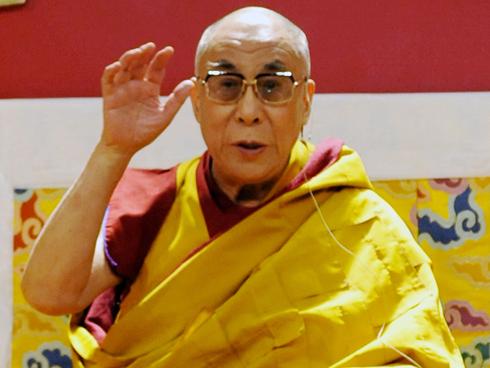
Dalai Lama Discloses How Unenlightened He Is

The Dalai Lama — a nominal voice for platitudes of “peace and compassion,” and whom many regard as a kind of messiah — just recently revealed how unenlightened he actually is, telling a group of Chinese students at the University of Minnesota, that he, the Dalai Lama, is, (and I quote) “a Marxist” — though, he hastened to add, “not a Leninist.”

This, understand, is coming not from a Barack Obama type, who preaches Marxism all while enjoying the benefits and comforts and wealth that capitalism brings, but rather from a man who has experienced firsthand the atrocities of Marxism. It is, when you stop and think about it, an amazing thing. From journalist Tsering Namgyal:

Last week, when the Dalai Lama was in Minneapolis, I had a chance to go to a conference attended by nearly 150 Chinese students. Luckily, I ended up being privy to a fascinating meeting. I sat at the back of the slightly-overheated and jam-packed conference hall of a hotel in downtown Minneapolis, and the Dalai Lama engaged with the students on topics ranging from Mao to Marxism to China-Tibet relations.

… Midway through the conversation, His Holiness, much to their surprise, told them “as far as socio-political beliefs are concerned, I consider myself a Marxist.” “But not a Leninist,” he clarified.

During the question and answer session, a student said that the Marxists these days criticize consumerism because they do not understand the difference between “consumption” and “consumerism.” He also asked about the contradiction inherent in the Dalai Lama’s economic philosophy and Marx’s critique of religion. The Tibetan leader answered that the Marx was not against religion or religious philosophy per se but against religious institutions that were allied, during Marx’s time, with the European ruling class. He also provided an interesting anecdote about his experience with Mao. He said that Mao had felt that the Dalai Lama’s mind was very logical, implying that Buddhist education and training help sharpens the mind. He said he met with Mao several times, and that once, during a meeting in Beijing, the Chinese leader called him in and announced: “Your mind is scientific!”—an assessment that was followed by the famous line, ”religion is poison.”

…Marxism, purported to be the guiding philosophy of the Chinese Community Party, has been replaced by American style capitalism in China. But the author of Das Kapital must be laughing in his grave for gaining new converts in the West, particularly in the academia, following the global financial crisis.

(Link)


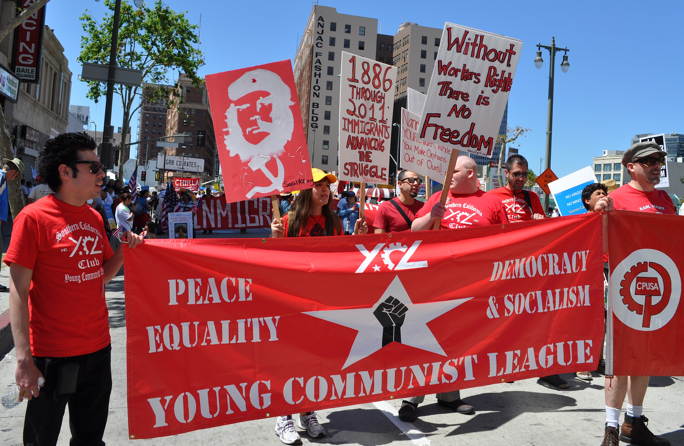
Labor Unions And Their Communist Allies

As I’ve long said: labor unions and communism go together like white wine and fish.

Anonymous photo journalist Zombie recently confirmed that.

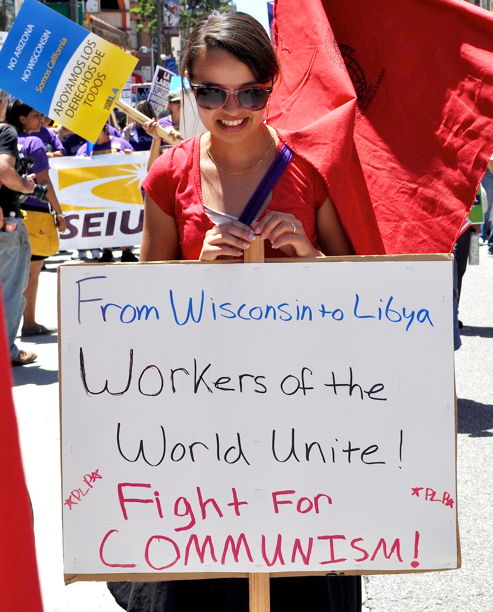
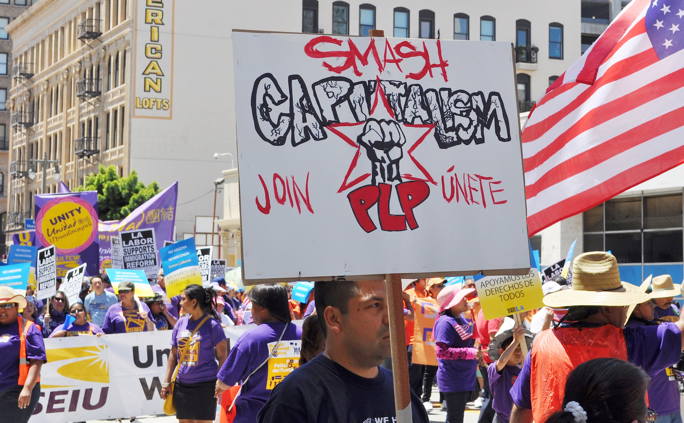
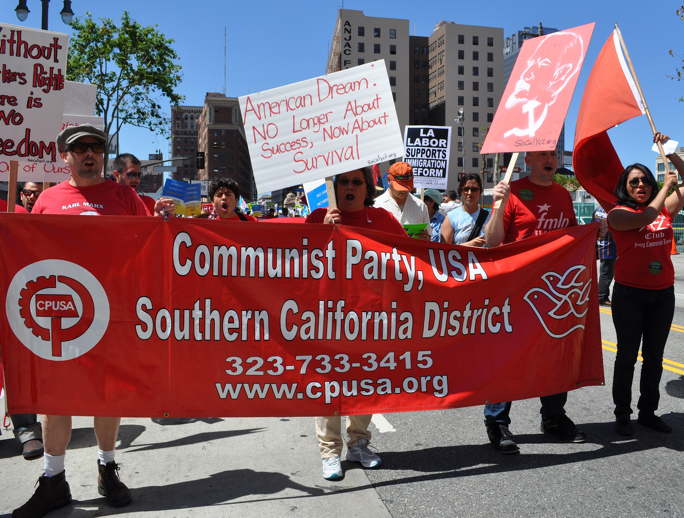
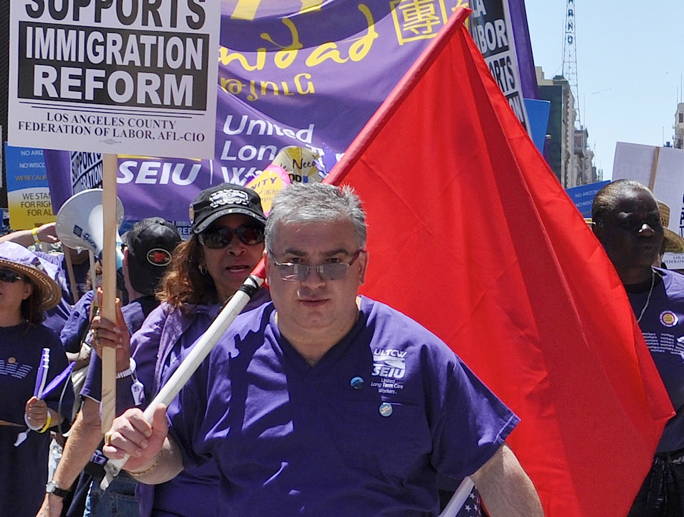
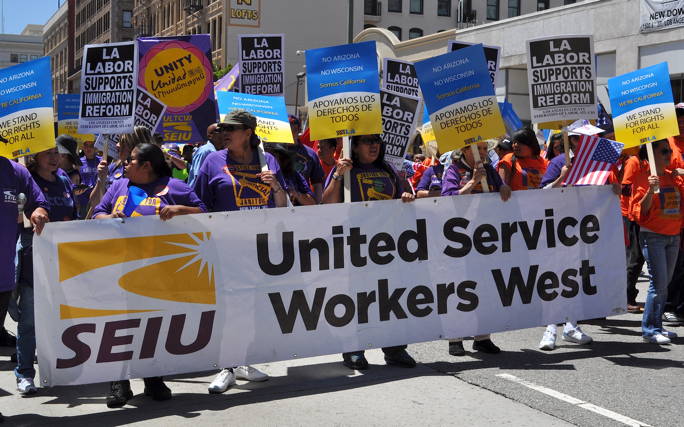
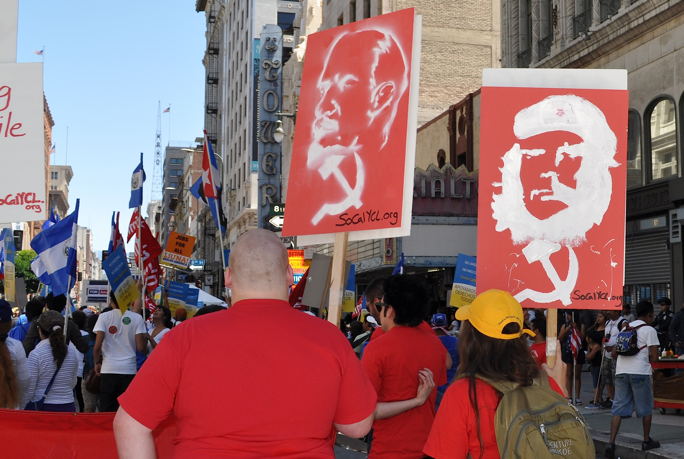
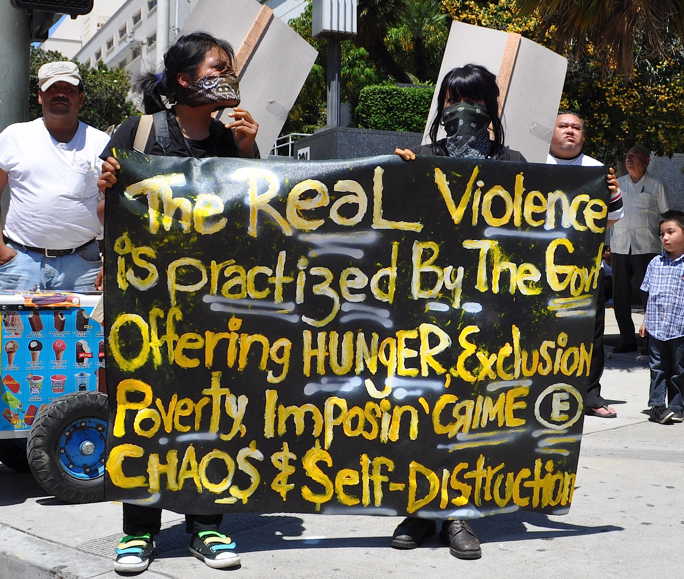
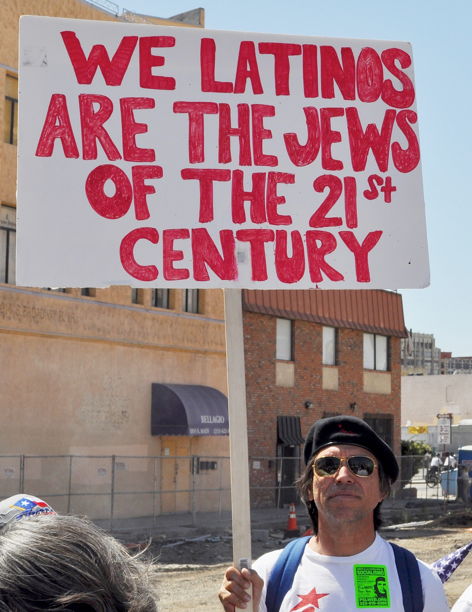
The following photos were captured by Zombie on May 5, 2011, at the May Day rally in downtown Los Angeles. This event was co-sponsored by the SEIU — a gigantic socialist labor organization that Barack Obama is famously fond of:

Barack Obama:

Everybody: There’s not a presidential candidate, a gubernatorial candidate, a congressional candidate, who won’t tell ya, that they’re pro-union, when they’re looking for their endorsements. They’ll all say, ‘Oh we love SEIU.’ But the question you gotta ask yourself is, do they have it in their gut, do they have a track record of standing alongside you on picket lines? Do they have a track record of going after the companies that aren’t letting you organize? Do they have a track record of voting the right way? But also helping you organize to build more and more power?

And some of you know I come from an organizing background, so — I’ve been working with the SEIU before I was elected to anything. When I was a community organizer, SEIU Local 880 and myself we organized people, to make sure that healthcare workers had basic rights; we organized voter registration drives, that’s how we built political power on the South Side of Chicago….and now the time has come for us to do it all across this country, and then we’ll paint the nation purple, with SEIU!

I would not be a United States Senator had it not been for the support of your brothers and sisters in Illinois. Those folks, they supported me early, they supported me often. I’ve got my purple windbreaker from my campaign in 2004.

And so, we’ve just got, what, four more days? Four more days of knocking on some doors. Four more days of working the precinct. Four more days of making sure all your co-workers are caucusing. SEIU, I am glad you are with me, let’s together change the country! SEIU! SEIU! SEIU! SEIU! SEIU!”

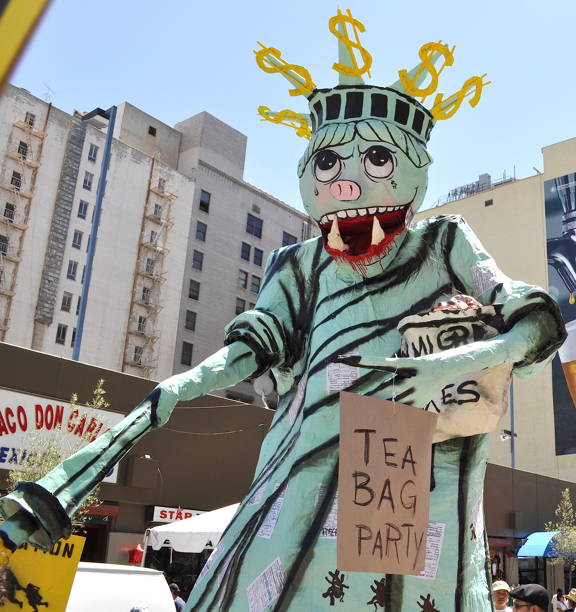
Here are Zombie’s unforgettable photos:

Note the red flag this SEIU communist is carrying

Douche


Please read Zombie’s full post here.


The REAL History of Thanksgiving

In May of 1606, the first American settlers arrived in Jamestown.

What they found when they came to the Virginia Tidewater Region, which is where these original 104 set up their colony, was a breathtakingly fertile chunk of land. So it was that these first American settlers discovered more resources than they could at first believe: oceans teeming with seafood, the woodlands swarming with birds, inexhaustible game, a soil that grew everything.

Yet within half a year only 38 of the original 104 settlers were still alive, the rest having succumbed to famine.

Not two years later, 500 more people were sent to refresh the devastated settlers.

Within half a year, the majority of these new arrivals — 440, to be precise — had died of starvation or disease.

Cannibalism was not uncommon.

The resources were still as plentiful and rich as ever before — hardly tapped, in fact — and so what went wrong?

This is an extraordinary period in America’s history; as it happens, it provides us with a real-life illustration of collectivism-versus-private property in action.

You can read more about it in Tom Bethell’s excellent book: The Noblest Triumph: Property and Prosperity Through the Ages.

You see, the original American settlers had intentionally adopted a socialist policy: specifically, communal ownership of property. As a direct result, most of these people starved to death, or were killed off by disease — the very same problem, it turns out, that has been occurring steadily three centuries later in every country that’s collectivized its economy, particularly its agriculture.

As one early Jamestown eyewitness, a man by the name of George Percy, described it (in his antiquated English):

“[The cause of] famine was want of providence, industrie … and not the barennesse and defect of the Countri, as is generally supposed” (Warren M. Billings, George Percy’s Account of the Voyage to Virginia and the Colony’s First Days).

But how could this possibly have been? How could people such as this have “lacked industrie” when many of these people were specifically chosen for having the exact opposite character?

The answer to this question is not particularly difficulty to fathom. On the contrary, the answer is deceptively simple: the people of Jamestown had no financial stake in their endeavors. Indeed, they were little more than indentured servants. Thus everything they produced went into a public pool. Working harder and longer, therefore, did not benefit any one person any more than another. And so these people responded exactly as humans always will in such a situation: they simply didn’t work harder — any of them.

In his book, Mr. Bethel notes what some few insightful economists have been saying for a long time: lack of work and “industrie” go hand-in-hand with lack of property rights.

Or as Philip Alexander Bruce said, in an article about these very Jamestown settlers:

“[They] did not have even a modified interest in the soil … Everything produced by them went into the [public] store, in which they had no ownership.”

Thus, all grew idle and most, in the end, refused to work at all.

“The absence of property rights – and of the work-reward nexus that such rights create – completely destroyed the work ethic of the settlers” (Thomas Dilorenzo, How Capitalism Saved America).

Frustrated, flummoxed, flailing, the British government, which had financed the colonization, sent in 1611 a man named Sir Thomas Dale to serve as “High Marshal of the Virginian Colony.” Listen closely to what Mr. Dale observed; it is astounding and yet perfectly predictable:

“Dale noted that although most of the settlers had starved to death, the remaining ones were spending much of their time playing games in the streets, and he immediately identified the problem: the system of communal ownership” (Ibid).

It was then that the High Marshal Sir Thomas Dale gave every man three acres of land for each to own unto himself. He simultaneously did away with pooling into a communal treasury. Private property, in other words, was officially enacted and public ownership abolished.

Immediately the colony began to prosper.

The notorious “free-rider problem,” endemic to socialism of every strain, vanished as each person became his own master – as each person bore the full brunt of inaction and non-productivity. At the same time, every person had incentive to work harder since harder work meant greater prosperity and a direct benefit to each from that labor.

One of the fundamental flaws of socialism of every stripe is that it assumes that people will work just as hard or harder for others as they will work for themselves. This is untrue. It’s untrue because it is contrary not only to human nature but also to the nature of life. Jamestown shows us a historical illustration of this writ large.

“As soon as the settlers were thrown upon their own resources,” says historian Mathew Anderson, “and each freeman had acquired the right of owning property, the colonists quickly developed what became the distinguishing characteristic of Americans — and aptitude for all kinds of craftsmanship coupled with an innate genius for experimentation and invention” (The Old Dominion, Vol. 1, University of Virginia).

Other propitious things began to happen as well.

“The Jamestown colonists had originally implored the Indians to sell them corn, but the Indians looked down on the settlers because [the settlers] were barely capable of growing corn, thanks to their communistic economics. After the introduction of private property and the resulting transformation, however, the Indians began coming to the colonists to acquire corn in return for furs and other items” (Ibid).

Thus began a friendly system of free-trade.

The division of labor — an absolutely indispensable component of private property, which promotes specialization of labor, insofar as each is no longer forced to produce all his own food since he can now trade specialty items for specialty products others produce — was instantly born. In addition to this explosion of prosperity, there was also greater peace:

It made no sense now for either side — Indians or settlers — to war with the other, because free-trade was advantageous to each. Whereas, prior to Sir Thomas Dale’s instituting of private property, the settlers used “to steal from the Indians,” and even “beg from them,” a fact which the Indians quite naturally resented.

In Jamestown, the institution of private property changed all this.

But there’s more to the story, much more.

Not many years later, in November of 1620, another group of American settlers — 101 of them, to be exact, this group not financed by the British government — arrived on the good ship Mayflower, in Cape Cod, Massachusetts.

These Pilgrims, as they were called, moved a short distance away to a place named Plymouth. They were not at all unaware of the early Jamestown disaster, the starvation, the disease, the famine; they were, however, unaware of what had caused it.

Accordingly, they proceeded to make the identical mistake that the settlers of Jamestown had made: namely, collective ownership of land.

And the Pilgrims too paid dearly for it.

Within a few short months, half were dead.

Over the course of the next three years, 100 more settlers arrived from England to Plymouth, all of whom were barely able to feed themselves. As Plymouth Colony Governor William Bradford wrote in his famous Of Plymouth Plantation:

“Many [settlers] sold away their clothes and bed coverings [to the Indians]; others (so base were they) became servants of the Indians … and fetch them water for a capful of corn; others fell to plain stealing, both day and night, from the Indians…. In the end, they came to that misery that some starved to and died with cold and hunger. One in gathering shellfish was so weak as he stuck fast in the mud and was found dead in the place.”

But this same William Bradford would soon solve “the ruin and dissolution of his colony,” and he would do it in the exact same way Sir Thomas Dale had saved Jamestown.

Here’s another famous passage from William Bradford’s book:

“After much debate of things … [it was decided that the Pilgrims] should set corn every man for his own particular, and in that regard trust to themselves … And so assigned to every family a parcel of land, for present use. This had very good success, for it made all hands very industrious, so as much more corn was planted than otherwise would have been by any means the Governor or any other could use, and saved him a great deal of trouble, and gave far better content. The women now went willingly into the field, and took their little ones with them to set corn; which before would allege weakness and inability; whom to have compelled would have been thought great tyranny and oppression.”

Bradford came to fully grasp how lack of property rights negates and indeed destroys the work incentive:

“For [men] and men’s wives,” he said, “to be commanded to do service for other men, as dressing their meat, washing their clothe, etc., they deemed it a kind of slavery, neither could many husband brook it” (Ibid).

“Common course” was abandoned in favor of setting “every man for his own particular,” meaning private property. Instantaneously, those who had been indolent became “very industrious,” so much so that woman and men who had “previously pleaded frailty worked long and hard – once they saw how they and their families could benefit from such hard work.”

William Bradford went on to correctly identify the source of the “disastrous problem” as “that conceit of Plato’s,” who, in direct contrast to Aristotle, advocated collectivism and collective ownership of land, which, as history has repeatedly proven, is pure poison to any society that implements it. Bradford even wrote later that those who mistakenly believed that communal property could make people “happy and flourishing” imagined themselves “wiser than God.”

Next time you hear Barack Obama, or Nancy Pelosi, or Noam Chomsky, or Howard Zinn, or any of the other Neo-Marxists propounding that “some” property should be “collectivized,” remember America’s real history.

Remember also how collectivization obliterates the work incentive, the survival instinct, and human industry.

Remember the real-life history of early America and the total failure of collectivization, which is actually a failure of lunacy.

Remember that not once in the history of the world has a communistic system ever flourished.

Remember that our lives, each and every one of us, are absolutely and inalienably our own, and by direct extension that means our property is absolutely and inalienably our own. Nobody may rightfully take any of that property from you without your permission, not for any reason, not in any amount, not even for the so-called “common good.”

Remember also that being compelled to serve the collective is a slow painful death to each member of that “collective.”

Finally, remember this:

“The Pilgrims had encountered what is called the free-rider problem, which is difficult to solve without dividing property into individual or family-sized units. And this is the course of action that William Bradford wisely took” (Tom Bethell, The Noblest Triumph).

Wisely because it set the trend for all that would make America what she would eventually become: a land of independence, industriousness, ingenuity, experimentation, invention, genius, and greatness.

Freedom and its economic corollary, capitalism, saved us in the beginning.

Communism, Socialism, And Welfare Statism

A reader writes:

Dear Mr. Harvey: What is the difference between communism, democratic socialism, and welfare statism?

– Sincerely Confused

Dear Sincerely Confused: First of all, Mr. Harvey is my dad. Please call me Ray.

Communism is a species of the genus socialism; it is one of the many variations on that tired theme. Communism explicitly calls for the violent overthrow of government. In theory, it is an anarchist ideology, believing that the state will one day magically “wither away,” as Karl Marx famously phrased it, though only after an unspecified period of gigantic bureaucratic control. Of course, in the long and blood-soaked history of communism, the state has never withered away, and never will. Why? Once entrenched, bureaucracy is impossible to retrogress away from.

Democratic socialism, on the other hand, doesn’t advocate the violent overthrow of government but intends to use force peacefully. By definition, by its very nature, socialism must resort to force because it must expropriate people’s money and other property in order to redistribute it. That is the distinguishing characteristic of any and all forms of socialism: government control of property and the means of production (which is one of the reasons so-called corporatism is another variation on socialism).

One must never forget: socialism is by definition an ideology of force.

Not all liberals are socialists — in large part because most of them don’t even know what “socialism” means, and it is for this reason also that many liberals, and, for that matter, many conservatives, are socialists and do not even know it.

Welfare statism is not exactly the same thing as democratic socialism. Welfare statism wants all the wealth and advantages that capitalism and private property creates, but at the same time, it wants to undermine the very things that makes all that wealth possible. Welfare statism takes for granted the advantages of capitalism — it wants to hold power over the producers of wealth — yet it wants those same wealth-producers to keep producing it for them. It is a short-sighted ideology the prevalence of which dominates academia from sea to shining sea.

The welfare state, which is what we live in today and have for some time, is the result of what von Mises called the “hampered or mixed market economy.” It is not identical to socialism proper, primarily because it is not explicit enough, but it too is a variation on the same theme.


Middle-of-the-Road Policy Leads to Socialism

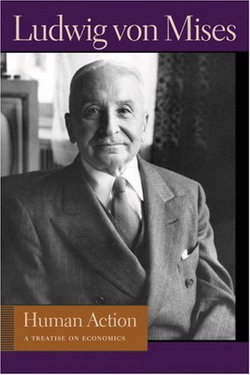
Economics deals with society’s fundamental problems; it concerns everyone and belongs to all. It is the main and proper study of every citizen (Ludwig von Mises, Human Action).

The following address was delivered before the University Club of New York, April 18, 1950, by Doctor Ludwig von Mises:

How Middle-of-the-Road Policy Leads to Socialism

The fundamental dogma of all brands of socialism and communism is that the market economy or capitalism is a system that hurts the vital interests of the immense majority of people for the sole benefit of a small minority of rugged individualists. It condemns the masses to progressing impoverishment. It brings about misery, slavery, oppression, degradation and exploitation of the working men, while it enriches a class of idle and useless parasites.

This doctrine was not the work of Karl Marx. It had been developed long before Marx entered the scene. Its most successful propagators were not the Marxian authors, but such men as Carlyle and Ruskin, the British Fabians, the German professors and the American Institutionalists. And it is a very significant fact that the correctness of this dogma was contested only by a few economists who were very soon silenced and barred from access to the universities, the press, the leadership of political parties and, first of all, public office. Public opinion by and large accepted the condemnation of capitalism without any reservation.

1. Socialism

But, of course, the practical political conclusions which people drew from this dogma were not uniform. One group declared that there is but one way to wipe out these evils, namely to abolish capitalism entirely. They advocate the substitution of public control of the means of production for private control. They aim at the establishment of what is called socialism, communism, planning, or state capitalism. All these terms signify the same thing. No longer should the consumers, by their buying and abstention from buying, determine what should be produced, in what quantity and of what quality. Henceforth a central authority alone should direct all production activities.

2. Interventionism, Allegedly a Middle-of-the-Road Policy

A second group seems to be less radical. They reject socialism no less than capitalism. They recommend a third system, which, as they say, is as far from capitalism as it is from socialism, which as a third system of society’s economic organization, stands midway between the two other systems, and while retaining the advantages of both, avoids the disadvantages inherent in each. This third system is known as the system of interventionism. In the terminology of American politics it is often referred to as the middle-of-the-road policy. What makes this third system popular with many people is the particular way they choose to look upon the problems involved. As they see it, two classes, the capitalists and entrepreneurs on the one hand and the wage earners on the other hand, are arguing about the distribution of the yield of capital and entrepreneurial activities. Both parties are claiming the whole cake for themselves. Now, suggest these mediators, let us make peace by splitting the disputed value equally between the two classes. The State as an impartial arbiter should interfere, and should curb the greed of the capitalists and assign a part of the profits to the working classes. Thus it will be possible to dethrone the moloch capitalism without enthroning the moloch of totalitarian socialism.

Yet this mode of judging the issue is entirely fallacious. The antagonism between capitalism and socialism is not a dispute about the distribution of booty. It is a controversy about which two schemes for society’s economic organization, capitalism or socialism, is conducive to the better attainment of those ends which all people consider as the ultimate aim of activities commonly called economic, viz., the best possible supply of useful commodities and services. Capitalism wants to attain these ends by private enterprise and initiative, subject to the supremacy of the public’s buying and abstention from buying on the market. The socialists want to substitute the unique plan of a central authority for the plans of the various individuals. They want to put in place of what Marx called the “anarchy of production” the exclusive monopoly of the government. The antagonism does not refer to the mode of distributing a fixed amount of amenities. It refers to the mode of producing all those goods which people want to enjoy.

The conflict of the two principles is irreconcilable and does not allow for any compromise. Control is indivisible. Either the consumers’ demand as manifested on the market decides for what purposes and how the factors of production should be employed, or the government takes care of these matters. There is nothing that could mitigate the opposition between these two contradictory principles. They preclude each other. Interventionism is not a golden mean between capitalism and socialism. It is the design of a third system of society’s economic organization and must be appreciated as such.

3. How Interventionism Works

It is not the task of today’s discussion to raise any questions about the merits either of capitalism or of socialism. I am dealing today with interventionism alone. And I do not intend to enter into an arbitrary evaluation of interventionism from any preconceived point of view. My only concern is to show how interventionism works and whether or not it can be considered as a pattern of a permanent system for society’s economic organization.

The interventionists emphasize that they plan to retain private ownership of the means of production, entrepreneurship and market exchange. But, they go on to say, it is peremptory to prevent these capitalist institutions from spreading havoc and unfairly exploiting the majority of people. It is the duty of government to restrain, by orders and prohibitions, the greed of the propertied classes lest their acquisitiveness harm the poorer classes. Unhampered or laissez-faire capitalism is an evil. But in order to eliminate its evils, there is no need to abolish capitalism entirely. It is possible to improve the capitalist system by government interference with the actions of the capitalists and entrepreneurs. Such government regulation and regimentation of business is the only method to keep off totalitarian socialism and to salvage those features of capitalism which are worth preserving.

On the ground of this philosophy, the interventionists advocate a galaxy of various measures. Let us pick out one of them, the very popular scheme of price control.

4. How Price Control Leads to Socialism

The government believes that the price of a definite commodity, e.g., milk, is too high. It wants to make it possible for the poor to give their children more milk. Thus it resorts to a price ceiling and fixes the price of milk at a lower rate than that prevailing on the free market. The result is that the marginal producers of milk, those producing at the highest cost, now incur losses. As no individual farmer or businessman can go on producing at a loss, these marginal producers stop producing and selling milk on the market. They will use their cows and their skill for other more profitable purposes. They will, for example, produce butter, cheese or meat. There will be less milk available for the consumers, not more.

This, or course, is contrary to the intentions of the government. It wanted to make it easier for some people to buy more milk. But, as an outcome of its interference, the supply available drops. The measure proves abortive from the very point of view of the government and the groups it was eager to favor. It brings about a state of affairs, which again, from the point of view of the government, is even less desirable than the previous state of affairs which it was designed to improve.

Now, the government is faced with an alternative. It can abrogate its decree and refrain from any further endeavors to control the price of milk. But if it insists upon its intention to
keep the price of milk below the rate the unhampered market would have determined and wants nonetheless to avoid a drop in the supply of milk, it must try to eliminate the causes
that render the marginal producers’ business unremunerative.

It must add to the first decree concerning only the price of milk a second decree fixing the prices of the factors of production necessary for the production of milk at such a low rate that the marginal producers of milk will no longer suffer losses and will therefore abstain from restricting output. But then the same story repeats itself on a remoter plane. The
supply of the factors of production required for the production of milk drops, and again the government is back where it started. If it does not want to admit defeat and to abstain from any meddling with prices, it must push further and fix the prices of those factors of production which are needed for the production of the factors necessary for the production of milk. Thus the government is forced to go further and further, fixing step by step the prices of all consumers’ goods and of all factors of production, both human, i.e., labor, and material, and to order every entrepreneur and every worker to continue work at these
prices and wages.

No branch of industry can be omitted from this all-round fixing of prices and wages and from this obligation to produce those quantities which the government wants to see produced. If some branches were to be left free out of regard for the fact that they produce only goods qualified as non-vital or even as luxuries, capital and labor would tend to flow into them and the result would be a drop in the supply of those goods, the prices of which government has fixed precisely because it considers them as indispensable for the satisfaction of the needs of the masses. But when this state of all-round control of business is attained, there can no longer be any question of a market economy. No longer do the citizens by their buying and abstention from buying determine what should be produced and how.

The power to decide these matters has devolved upon the government. This is no longer capitalism; it is all-round planning by the government, it is socialism.

Please read the rest of this brief but edifying essay here.


Political Theory: Theory of Government

Political theory is the theory of government. It is a sub-branch of ethics, and economics, in turn, is a sub-branch of politics.

Ethics — the science of human action — precedes politics because politics is the science of human action in societies, and societies are composed only of individuals. For this reason, the individual has hierarchical primacy.

Capitalism, socialism, communism, anarchy — these are all a species of the genus ethics, as is any specific political theory.

Governments, properly defined, are the body politic that have the power to make and implement the laws of the land, and humans are the only species who possess them. But what ultimately gives rise to these political bodies, and do we really need them at all? If so, why?

Some 40,000 years ago, when Homo sapiens sapiens first emerged, we existed exclusively in bands and small tribes.

A band is the smallest of societies, consisting of five to seventy-five people, all of whom are related either by birth or marriage.

Tribes, the next size up, consist of hundreds of people, not all of whom are related, although everyone is known by everyone else.

It is for this reason that conflicts in band and tribal life are resolved without the need of government. Indeed, it’s a well-established fact among anthropologists that governments do not exist in societies of this size.

As Jared Diamond appositely explains it in his otherwise overrated Guns, Germs, and Steel:

“Those ties of relationships binding all tribal members make police, laws, and other conflict-resolving institutions of larger societies unnecessary, since any two villagers getting into an argument will share kin, who apply pressure on them to keep it from becoming violent.”

Homo sapiens lived for approximately 40,000 years in just such non-governmental societies.

Around 5,500 BC, however, chiefdoms arose.

Chiefdoms are one size up from tribes but still smaller than nations.

These societies have populations that number in the thousands or even tens of thousands, whereas nations consist of fifty thousand people or more.

It is at the stage of chiefdoms that the necessity of government begins; for when populations increase to this size, the potential for conflict and disorder increases proportionally.

And here we get a glimpse of government’s primary function: to protect against conflict.

As long as the potential for conflict exists among humans, the need for protection and adjudication exists as well.

“With the rise of chiefdoms around 7,500 years ago, people had to learn, for the first time in history, how to encounter strangers regularly without attempting to kill them…. Part of the solution to that problem was for one person, the chief, to exercise a monopoly on the right to use force” (Ibid, p. 273).

The legal use of force is the defining characteristic of government.

It is also the fundamental difference between governmental action and private action.

In the words of Auberon Herbert, speaking over 100 years ago:

Nobody has the moral right to seek his own advantage by force. That is the one unalterable, inviolable condition of a true society. Whether we are many, or whether we are few, we must learn only to use the weapons of reason, discussion, and persuasion…. As long as men are willing to make use of force for their own ends, or to make use of fraud, which is only force in disguise, wearing a mask, and evading our consent, just as force with violence openly disregards it – so long we must use force to restrain force. That is the one and only one right employment of force … force in the defense of the plain simple rights of property, public or private, in a world, of all the rights of self-ownership – force used defensively against force used aggressively” (Auberon Herbert, The Principles of Voluntaryism, 1897).

Among individuals, the initiation of force is illegal, whether the force is directly used, as in rape, or indirectly used, as in extortion (a crucial distinction, incidentally, which Mr. Herbert notes in his fraud-is-force-in-disguise example above).

People can only infringe upon the rights of other people by means of (direct or indirect) force.

In this sense, government is an institution whose function is to protect the individual against the initiation of force.

In the words of Thomas Jefferson: “The legitimate functions of government extend to such acts only as are injurious to others” (Notes on the State of Virginia).

Around the same time that Thomas Jefferson was writing those words, another articulate fellow by the name of Wilhelm von Humboldt independently came to an almost identical conclusion:

Any State interference in private affairs, where there is no reference to violence done to individual rights, should be absolutely condemned…. To provide for the security of its citizens, the state must prohibit or restrict such actions, relating directly to the agents only, as imply in their consequences the infringement of others’ rights, or encroach on their freedom of property without their consent or against their will…. Beyond this every limitation of personal freedom lies outside the limits of state action (Wilhelm von Humboldt, The Limits of State Action, 1791).

What professor Jared Diamond incorrectly refers to as government’s “right to use force” (governments do not, strictly speaking, possess rights but only permissions) is a sentiment that has been stated more succinctly many times by Enlightenment thinkers, such as the best theoreticians among our Constitutional framers; but it was perhaps expressed most eloquently by the fiery political philosopher Isabel Paterson:

Government is solely an instrument or mechanism of appropriation, prohibition, compulsion, and extinction; in the nature of things it can be nothing else, and can operate to no other end…. Seen in this light, government is so horrific – and its actual operations in the past have been so horrible at times – that there is some excuse for a failure to realize its necessity (Isabel Paterson, The God of the Machine, 1943).

If, however, government only becomes necessary when societies reach the size of chiefdoms or beyond, what precipitated this sudden population leap, when for 40,000 years — by far the majority of our short history — human growth had remained relatively static?

Why, in other words, do we not still exist in bands and tribes, without the need of government?

The answer, it turns out, is food.

“We have seen that large or dense populations arise only under conditions of food production.… All states nourish their citizens by means of food production” (Jared Diamond, Guns, Germs, and Steel).

When survival is made easier, populations increase. When populations increase, societies become more complex. When food production increases, mankind increases, societies become increasingly complex, and governments become necessary to maintain order. So it is with increased food production that the science of economics is born.

At root, economics is indeed the science of production and exchange.

Money, in the form of currency, is nothing more, or less, than a symbol of production — an invaluable one, to be sure, since money simplifies so drastically the process of exchange.

It also creates the possibility to store and save over long time periods and makes usury possible, which in turn creates more wealth. This is a crux because it illustrates the deep connection between politics and economics.

Thus, increased food production equals increased population equals increased production equals more people equals more societal complexity, and so on, reciprocally.

This is the process whereby societies develop the need for government.

This is why the fact of government is inescapable.

Whatever a society’s original size, smaller ones only make that initial leap to larger by producing more food.

(If they don’t make it, they are absorbed either by the actual use of force or by its mere threat, by the societies that do produce more food. For this reason, bands and tribes have become all but obsolete today, with a few Amazonian and New Guinean exceptions, most of which are also being swiftly amalgamated.)

Thereafter, in order for that society to flourish, it must now continue to produce food, but it must also efficiently manage its size increase, with all that ensuing complexity. Countless societies have foundered at this stage, as they still do today (see, for example, present day Yugoslavia, or Turkey, or Russia).

Advancements in irrigation, the domestication of animals, the introduction of fertilizers and pesticides, these things begin to make societies complex, because they increase food production. But with this added complexity come new challenges:

To thrive, these societies must sort out and solve a host of additional problems, ranging from mass uprisings, to increasing economic developments, to internecine warfare, to the threat of governmental takeovers, to crime and punishment, to many, many other things as well.

In the final analysis, then, we can say that governments are unique to humans because humans are the only conceptual species. We produce our food, we build our homes, we create our medicine, we extract our energy, and we deal with one another not as animals, by brute force, but as men, by agreement.

Trade is the natural drive of the conceptual mind.

So that at this point, our world without government would collapse into chaos — until, that is, the strongest faction seized control, forcefully, you can be sure, and then laid down its own version of order (see present day Somalia).

Who would stop them?

Other warring factions?

In the end, however necessary government may be, never forget this:

“In its best state, government is but a necessary evil; in its worst state an intolerable one” (Thomas Paine, Common Sense).

Government, in short, is inherently dangerous because it holds exclusive power over the people.

The task, then, is not necessarily to do away with government altogether but rather to limit government in the extreme: to build a government which protects its citizens without, at the same time, creating oppression of any kind, including taxation to the point of plunder under that mythical guise of a “right” to redistribute your money – which is the symbol of your work.


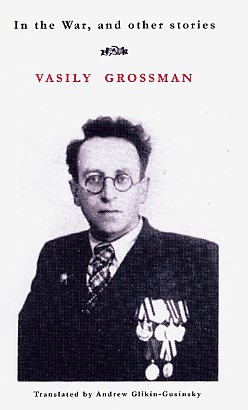
Vasily Grossman

The following is from Chapter 30 of my book Leave Us Alone — A Capitalist Credo:

The Russian writer Vasily Grossman was born in 1905 in what is now the Ukrainian town of Berdichev. At that time, Berdichev was still part of the Russian Empire. Vasily Grossman attended high school in Kiev and then the University of Moscow. He graduated from University in 1929 with a degree in chemical engineering. He worked as an engineer for five years, after which time he devoted himself entirely to writing.

He published his first news article in 1928, his first fictional story in 1934.

During the middle and latter 1930’s Vasily Grossman was exceptionally prolific, and even more so after the start of World War II. At that point he became a correspondent for Red Star (Krasnaya Zvezda). He spent the entire war on the treacherous front, covering, in minute detail, the blood-soaked siege of Stalingrad. In popularity his war reportage was second to none (well, maybe one: the famous Ehrenburg), and Grossman is loosely portrayed by actor Joseph Fiennes in the inaccurate movie Enemy at the Gates.

In his youth and well into his thirties, Vasily Grossman was devoted to the communist philosophy. But during and immediately after the war, he became increasingly disillusioned with that socialist system, so that, starting in 1943, he began explicitly challenging the whole Soviet ideal — both for its repression of freedom and for its anti-Semitism.

His war fiction at this time also began to generate criticism from high Soviet officials. In a matter of months, thus, his writings were suppressed. Over the course of his latter years, Vasily Grossman became an outright opponent of socialism. His writings are, at times, not consistently, among the most eloquent expression of freedom of any person in any era.

Stomach cancer killed him in 1964.

What follows is a short passage from his last novel Forever Flowing. It is one side of a brief dialogue spoken, in part, by the novel’s protagonist Ivan Grigoryevich, who after thirty years of imprisonment has just been released from the Russian Gulag. I quote it as a tribute to freedom, to be sure, but also as a tribute to the man who came to understand the philosophical roots of freedom — and that in a country where freedom was not allowed; in a country where philosophies and freedom were replaced by blind obedience and dogma. It’s important that people like Vasily Grossman are not forgotten.
Please think of the following passage the next time you hear an environmentalist talk about more centralized government and more government ownership of land for the sake of “our endangered environment.”

Please think of it next time you see someone wearing a Che Guevara T-shirt (or necklace) in glorification of Che Guevara’s communistic ideals, or romanticizing communist Cuba and Castro for their healthcare system, or Chairman Mao with the blood of billions on his hands:

I used to think freedom was freedom of speech, freedom of press, freedom of conscience. But freedom is the whole life of everyone. Here is what it amounts to: you have to have the right to sow what you wish to, to make shoes or coats, to bake into bread the flour ground from the grain you have sown, and to sell it or not sell it as you wish; for the lathe operator, the steelworker, and the artist it’s a matter of being able to live as you wish and work as you wish and not as they order you to. And in our country there is no freedom – not for those who write books nor for those who sow grain nor for those who make shoes.

Forever Flowing

Vasily Grossman (1905–1964)


Capitalism


Capitalism is a social system based upon private ownership of the means of production and the preeminence of the individual over the group.

The word capitalism was popularized by Karl Marx, in the 1850′s. Marx used it to denounce private ownership of the means of production and the autonomous workings of the free market.

Capitalism is an entire political theory — not, as is sometimes supposed, merely economic. In this regard — and only in this regard — it is akin to communism.

The exclusively economic component of capitalism may be described as the right to life, liberty, and property applied to commerce and industry.

Pure laissez-faire capitalism, which does not exist now and has never existed fully, means that government removes itself from all commerce (and that includes healthcare), in the same way that government removes itself from your bedroom.

In addition to early America, there is at least one other society that has come close to laissez faire:

After the War Hong Kong had no minimum wage, low and simple taxes, zero tariffs, zero capital controls, and a stable legal environment. Postwar Hong Kong went as far with economic laissez faire as any other country in history. This resulted in economic development that benefited virtually all the people of Hong Kong. Living standards increased substantially even for the poorest people in Hong Kong (Stefan Karlsson, Inflation Leads to Protectionism, 2004).

Capitalism means that commerce and industry are entirely privatized.

Corporations that receive government subsidies are not capitalistic. They’re the opposite: they’re mercantilistic.

The same is true of small businesses and farms that receive subsidies.

Trade tariffs are not capitalistic but mercantilistic.

Mercantilism is an ancient and more primitive form of socialism. It is socialism before Karl Marx.

Political theory is the theory of government, and government, properly defined, is the body politic that possesses rule over a certain geographic region.

Economics is the science of production and exchange, but production does not just mean agriculture, although that is certainly included.

Productive work is any kind of work geared toward the task of survival — survival in the fully human sense of the word, including, therefore, arts, sports, industry, and so on.

Thus the essential questions of government are these:

Do humans exist by right or by permission? Are we free by nature? If so, why? Are we free to produce, exchange, and exist, or do politicians, elected or not, have authority and jurisdiction over the lives of us — to any degree?

Obviously, there’s only one sane answer to all these questions; for to say that humans do not exist by right is the same as saying humans only exist when someone permits us to. But if that were true, we must then ask: who permits? And why? And who gives these people permission?

Fundamentally, political freedom can be achieved only through recognizing each and every single individual’s right to life.

If, then, you believe that we are each individuated and sovereign, and if you believe that our lives are entirely our own and not the government’s and not another’s, if, in short, you believe “we each have a property in our person,” as John Locke said, then you believe in the inalienable right to life, liberty, and property.

You believe, therefore, in laissez-faire capitalism.


Socialism, Nazism, and Environmentalism

The National Socialist German Workers’ Party was founded in 1919 and abolished in 1945. It came into full power under Adolph Hitler in 1933, and proceeded at that time to slaughter a spectacular number of people in a relatively short span of years.

Socialists today are of course universally agreed that Nazism was many things, but socialistic was not one of them.

Indeed, socialists are most emphatic that you understand this point — and for a very good reason: Nazism exposes socialism for what it actually is: a horrific philosophy in which humans are slaves to a ruling elite.

In fact Nazism was pure socialism.

As we’ve pointed out many times before — and can never point out enough — socialism is fundamentally defined by the abolition of private property.

Private property, or private ownership, is, in the language of the law, Not only money and other tangible things of value, but also includes any intangible right considered as a source or element of income or wealth. The right and interest which a man has in lands and chattels to the exclusion of others. It is the right to enjoy and to dispose of certain things in the most absolute manner as he pleases, provided he makes no use of them prohibited by law. [Property] is a claim by a person or persons to exclusive utilization, consumption, or transfer of some category of goods. The right of property is the right to use and discard (Lectric Law Library).

It was by means of the Food Estate guild, the Estate of Trade and Industry guild, and the Labor Front guild that the Nazis were able to take control of every group of producer and consumer in Germany.

German socialism, so-called, assumed complete control of the means of production, while maintaining the facade of a market economy. The crucial point here, however, which one must never overlook, is the fact that prices and wages were all ‘fixed by the central authority.’ Thus, they were only ostensibly prices and wages — meaning: in actual fact, prices and wages were determined by order of the socialist German government, not the free-market. In this way, Nazism masqueraded as a system of free-enterprise, but in reality it was socialist up to its gills.

The difference between National Socialism (Nazism) and communistic socialism is purely a question of form: the Nazis, unlike the Marxists, did not advocate public or governmental ownership of the means of production. Nazism, rather, openly demanded that government oversee and regulate the nation’s economy. The issue of ‘legal’ ownership, explained Adolph Hitler, is secondary; what counts is the issue of control.

“Under Nazism, citizens retain the responsibilities of owning property, without freedom to act and without any of the advantages of ownership. Under Marxist socialism, government officials acquire all the advantages of ownership, without any of the responsibilities, since they do not hold title to the property, but merely the right to use it — at least until the next purge” (George ReismanCapitalism).

Both are variations on the same theme, and that theme is collectivism.

Collectivism is the political theory which believes that “the collective” has primacy over the individual.

“The collective” refers to “the society” “the group” “the gang” “the tribe” “the proletariat” “the superior race” “the environment” “the common good” “labor” and many other things as well. The specifics do not matter because the principles are the same.

What really matters is that the individual is subordinate to the named collective.

This system of de facto socialism, carried out under the outward guise and appearance of capitalism, in which the legal forms of private ownership are maintained, has been aptly characterized by Ludwig von Mises as socialism on the German pattern. The Germans under Ludendorf and Hindenburg in World War I, and later under Hitler, were the foremost practitioners of this type of socialism. (The more familiar variant of socialism, in which government openly nationalizes the means of production and establishes socialism de jure as well as de facto, von Mises calls socialism on the Russian or Bolshevik pattern.)

It cannot be emphasized too strongly that Nazi Germany was a socialist country and that the Nazis were right to call themselves National Socialists. This is something everyone should know; yet it appears to have been overlooked or ignored by practically all writers but von Mises and Hayek.

In Nazi Germany, the government controlled all prices and wages and determined what each firm was to produce, in what quantity, by what methods, and to whom it was to turn over its products. There was no fundamental difference between the Nazis and other socialists (ibid).

“Basically, National Socialism and Marxism are the same,” said Adolph Hitler.

“Profit is the source of all evils,” said Goebbles, whose hatred of capitalism was stupendous.

“We believe that the scourge of pollution, depletion of resources and degradation of our natural environment is primarily the result of the reckless policies of profit-driven capitalism,” says a present-day environmental group called Socialist Action, who also add:

“We believe that under socialism – through a rational, democratically controlled planned economy – we will be able to make decisions that can stop and reverse the destruction of the environment.”

The following is from a present-day environmentalist named Roger Field:

“In fact, there are a number of environmentalisms in this country: wilderness preservation, animal rights and the like. But it is in the rich, class-based struggle to control the excesses of unrestrained industrialism where environmentalism and socialism can most easily be seen to meet.”

From Canada dot com:

“Saving the planet, like fighting wealth and privilege, is a moral proposition. It supersedes factual argument…. Environmentalism is neither religion nor science. It is a political mission, every bit as unquestioning as socialism in its heyday, and offering the same giddy promise to followers: The delicious prospect of being in the right, and better still, running things.”

“Each activity and each need of the individual will thereby be regulated by the party as the representative of the general good. There will be no license, no free space, in which the individual belongs to himself. This is socialism — not such trifles as the private possession of the means of production. Of what importance is that if I range men firmly within a discipline they cannot escape? Let them then own land or factories as much as they please. The decisive factor is that the State, through the party, is supreme over them, regardless whether they are owners or workers. All that, you see, is unessential. Our socialism goes far deeper,” said Adolph Hitler.

“Individual rights will have to take a back seat to the collective,” says Harvey Ruvin, of the International Council for Local Environmental Initiatives, in Dade County Florida.

From a book by the Sierra Club, entitled Call to Action, Handbook for Ecology, Peace and Justice: “The political and economic system that destroys the Earth is the same system that exploits workers” – i.e. capitalism.

The head of the 1992 Earth Summit asks in all seriousness: “Isn’t the only hope for the planet that the industrialized civilizations collapse? Isn’t it our responsibility to bring that about?”

“The state of mind, which subordinates the interests of the ego to the conservation of the community, is really the first premise for every truly human culture. This basic attitude from which such activity arises, we call — to distinguish it from egoism and selflessness — idealism. By this we understand only the individual’s capacity to make sacrifices for the community, for his fellow men.”

Said Adolph Hitler.


New Entries

Newest comments

  • JJ: You mention “there is no connection between wealth and clean, healthy environments.” What data or...
  • Eaturownface: Bukowski is the ultimate artist. You guys have no sense of the kind of art he conjured, probably,...
  • T. D Wiley: Is that really a serious question? Is there anyone on this earth who can even get close to Mr Lynch?...
  • Mike Hosford: I remember in the 1960′s there was something called the Bellamy Award. It was named after Francis...
  • Ray: Merry Christmas, Maura.
  • Maura: Merry Christmas Ray!
  • redmond: doh page is down!
  • redmond: when the F is congress going to get some balls and do something about this mess!

Categories

Monthly Archives

Search


rayharvey.org Bio  |  Books  |  Contact  |  Blog

Back to top