
Category: Healthcare


The ObamaCare Provision That Compels You To Pay For My Contraception

February 12th, 2012 — 2:18pm


The storm of controversy surrounding the provision in ObamaCare that will force America’s many Catholic institutions to fund, for example, sterilizations, contraceptives, and morning-after pills for their employees — “despite each of these being fully athwart fundamental Catholic doctrine on sexuality, abortion and life,” as Rex Murphy eloquently put it — has many people like me wondering the following:

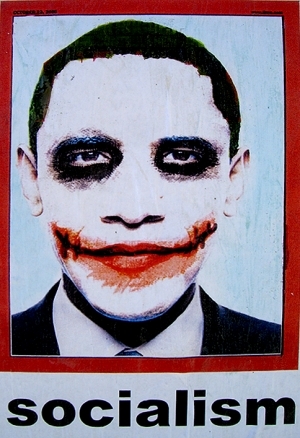
Why suddenly the big furor now? I mean, this is socialism:

I don’t pay for my own medicine, because it’s not my responsibility: it’s yours.

This is exactly what you voted for when you voted for Barack Obama.

Please don’t insult us by being surprised now, after all the time we spent trying to tell you.

Governmental compulsion: it’s the American way.

“We’ve actually been operating in a way entirely consistent with free-market principles.” — Barack Obama, 2009


10 comments » | Healthcare

Fineman to Mathews: ObamaCare Was Barack Obama’s Biggest Mistake

September 4th, 2011 — 2:31pm

It’s saying a lot, but Howard Fineman, of the notoriously left-wing Huffington Post, this Sunday told notorious left-winger Chris Mathews that ObamaCare was Barack Obama’s biggest political mistake — to which notorious left-winger David Ignatius, of the notoriously left-wing Washington Post, concurred. Watch:

(Video via Newsbusters)


1 comment » | Healthcare, ObamaCare

The Best Day Yet For Individual Freedom — By Ilya Shapiro

June 9th, 2011 — 3:02pm

Ilya Shapiro is a senior fellow at the Cato Institute. He is also the editor-in-chief of the Cato Supreme Court Review. Before joining Cato, he was a special assistant and advisor to the Multi-National Force in Iraq. The following article, which is brief and well-done, appeared June 8th, 2011, on the CATO website:

In the most important appeal of the Obamacare constitutional saga, today was the best day yet for individual freedom. The government’s lawyer, Neal Katyal, spent most of the hearing on the ropes, with the judicial panel extremely cautious not to extend federal power beyond its present outer limits of regulating economic activity that has a substantial aggregate effect on interstate commerce.

As the lawyer representing 26 states against the federal government said, “The whole reason we do this is to protect liberty.” With those words, former solicitor general Paul Clement reached the essence of the Obamacare lawsuits. With apologies to Joe Biden, this is a big deal not because we’re dealing with a huge reorganization of the health care industry, but because our most fundamental first principle is at stake: we limit government power so people can live their lives the way they want.

This legal process is not an academic exercise to map the precise contours of the Commerce Clause or Necessary and Proper Clause — or even to vindicate our commitment to federalism or judicial review. No, all of these worthy endeavors are just means to achieve the goal of maximizing human freedom and flourishing. Indeed, that is the very reason the government exists in the first place.

And the 11th Circuit judges saw that. Countless times, Judges Dubina and Marcus demanded that the government articulate constitutional limiting principles to the power it asserted. And countless times they pointed out that never in history has Congress tried to compel people to engage in commerce as a means of regulating commerce. Even Judge Hull, reputed to be the most liberal member of the panel, conducted a withering cross-examination to establish that the individual mandate didn’t help that many people get affordable care, that the majority of people currently without coverage would be exempt from the requirement (presumably due to their income level).

In short, while we should never read too much into an oral argument, I’m more optimistic about this case now than any other.


Comment » | Healthcare, ObamaCare

Second Judge Rules Individual Mandate Unconstitutional

January 31st, 2011 — 2:34pm

Tad the bartender: Did they shoot your horse?

Tom Reagan: If there’s any justice.

Miller’s Crossing (1989)

Well, thank goodness, there is still some, Tom.

This Monday, January 31st, 2011, U.S. District Judge Roger Vinson became the second judge to officially recognize the painfully obvious: namely, that forcing people to buy health insurance is unconstitutional.

Judge Vinson ruled that the reform law’s so-called “individual mandate” went “too far” in requiring that Americans start buying health insurance in 2014 or pay a penalty, stating furthermore:

“Because the individual mandate is unconstitutional and not severable, the entire act must be declared void. This has been a difficult decision to reach, and I am aware that it will have indeterminable implications.”

Difficult decision? Seriously? This is a no-brainer.

Today was a small victory for my favorite lady, and yet Judge Vinson — who was so overwhelming correct in his ruling — makes me nervous with his equivocal language, leading to the real question:

How could any sane person actually believe that government possesses legitimate authority to force me or anyone to buy health insurance?


15 comments » | Healthcare, ObamaCare

Newsweek’s Evan Thomas: ‘The Health Care Bill Is A Disaster’

January 11th, 2011 — 3:21pm

No shit.

The only real question here is this: what took you liberals so long to figure it out?

And, make no mistake, Evan Thomas is a liberal — about as liberal as they come, as a matter of fact, once even uplifting his hero Barack to the status of a deity.

From The Daily Caller:

“It ain’t because of Congress,” Thomas said. “The unemployment will go down a little bit but the game in Washington will still be this unreal game. Health care though – I got to say, is one place where I think where Republicans are right.”

Back in November 2009, Thomas admitted the health care reform bill had flaws, but still voiced his support for it. Now he has proclaimed it a failure.

“The health care bill is a disaster,” Thomas continued. “We’re sort of slowly learning – it’s not working. It’s interesting – they’re implementing it and it’s not working out at all as people anticipated. There’s all sorts of wildly wrong projections. As it’s being practiced – it’s failed.”

Read the full article here.

Watch the video here:


5 comments » | Healthcare

The States Versus ObamaCare — By Pam Bondi

January 5th, 2011 — 2:32am

Smart Lady Pam Bondi

Pam Bondi is the attorney general of Florida. In the latest edition of the Wall Street Journal (January 5, 2011), she wrote the following article, which is a rather remarkable article that I think should be read by every American who believes that (a) government has legitimate authority to force each of us to pay for one other’s healthcare; and (b) that congress acted lawfully in the methods used to pass that abortion known as ObamaCare:

This week begins the inauguration and swearing-in ceremonies for newly elected officials all over the country. One thing many of us have in common is that the voters rewarded us for our outspoken opposition to ObamaCare.

The electorate’s decisive rejection of the Obama administration’s policies reveals a pervasive concern over the federal government’s disregard of fundamental aspects of our nation’s Constitution. No legislation in our history alters the balance of power between Washington and the states so much as ObamaCare does.

The tactics used to pass the health-care bill gave all Americans ample warning of the constitutional wrongdoing that was about to occur. Concerns were raised in the summer of 2009 over the constitutionality of the individual mandate and other portions of the bill, yet the president and Congress proceeded full-steam ahead. In the Senate, the much-ridiculed “Cornhusker Kickback” gave Nebraska an all-expenses-paid Medicaid expansion program. Due to public pressure, the provision was eventually removed from the final law.

Following Senate passage, House Speaker Nancy Pelosi planned to “deem-and-pass” the federal health-care bill, a constitutionally suspect procedure of passing a bill without actually voting on it. Instead, the speaker allowed the House to vote on the Senate version of the bill without amendments, and Congress subsequently used a parliamentary maneuver called budget reconciliation to “fix” the flawed bill [emphasis mine]. In the end, not a single Republican voted for the legislation.

Unwilling to acquiesce to such a blatantly unconstitutional act, Florida and 19 other states challenged the new law and its requirement that nearly every American purchase health insurance. The lawsuit is based on the common sense notion that an individual’s decision not to purchase health insurance is not an act of “commerce” that can be regulated under Congress’s constitutionally enumerated powers. Unsurprisingly, the Obama administration has invoked shifting and contradictory arguments in its efforts to defend the indefensible.

The U.S. Department of Justice first argued that the fine triggered by noncompliance with the individual mandate was not a penalty but a tax authorized by the Constitution’s Taxing and Spending Clause—hoping no one noticed President Obama’s claim on national television that the individual mandate is “absolutely not a tax.” The Justice Department continued to press this tax argument despite the fact that Congress referred to the individual mandate as a “penalty,” excluded it from the bill’s revenue-raising section, and claimed the Commerce Clause as the constitutional authority to pass it.

The federal judge presiding over the states’ lawsuit in Pensacola, Fla., got it right when he wrote: “Congress should not be permitted to secure and cast politically difficult votes on controversial legislation by deliberately calling something one thing, after which the defenders of that legislation take an ‘Alice-in-Wonderland’ tack and argue in court that Congress really meant something else entirely.”

The Department of Justice has even argued that the individual mandate regulates the so-called commerce-related activities of “mental processes” and “economic decisions.” It doesn’t matter if a person is currently engaged in an activity affecting commerce, according to the Justice Department, but only that a person inevitably will. Gaining little traction with this thought-equals-action argument, the Justice Department pivoted and claimed that the individual mandate is “essential” for this kind of health-care reform. The Constitution grants Congress only specific powers—it does not empower Congress to pursue its policy objectives by any means necessary.

As new state attorneys general take office in the coming week, I fully expect an increase in the ranks of the states fighting ObamaCare in court. Our lawsuit, together with a similar lawsuit filed by Virginia’s attorney general, has exposed the health-care law’s threat to individual liberty and to the constitutional structure that the Founders designed as a means of protecting that liberty. The stakes are clear and compelling: If the courts deem the federal health-care law to be constitutional, then there are no meaningful constitutional restraints on Congress’s power to regulate virtually every facet of our lives.
(Link)

Here, though, is what I’d really like to know from all defenders of socialized medicine:

Upon whose authority or upon what authority do you justify the wild notion that a group of bureaucrats possesses legitimate power to force me to pay for your healthcare? Says who? And why?


3 comments » | Healthcare

Mandatory Health Insurance And Car Insurance — “A Stupid Analogy”

December 23rd, 2010 — 1:56am

Tibor Machan

The following article, which I reprint only in part and which destroys the mandatory-car-insurance-mandatory-health-insurance canard, was written by Tibor Machan, who teaches business ethics and general philosophy at Chapman University in Orange, CA:


A Stupid Analogy

Now that Judge Henry E. Hudson of the Virginia district court ruled that the Obama health care measure violates the U. S. Constitution by forcing people to make purchases they may not want to make, there are innumerable sophists who want to refute the rationale for the ruling. They trot out the “argument” that since people living in states may be required to carry auto insurance, they can also be made to purchase anything the government, including the feds, decides they must.

But this analogy fails because people do not have to drive! Yet under Obamacare by simply being living citizens, they would have to purchase health insurance. Never even mind that the state regulations requiring people to purchases auto insurance aren’t universal across the country and different states have the constitutional authority to handle the issues involved in their own way, with no federal mandate dictating to them what they must do.

Furthermore, one rationale in support of the state requirement that citizens who choose to drive carry insurance is that nearly all driving happens on state roads. There is no requirement to get insurance if one stays off them and confines one’s driving to private thoroughfares. And this is because it is the states that claim legal ownership of roads and they then get to set the standards for what those using the roads need to do for the privilege. (Yes, it is deemed a privilege, not a right, because of the state’s collective ownership of most roads.)

So the analogy with state requirements to carry driver’s insurance is fallacious. But when that’s pointed out, another tack is put forth, namely, that ill health is contagious like the plague or leprosy. This is desperate since it is blatantly wrong. One can have all sorts of ailments that will not be communicated to anyone near or far. One can contract ill health, injuries, maladies and so forth without the involvement of others. Sometimes it is just misfortune that brings this about, sometimes it is one’s own reckless conduct, sometimes the recklessness of people with whom one freely associates and rarely because of injuries sustained from what others do. In no such cases are those left out implicated and thus no one should be legally required to foot the bill of the health care measures, including insurance, that may be need to fix or treat things.

The sophists who bring up this line of shabby reasoning are capitalizing on the common sense idea that when people emit harm from their private activities–such as manufacture, smoking, reckless driving, and so forth–they ought to shoulder the burden that befalls others in consequences of it all. In short, no one ought to dump on other people the cost and liabilities of one’s own malpractice.

(Read the full article here.)

5 comments » | Health, Healthcare, Individual rights

Judge Rules AGAINST ObamaCare’s Individual Mandate

December 13th, 2010 — 2:00pm

Sage Judge Henry Hudson

In the biggest blow yet to ObamaCare, Judge Henry E. Hudson (U.S. District Court of Virginia) recognized the obvious: namely, it is utterly unconstitutional for any government to force its citizens to carry insurance, or pay a penalty if they don’t. In the Judge’s wise words: “[It] exceeds the constitutional boundaries of congressional power.”

And:

“[The individual mandate] would invite unbridled exercise of federal police powers. At its core, this dispute is not simply about regulating the business of insurance — or crafting a scheme of universal health insurance coverage — it’s about an individual’s right to choose to participate.”

Indeed, indeed. This is a textbook example (one of an endless number) of how so-called progressive liberalism is, like all other forms of socialism, a philosophy of force — a philosophy that must resort to force in order to achieve its goals. So don’t be duped by all their peace-loving talky-talky. In actuality, these people worship at the shrine of authoritarianism, governmental power, and state coercion. Their ideology cannot succeed in any other way.

Though this ruling will be appealed, drug-out, and very possibly overturned, it is appropriate, I think, for us to take a moment to say, thank you, Judge Henry E. Hudson, for recognizing and codifying the painfully obvious.

More here.


3 comments » | Barack Obama, Healthcare, ObamaCare

Saudi King Abdullah Won’t Use “Universal” Health Coverage But Comes To The U.S. For His Blood Clot Treatment

November 21st, 2010 — 3:04pm

This isn’t new: everyone knows and has always known that the best doctors and the best healthcare in the world are to be found in the United States. Which is why, when the chips are down, the United States is precisely where they all come for treatment.

No, the reason this particular story is a little more interesting than the usual traduce-America’s-health-care-system-until-you-get-seriously-sick scenario is that Saudi King Abdullah reportedly phoned Obama the day after Obamacare was forced through congress (via the unlawful use of the reconciliation process) and congratulated him on its passage.
As Doug Powers reports:

The day after the Obamacare law passed, Saudi King Abdullah reportedly called President Obama to congratulate him. The bill, it seems, was one more step toward the US embracing a superior universal health care system like that which can be found in Saudi Arabia, where treatments for medical problems such as, oh, say, blood clots, are fully covered.

Now, the king of the country with that health care system that gives the US something to strive for won’t be treated in that system, but will instead come to the US for treatment. He’s lucky the law that will make US health care system more closely resemble the Saudi system — the one that isn’t good enough for Saudi royalty — hasn’t kicked in yet:

RIYADH, Saudi Arabia – Saudi Arabia’s aged ruler will fly to the United States for medical tests over a blood clot, according to a Saudi official, in a development that would renew questions about succession in the oil-rich kingdom.

The 86-year-old King Abdullah is set to leave on Monday, three days after he was admitted to the hospital suffering from back pain due to a blood clot, the official said late Saturday. The official didn’t say which hospital would receive the king.

To paraphrase John McCain’s question, when Obamacare is fully implemented in America, where will rich Saudis go for health care?

(Link)


4 comments » | Barack Obama, Healthcare

Doctor Hal Scherz: Dear Patients — Vote to Repeal ObamaCare

September 1st, 2010 — 1:33pm

Dr. Hal Scherz

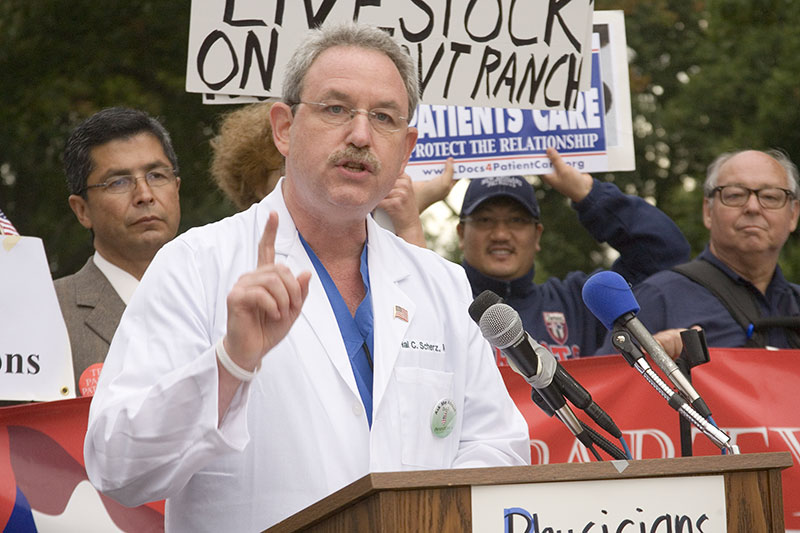
Doctor Hal Scherz is a pediatric urological surgeon at Georgia Urology and Children’s Healthcare of Atlanta. He also serves on the faculty of Emory University Medical School and is president of Docs4PatientCare. Just recently, he wrote that “because the issue this upcoming election is so stark — literally life and death for millions of Americans in the years ahead — we are this week posting a ‘Dear Patient’ letter in our waiting rooms.” This is, in part, what that letter says:

“Dear Patient: Section 1311 of the new health care legislation gives the U.S. Secretary of Health and Human Services and her appointees the power to establish care guidelines that your doctor must abide by or face penalties and fines. In making doctors answerable in the federal bureaucracy this bill effectively makes them government employees and means that you and your doctor are no longer in charge of your health care decisions. This new law politicizes medicine and in my opinion destroys the sanctity of the doctor-patient relationship that makes the American health care system the best in the world.”

In this same letter, Doctor Scherz writes:

“Badly exacerbating the current doctor shortage [ObamaCare will bring] major cost increases, rising insurance premiums, higher taxes, a decline in new medical techniques, a fall-off in the development of miracle drugs as well as rationing by government panels and by bureaucrats like passionate rationing advocate Donald Berwick that will force delays of months or sometimes years for hospitalization or surgery.”

He also cites the brutal, unignorable, irrefutable facts of ObamaCare’s passage:

“Despite countless protests by doctors and overwhelming public opposition — up to 60% of Americans opposed this bill — the current party in control of Congress pushed this bill through with legal bribes and Chicago style threats and is determined now to resist any ‘repeal and replace’ efforts. This doctor’s office is non-partisan — always has been, always will be. But the fact is that every Republican voted against this bad bill while the Democratic Party leadership and the White House completely dismissed the will of the people in ruthlessly pushing through this legislation….

“In the face of voter anger some Democratic candidates are now trying to make a cosmetic retreat, calling for minor modifications or pretending they are opposed to government-run medicine. Once the election is over, however, they will vote with their party bosses against repealing this bill.”

The letter’s final lines are perhaps the most important:

“Please remember when you vote this November that unless the Democratic Party receives a strong negative message about this power grab our healthcare system will never be fixed and the doctor patient relationship will be ruined forever.”

In the Wall Street Journal, the following from Doctor Scherz is appended:

This message is going out to an electorate that is already frustrated over what they see happening to health care. Missouri voters rejected ObamaCare overwhelmingly in August, voting by a margin of 71%-29% to reject the federal requirement that all individuals purchase health insurance. Democratic pollster Douglas Schoen has assessed that ObamaCare is “a disaster” for Democrats. And around the country many little-noticed primaries have reflected voter rage—including the Republican primary victory of surgeon, political newcomer, and advocate of repeal Daniel Benishek in Michigan’s first district.

Meanwhile, the Obama administration’s damage-control efforts have fallen flat. The latest round of pro-ObamaCare television spots targeting the elderly and starring veteran actor Andy Griffith have not only failed to move the polling numbers. They have caused five U.S. Senators to ask for an investigation of the ads as a violation of federal laws barring the use of tax dollars ($750,000) for campaign purposes.


(Link)

2 comments » | Health, Healthcare, socialism

A Doctor’s Take On Healthcare

June 29th, 2010 — 5:52pm


The dynamic Doctor Mariela Resendes (M.D.) is a private practitioner who spent her previous 5 years as the Managing Partner/CEO of the largest Radiology practice in the San Joaquin Valley of California, CMI Radiology Group. Just recently, she wrote an irrefutable and scathing essay on the coming healthcare disaster that Barack Obama and his clownish administration have just unleashed. I reprint it here in full:

As a practicing doctor in California it troubles me that those with the ability to influence health care legislation have either been politically motivated to remain silent, or strikingly inarticulate when it comes to voicing the major issues patients and taxpayers will face with the new health care bill. My own, long-held view has been that any reform should be of the free market variety.

In that sense, I’m increasingly scared as I learn more about what’s inside the health legislation passed by Congress not long ago. Despite the rising level of unhappiness with what has transpired, it dismays me that the general public, like me, is not fully aware of the financial tsunami that is on the way for patients, insurers and hospitals thanks to this legislation, not to mention the irregular way in which it was passed.

In the newspapers we all read that the legislation was passed via reconciliation. Most people do not understand what this represented. What Congress did was to pass this legislation under the Congressional Budget Act of 1984, which allows a loophole to avoid a 60 vote filibuster in laws which refer to changes in revenue and spending amounts; i.e. budgetary issues.

The legislation which Congress passed certainly does affect the budget, but clearly the bill’s intent wasn’t budgetary; rather it concerned dramatic changes for a large portion of our economy: health care. Given the bill’s intent, one can only hope that the upcoming elections bring greater ideological balance so that what promises to be damaging can at the very least be amended.

“Obamacare”, as it is colloquially termed, is financially a disaster for doctors, hospitals, insurers, and will ultimately be a disaster for our nation’s budget. It is also unfortunate for patients needing care.

Obamacare’s proponents tout the legislation’s cost controls, along with expansion of coverage for those who currently do not have insurance. The policy wonks seek cost containment and “efficient” use of resources. More realistically, cost containment could only be achieved if access to care were rationed.

Rationing in mind, Rahm Emmanuel’s brother published a very well received paper in the New England Journal Of Medicine about efficient or optimal deployment of resources in health care. The upshot is that a young man is worth spending a lot of money on, a young child much less, and for seniors, pretty much nothing; all in a calculated return on investment model.

For physicians, Obamacare initially offered promises of tort reform, as well as promises to reverse the Medicare cuts that made it so difficult for physicians to practice. Neither is in the final legislation. As a result, doctors will continue to practice defensive medicine, and for doing so will face 20%+ cuts in their Medicare payments.

Physicians in primary care will initially see an income boost from 2011-2014, thus encouraging them to take on indigent patients the system needs to absorb. Unfortunately, starting in 2014, the payments per patient will fall for primary care doctors too.

Specialists will receive a financial hit right from the beginning. The goal here is to have less in the way of specialists, and more general practitioners. On its face this will drive more doctors into early retirement.

As for the physicians that choose to continue practicing, they’ll have difficulty staying afloat financially, and many will seek employment opportunities similar to those of “foundation” practices (such as those seen in states like California where hospitals can’t employ physicians), or hospital owned practices in other states.

The explicit goal here is to slow the move toward private practice. Doctors in foundation types of practices act more like union or shift-workers, and less like professionals. Their productivity tends to be lower than in traditional private practices; ergo more doctors are needed for a similar number of patients. Considering a scenario of rising physician retirement alongside a large increase in the number of patients, it is unclear how treatment and diagnosis will occur in a timely fashion.

Hospitals are similarly not going to fare well, and many will simply go under. Previously, hospitals took in higher payments from privately insured patients in order to care for those who couldn’t pay, or for those covered by Medicaid. At the same time, hospitals which had a higher number of indigent patients also received what is called disproportionate share funds from state and federal governments. Rural hospitals in particular received extra funds.

But with Washington’s new mandate, the expectation is that all of the previous non-paying patients will now pay for themselves such that subsidies for indigent-care will be eliminated. Unfortunately, this will occur in concert with reduced inflows from privately insured patients whose costs will be reduced to Medicaid levels.

In short, the money from the increased volume of “paying” patients is not enough to counter the loss of disproportionate funds and decreased classic private insurance payments. The net result will be a deficit for many hospitals. They will not be able to keep their doors open if they sustain persistent losses, which is what is expected.

Many insurance companies will be squeezed out of existence thanks to rules that will bar them from denying coverage for pre-existing conditions. And unlike the federal government they won’t be able to operate in the red forever. The end result points to a single-payer system run out of Washington.

Looking ahead, it is increasingly apparent that by 2020 we will have severe cuts in service thanks to rising retirement among doctors, a decrease in the number of private insurers, and a reduction in the number of hospitals due to federal mandates that fail to marry costs with services. The end result will be rationing and delay of elective procedures, denial of expensive but effective treatments a la England, and most likely a single-payer system the likes of which is seen in other, less advanced health care systems around the world.

Here is more on how our healthcare crisis began.

And here is the real solution.


2 comments » | Barack Obama, Health, Healthcare, socialism

An Easy Way To Prove That Healthcare is NOT A Right

April 6th, 2010 — 7:40pm


Dr. Jack Cassell is a urologist in Florida. Just recently, he put the following notice on his Mount Dora practice:

“If you voted for Obama, seek urologic care elsewhere. Changes to your healthcare begin right now, not in four years.”

Cassell told reporters that he wasn’t refusing care to patients; he wanted only to educate them on how the new healthcare takeover would affect them:

I came across the timeline for implementation of Obamacare and I got a little discouraged when I got to next year when I found that most of the ancillary services and nursing homes and diagnostic imaging, all these things start to fade away,” he told Fox News’ Neil Cavuto. “And I felt that my patients really need to know about this. And the more I thought about it, the angrier I got until I finally felt like I’m going to put a little splash page on my front door and just get people thinking a little bit.

As it turns out, Doctor Cassell — and I applaud you for your efforts and think that every doctor in the country should go on strike right now, this very moment, to show that their lives and their labor are their own and do not in any belong to the state or to other people — there’s a painfully simple way to demonstrate how and why urologic care, like all healthcare, is not a right:

Rights by definition are immutable and timeless. They apply as much to humans now — and for the same reasons — as they did to humans five or ten thousand years ago. If healthcare is a right, then, where was your right to a heart transplant 200 years ago?

Where is your right to be completely cured of cancer today?

Where is your right to kidney dialysis if there are no kidney dialysis machines?

Where is your right to medical care if there are no doctors anywhere near you because young people are no longer studying the science of medicine, since to be a doctor means to be a slave to the state?


23 comments » | Healthcare, socialism

Seven Simple Rules for Health Care Reform

March 18th, 2010 — 7:21am

The 2000-plus-page ObamaCare legislation would of course obliterate any remnants of free-market medicine that still exists in this country, and in so doing it would not lower the cost of medicine, nor would it improve medical quality, nor would it ultimately insure more people, as the democrats themselves admit. The reason American medicine is so expensive in the first place is because of the massive bureaucratic apparatus that has gripped the American medical industry — an apparatus that was initially put in place in the mid-1930′s, under FDR and his horrific tax discrimination laws (which created employer-sponsored healthcare), and then expanded drastically in the 1960′s under LBJ.

The obvious question, then, is this: if government intervention created the problem, how is more government intervention going to help?

Answer: it’s not.

In fact, it’s going to compound the problem astronomically.

The following, however, which comes to us via Richard E. Ralston, Executive Director of Americans for Free Choice in Medicine, would help solve the problem, and it would do so without the unconstitutional coercive measures ObamaCare explicitly endorses.

Seven Simple Rules for Health Care Reform

The first simple rule: Make all medical services, insurance and personal savings for such expenses exempt from all federal, state and local income and payroll taxes. Those who complain about the cost of medical care and insurance must be confronted with the fact that if we cannot afford medical care, we surely cannot afford to pay taxes on the money we set aside for it.

The second simple rule: Allow an individual or corporate tax deduction equal to double the value of the service for all charity care by medical care providers. At one time America had a vigorous network of private charity care, which was largely destroyed by the government barging in. We need to restore that environment of private charity, which was more efficient, effective and compassionate.

The third simple rule: Pass legislation now proposed in the U.S. Congress that would give every individual or business the ability to purchase insurance in a national market, from insurance companies in any state. That would allow for ownership of health insurance that is more affordable and can follow individuals from job to job and state to state. The increased competition between insurance companies would restrain the cost of insurance.

The fourth simple rule: Allow the purchase of basic health insurance with high deductibles and low premiums that covers major illness or injury and annual exams, in conjunction with tax-free accounts for out-of-pocket expenses, such as deductibles. That, more than anything, would make insurance premiums more affordable for Americans who fear the financial consequences of health misfortune.

The fifth simple rule: Broaden the availability of optional coverage provided by Medicare Advantage, but allow for additional tax-deductible premiums to be paid by those seniors who elect such options. More choices from more options should be available to retirees—but not paid for by taxpayers. This would allow for expanded and more efficient coverage, and reintroduce an element of competition to those who seek to provide health care to seniors.

The sixth simple rule: Allow Medicare patients to utilize their Health Savings Accounts to pay for services from their Medicare physicians. This could bring thousands of doctors back into the Medicare program overnight and eliminate the ridiculous and unjust prohibition on those who want to spend their own money on their medical care.

The seventh simple rule: Limit non-economic or punitive damages in all malpractice or other litigation against medical providers or drug and medical equipment firms to a maximum of $250,000 (indexed for inflation). This would wring the bonanza for a few law firms out of the current ocean of litigation—and the high cost of “defensive medicine” now practiced by providers as protection against such legal extortion. The effect would be a reduction in the cost of medical care and insurance for everyone.

(Link)

For more on the atrocity exhibition of cradle-to-grave healthcare, please read Dr. Yuri N. Maltsev’s account of socialized medicine in Russia. Dr. Maltsev was for many years an economist for Mikhail Gorbachev’s economic reform team. He now teaches economics at Carthage College, in Kenosha, Wisconsin.

Read also medical doctor Paul Hsieh’s limpid explanation of how ObamaCare will prevent good doctors like him from upholding their Hippocratic Oath.


10 comments » | Healthcare

How The American Healthcare Crisis Began

February 16th, 2010 — 9:36am

Staff of Asclepius, symbol of healing

What is now termed modern medicine actually began in the early 1920s when science — in particular, germ theory — culminated to a point that sickness and disease were at last being treated reliably. It was then that doctors and hospitals got much better at the business of saving lives. This more highly developed service and expertise raised the value of their work, and they charged accordingly for their increased skill and labor.

And that, really, is when the situation started: for when lives can be saved and health can be gained because of developments in technology, everyone suddenly believes that it’s his or her right to have that thing. We see the same principle at work in, for example, the platitude “No one should go hungry when Americans are throwing away food.”

The error in both cases is the fraudulent notion that survival should be assured. This notion neglects the singular fact that abundance and technology are produced — and produced, moreover, by individuals.

No one has the right to the life and labor (i.e. production) of any individual, including the life and labor of doctors.

An easy way to demonstrate this truth is by asking the following: where was that right before these goods and services were produced or invented?

Fact: American medicine is already 50 percent socialized; there is a clear and incontrovertible correlation between rising healthcare costs and the socialization of medicine in this country. More government intervention will only compound the problem.

In the 1920s, when advancing healthcare became more expensive (though still very reasonable), the administrator of Baylor Hospital in Dallas, one Dr. Justin Ford Kimball, created a system called Blue Cross. The Blues (so-called) were nonprofit health insurers. They served local organizations like the Rebeccas and the Elks Club, and — please pay attention — they kept their premiums low in exchange for tax breaks.

Tax breaks are one of the main components to our current healthcare crisis. They’re what initially created the problem.

Blue Cross, you see, was successful because of these tax breaks. Up until then, commercial insurers had always regarded medicine as a mediocre market, and therefore commercial insurers didn’t deal too much in medicine. But when commercial insurers saw that the Blues were making money, it convinced them to enter the medical field. This was not a problem, at first — until the 1940s, when private insurers increased their efforts to get around wartime wage controls, thus:

During World War II, Franklin Delano Roosevelt’s price-and-wage people, who didn’t generally permit wage increases or price increases (regardless of market forces) sanctioned a form of tax discrimination: specifically, they allowed employers to pay for employee medical insurance with pretax dollars.

This quickly became one of the few ways employers could attract new and better employees, since FDR had actually mandated that employers were no longer permitted to pay out higher wages. (How this ridiculous idea came about is another story, for another time.)

To this day, those who get employer-financed healthcare are purchasing their healthcare coverage with pretax dollars. On the other hand, those who buy their own healthcare are purchasing it with after-tax dollars.

As far as the employer was (initially) concerned, this wasn’t any different from additional labor costs — which is to say, medical insurance was not, from the employers perspective, any different from a rise in wages, and yet FDR’s price-and-wage control people did not at all see it as a wage increase. They therefore allowed it, which may seem surprising in light of FDR’s desire to control the entire economy.

Likewise, the IRS bureaucrats under FDR did not regard this maneuver as a wage increase, and for this reason they didn’t slap a tax on it. Neither did the employees see it as a real raise in wages — a fact that is singular to how this whole horrible precedent was set — because these costs are what economists call hidden costs.

The upshot: people didn’t and very often still don’t know that it is, after all, their own money paying for this prepaid medical coverage, and that medical coverage isn’t free.

In fact, health insurance today isn’t even really health insurance. It’s more properly called prepaid healthcare. But — and this is an absolute crux — it gives the appearance of being free or substantially free to the user, and it therefore substantially increases the demand for it and therefore its cost. Of course, the root of this whole problem is the misbegotten notion that healthcare is not a good and service to be traded on the open market, but a right.

Let us remember what insurance actually is:

Insurance, properly defined, is what you purchase in order to avoid financial ruin in the case of a rare emergency.

Under the dangerous system FDR created, employees came to regard their healthcare coverage as a kind of blessed phenomena which came without cause or consequence. Quickly, this phenomena was absorbed into the working culture and as quickly was taken for granted: employees got used to receiving free goods, which goods, however, were not actually free. Employees just could not see that they were paying for them, and paying for them, furthermore, with pretax dollars.

A family in the bottom fifth of the income distribution pays about $450 more in taxes than insured families at the same income level. For families in the top fifth of the income distribution, the tax penalty is $1,780. On average, uninsured families pay about $1,018 more in federal taxes each year because they do not have employer-provided insurance. Collectively, the uninsured pay about $17.1 billion in extra taxes each year because they do not receive the same tax break as insured people with similar income. If state and local taxes are included, the extra taxes paid by the uninsured exceed $19 billion per year (“Are the uninsured freeloaders?” National Center for Policy Analysis, Brief Analysis No. 120).

Among other things, this illustrates again why entitlements are such a deadly precedent: once they’re entrenched, it’s virtually impossible to retrogress. Why? Because people acclimate to entitlements and in no time cannot imagine life without them.


11 comments » | economics, Healthcare

Dr. Yuri N. Maltsev Reveals Socialized Medicine in Soviet Russia

December 8th, 2009 — 6:30am

Dr. Yuri Maltsev

Dr. Yuri Maltsev


Dr. Yuri N. Maltsev is an economist who teaches at Carthage College, Kenosha, Wisconsin. Prior to that, for many years, he was an economist for Mikhail Gorbachev’s economic reform team. In 1989, he defected to the United States of America. Dr. Maltsev is now among the most articulate living defenders of laissez-faire capitalism.

Just recently, Dr. Maltsev wrote a searing essay on socialized medicine Soviet style. He lived it firsthand for a number of years. His essay is an eye-popping read that’s liable to make you sick to your stomach.

Here’s an excerpt:

In 1918, the Soviet Union became the first country to promise universal “cradle-to-grave” healthcare coverage, to be accomplished through the complete socialization of medicine. The “right to health” became a “constitutional right” of Soviet citizens.

The proclaimed advantages of this system were that it would “reduce costs” and eliminate the “waste” that stemmed from “unnecessary duplication and parallelism” — i.e., competition.

These goals were similar to the ones declared by Mr. Obama and Ms. Pelosi — attractive and humane goals of universal coverage and low costs. What’s not to like?

The system had many decades to work, but widespread apathy and low quality of work paralyzed the healthcare system. In the depths of the socialist experiment, healthcare institutions in Russia were at least a hundred years behind the average US level. Moreover, the filth, odors, cats roaming the halls, drunken medical personnel, and absence of soap and cleaning supplies added to an overall impression of hopelessness and frustration that paralyzed the system. According to official Russian estimates, 78 percent of all AIDS victims in Russia contracted the virus through dirty needles or HIV-tainted blood in the state-run hospitals.

Irresponsibility, expressed by the popular Russian saying “They pretend they are paying us and we pretend we are working,” resulted in appalling quality of service, widespread corruption, and extensive loss of life. My friend, a famous neurosurgeon in today’s Russia, received a monthly salary of 150 rubles — one third of the average bus driver’s salary.

In order to receive minimal attention by doctors and nursing personnel, patients had to pay bribes. I even witnessed a case of a “nonpaying” patient who died trying to reach a lavatory at the end of the long corridor after brain surgery. Anesthesia was usually “not available” for abortions or minor ear, nose, throat, and skin surgeries. This was used as a means of extortion by unscrupulous medical bureaucrats.
“Slavery certainly ‘reduced costs’ of labor, ‘eliminated the waste’ of bargaining for wages, and avoided ‘unnecessary duplication and parallelism’.”

To improve the statistics concerning the numbers of people dying within the system, patients were routinely shoved out the door before taking their last breath.

Being a People’s Deputy in the Moscow region from 1987 to 1989, I received many complaints about criminal negligence, bribes taken by medical apparatchiks, drunken ambulance crews, and food poisoning in hospitals and child-care facilities. I recall the case of a fourteen-year-old girl from my district who died of acute nephritis in a Moscow hospital. She died because a doctor decided that it was better to save “precious” X-ray film (imported by the Soviets for hard currency) instead of double-checking his diagnosis. These X-rays would have disproven his diagnosis of neuropathic pain.

Read the rest of the article here — read it and weep, that is.

1 comment » | Healthcare

New Entries

Newest comments

  • micky: Yes, “keeping up” has become difficult, to say the least. Reminds me of that flick...
  • Ray: I know, I know. I’ve thought a lot about that. I am, in fact, very busy with my other job, but I also feel...
  • micky: Wow Ray, I can only assume you’re busy or just taking a break from your usual excellent posts but...
  • Ray: Yeah, I heard that.
  • micky: Pray for Oklahoma, or meditate , those poor people, jeez.
  • micky: This guy sounds like a tweaking meth head in a holding cell. Good grief. If this guy were seen talking to cops...
  • Ray: Thank you, Bev. Thank you for dropping by.
  • Ray: I know what you mean, my brother. And I completely agree with your comment.

Categories

Monthly Archives

Search


rayharvey.org Bio  |  Books  |  Contact  |  Blog

Back to top